
Barta’a-Reihan, Tura-Shaked, Ya’bed-Dotan
06:00 – Barta’a-Reihan Checkpoint
A line that splits into two “tails,” crowded with workers who arrive at the main road. Every face is aware of the only turnstile, through which about 60 workers pass through each time it opens. The pause between each group that enters is longer than usual. At the entrance to the terminal there is also a line, although short, but constant. Two workers turn in their tracks. One discovers today that he is prohibited by police from entering. The second discovers he is prohibited by the General Services because his brother or a cousin is in prison. Aliya, who works with Sylvia, takes down the details.
06:45 – Tura-Shaked Checkpoint
It looks like the checkpoint was opened today on time. Next to the turnstile from the second passageway, already no one is waiting. Cars pass through quickly from side to side (of the checkpoint). At 07:05, the younger, smaller pupils start to arrive. For some reason, they pass through by way of the inspection room; they enter and exit immediately from the second passageway.
07:15 – We decide to return to Barta’a Checkpoint, to check the situation of the line. From the road it now looks like everyone who arrives passes through the turnstile immediately. The truck loaded with vegetables that was parked in the big parking lot, goes up to be inspected.
Ya’bed-Mevo Dotan Checkpoint
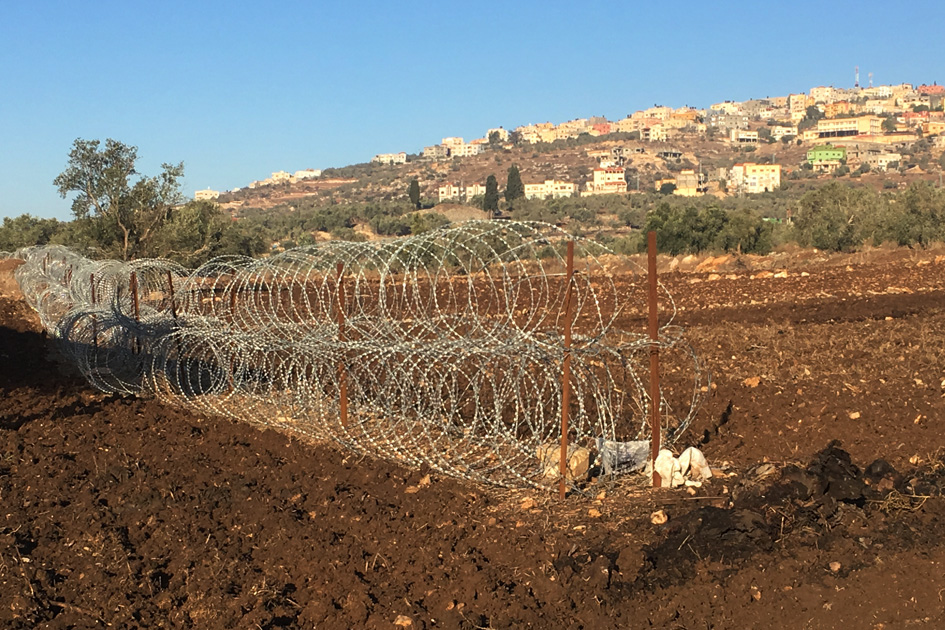
area next to Ya’bed
The checkpoint is not manned; there is just a pillbox (watchpost). The cars zig-zag between the concrete obstacles and continue on their way. We start to move and notice a strange thing: out of the blue, opposite the checkpoint, in the heart of the olive groves that stretch out between the road and Ya’bed, a two-tiered, curled barbed-wire fence appeared, shining in the sun. We drive slowly and follow the new fence. We arrive at a turn in the muddy road, turn, travel a distance and continue on foot. The new fence reaches to the right of the road and continues from the left a bit inside, beyond the hothouse. Two workers arrive and tell us that the fence was installed two months ago to prevent, according to the claims of the soldiers, stones being thrown at the cars. From time-to-time an army jeep arrives to guard the passage between the fences. Such is the “Occupation,” says one of the men. We continued to travel on the road until the locked checkpoint (the yellow arm that prevents the residents of Ya’bed from shortening the road to Barta’a Checkpoint). We crossed it by foot and discovered the barbed-wire fence from two sides of the road, truly between the olive trees. We were shocked at the malicious dissection of the grove and from the enormous investment in what appears to be more like maltreatment of the farmers’ difficult days than prevention of stone-throwing.
Barta’a-Reihan Checkpoint
See all reports for this place-
This checkpoint is located on the Separation Fence route, east of the Palestinian town of East Barta’a. The latter is the largest Palestinian community inside the seam-line zone (Barta’a Enclave) in the northern West Bank. Western Barta’a, inside Israel, is adjacent to it. The Checkpoint is open all week from 5 a.m. to 9 p.m. Since mid-May 2007, the checkpoint has been managed by a civilian security company subordinate to the Ministry of Defense. People permitted to cross through this checkpoint into and from the West Bank are residents of Palestinian communities inside the Barta’a Enclave as well as West Bank Palestinian residents holding transit permit. Jewish settlers from Hermesh and Mevo Dotan cross here without inspection. A large, modern terminal is active here with 8 windows for document inspection and biometric tests (eyes and fingerprints). Usually only one or two of the 8 windows are in operation. Goods, up to medium commercial size, may pass here from the West Bank into the Barta’a Enclave. A permanent registered group of drives who have been approved by the may pass with farm produce. When the administration of the checkpoint was turned over to a civilian security firm, the Ya’abad-Mevo Dotan Junction became a permanent checkpoint. . It is manned by soldiers who sit in the watchtower and come down at random to inspect vehicles and passengers (February 2020).
-
Tura-Shaked
See all reports for this place-
Tura-Shaked
This is a fabric of life* checkpoint through which pedestrians, cabs and private cars (since 2008) pass to and from the West Bank and the Seam-line Zone to and from the industrical zone near the settler-colony Shaked, schools and kindergartens, and Jenin university campuses. The checkpoint is located between Tura village inside the West Bank and the village of Dahar Al Malah inside the enclave of the Seam-line Zone. It is opened twice a day, between 7 a.m. and 10 a.m., and from 12 noon to 7 p.m. People crossing it (at times even kindergarten children) are inspected in a bungalow with a magnometer. Names of those allowed to cross it appear in a list held by the soldiers. Usually traffic here is scant.
- fabric of life roads and checkpoints, as defined by the Terminals Authority in the Ministry of Defense (fabric of life is a laundered name that does not actually describe any kind of humanitarian purpose) are intended for Palestinians only. These roads and checkpoints have been built on lands appropriated from their Palestinian owners, including tunnels, bypass roads, and tracks passing under bridges. Thus traffic can flow between the West Bank and its separated parts that are not in any kind of territorial contiguity with it. Mostly there are no permanent checkpoint on these roads but rather ‘flying’ checkpoints, check-posts or surprise barriers. At Toura, a small (less than one dunam) and sleepy checkpoint has been established, which has filled up with the years with nearly .every means of supervision and surveillance that the Israeli military occupation has produced. (February 2020)
 Mar-21-2022Anin Checkpoint: A magnificent breach in the center of the checkpoint
-
Ya'bed-Dotan
See all reports for this place-
Ya’bed-Dotan
This checkpoint is located on road 585, at the crossroads of Mevo Dotan settler-colony / Jenin/ Ya’abad. It has an army watchtower (‘pillbox’ post) and concrete blocs that slow down vehicular traffic. It was erected when Barta’a Checkpoint, lying to the west on the Separation Fence, was privatized and its operation was passed over to civilian security personnel. Since December 2009 this checkpoint enables flow of Palestinian vehicular traffic towards the Barta’a Checkpoint. Seldom is it manned by soldiers sitting in the watchtower, who conduct random inspections of vehicles and passengers. (february 2020)
-
