
Irtah (Sha’ar Efrayim)
4:07 At the separation barrier there’s no line, everyone who arrives goes straight into the checkpoint. We pick two men and a woman to watch for.
At the entrance to Israel, only one turnstile is working, and it seems to have trouble. The side gate is padlocked shut. A crowd has collected of people waiting to get out, and the path they need to take involves a sharp jog to avoid a large puddle as soon as they pass the turnstile. I went to speak to the guard about opening the second turnstile or the side gate. He says that the turnstile is broken, and he’ll ask about opening the side gate.
The woman we were watching for comes out after ten minutes, the men in 15-17 minutes.
4:30 At the separation barrier again. Still no line.
At the entrance to Israel, the side gate is open. The people we were watching for came through immediately, just a few minutes. The rain is pouring down, everyone waiting for their rides crowds together under whatever roof is available.
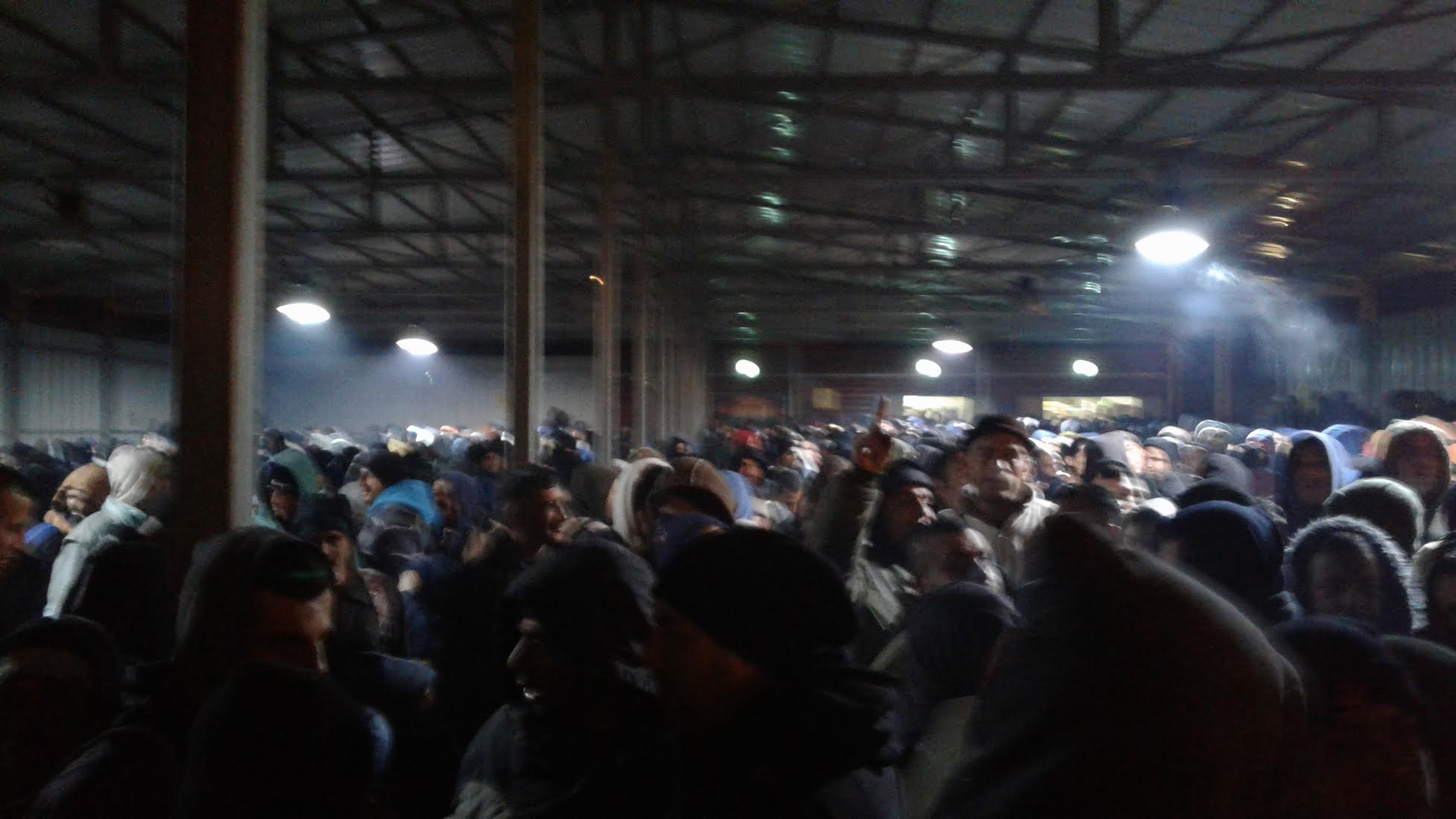
4:45 At the separation barrier, there’s still no line. We see several people moving back into Palestinian territory; we guess that they decided to go home when the rain got so bad.
5:05 We leave.
Irtah (Sha'ar Efrayim)
See all reports for this place-
The checkpoint is for Palestinians only. It is the main barrier to the passage of workers from the northern West Bank to Israel. Workers with a permit to work in Israel and also for trade (with appropriate permissions), medicine, and visiting prisoners. One can cross the checkpoint only on foot. The checkpoint is located north of Road 557 and south of Tulkarm. Operated by a civil security company, opening hours: between 4:00 and 19:00 on weekdays. As members of Machsom Watch, we began our shifts to this location in 2007. We arrived before it opened at 4 in the morning and report since, on the harsh conditions and the long and crowded queues of workers. The workers who pass by continue their journey by transportation to work throughout Israel. In the first period of its activity, about 3,000 and then 5,000 people passed through this checkpoint every day. Due to the small number of checking points and arbitrary delays for long periods of time in the "rooms", workers feared losing their transportation. Hence workers leave their homes at 2:30 at night to be among the first. Today, 15,000 pass and the transition is faster. Workers are still leaving their homes very early to get past the checkpoint at 7 p.m. In an adjacent compound, there is a terminal for the transfer of goods on a commercial scale, using the back-to-back method.
-