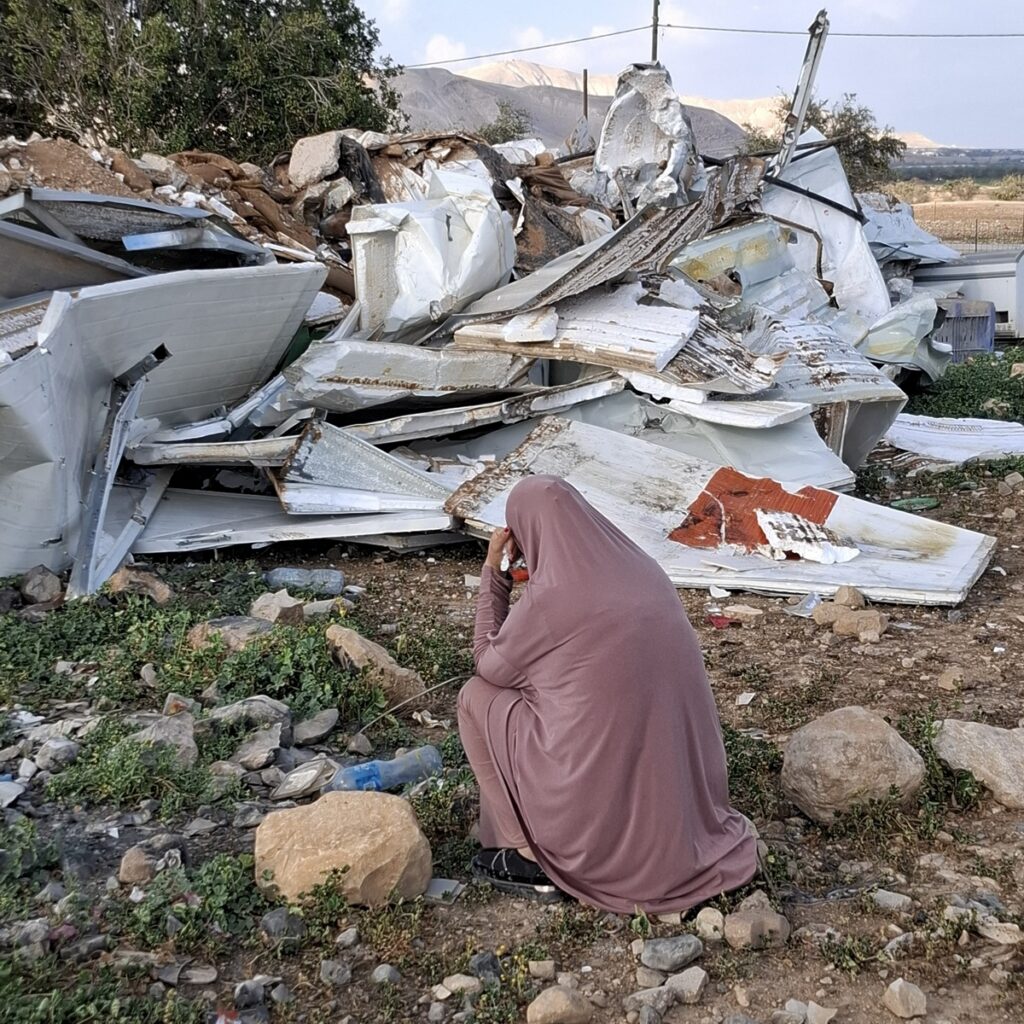
South Hebron Hills
9:00 – 12:30
Mira (reports), Muhammad (driver, translator and activity participant)
Goal: Activity in the Huda kindergarten in Hashem-el-Darage
Activity Music
25 children, two teachers (Huda and Chaula), and their assistant (Amna) were present at the preschool. When we arrived the children were sitting outside – sucking on lollipops that Huda had given them. The children ran to us, competing to shake our hands. We have already mentioned the creation of personal relationships – in spite of the language barrier.
This time the activity was centered on the topic of different ways of expressing calm feelings versus stormy feelings. This was done by focusing on the experience of wind.
At the beginning, Chaula read a story about a wind that blows the feathers off a hat that a girl is wearing, until she learns to hold them on. The children sat on the carpet and participated in the story. After the story, we chose children to “act out” the story. This was not entirely successful.
The activity revolved around a song about wind – gentle and strong in turn. I sang the song, and the children responded with movements that simulated the wind song. I also had Arabic words to the song but in the moment of truth – I forgot the words and switched to Hebrew. Musical instruments were passed out to the children – bells and percussion instruments of all kinds, and triangles. We continued with the song and playing the instruments quietly or loudly depending on the lyrics and the type of instrument. As usual, there was a problem of attention and maintaining quiet – even with the staff, particularly Amna, who continued to scold the children in a loud voice which made it difficult to hear the song. But slowly, slowly, there was an increase in attention, almost complete quiet was achieved before the song began. By the end, every child played his instrument. The children really loved everything about the musical instruments.
End of activity – a sheet game: all the children held on to the edge of sheet while I sang the song. A ball was in the middle of the sheet, and later, a small child. The aim of course – was not to drop the ball or the child. The children were really attentive to the type of wind throughout the song. The children began to sing (in Arabic) the song with me after they had heard it a number of times in a row. This game always leads to much joy and laughter.
We sat briefly with the staff for coffee and cake that Huda and Amna baked – it turns out that occasionally Huda bakes for the children in the preschool. We talked about the need to allow the children free access to books, despite the possibility that some of the books will be torn. Huda requested a small cabinet with open shelves – for books. The preschool has few books, most of which we provided throughout the years.
On our return trip, we stopped at Um-el-Khir. We met Ehud, Ariela, and Danny from the Village Group at the house of the hajj. They talked with some of the residents of Um-el-Khir about the possibility of reopening the preschool there. We also talked about the preschool in Tuwani. They told us there were not enough children for a preschool. We will try to check this during our next visit.
Further on, we again noted that next to the Egged bus stop at the turn off to the illegal outpost of “Asaal”, there is a shed of “Netivei Israel (National Transport Infrastructure Company) ”. Convenient public transportation for the residents of the settlement.
Pictures of the activity – The 13.10.2016 album:
https://photos.google.com/u/1/albums
South Hebron Hills
See all reports for this place-
South Hebron Hills
South Hebron Hills is a large area in the West Bank's southern part.
Yatta is a major city in this area: right in the border zone between the fertile region of Hebron and its surroundings and the desert of the Hebron Hills. Yatta has about 64,000 inhabitants.
The surrounding villages are called Masafer Yatta (Yatta's daughter villages). Their inhabitants subsist on livestock and agriculture. Agriculture is possible only in small plots, especially near streams. Most of the area consists of rocky terraces.Since the beginning of the 1980s, many settlements have been established on the agricultural land cultivated by the Palestinians in the South Hebron Hills region: Carmel, Maon, Susia, Masadot Yehuda, Othniel, and more. Since the settlements were established and Palestinians cultivation areas have been reduced; the residents of the South Hebron Hills have been suffering from harassment by the settlers. Attempts to evict and demolish houses have continued, along with withholding water and electricity. The military and police usually refrain from intervening in violent incidents between settlers and Palestinians do not enforce the law when it comes to the investigation of extensive violent Jewish settlers. The harassment in the South Hebron Hills includes attacking and attempting to burn residential tents, harassing dogs, harming herds, and preventing access to pastures.
There are several checkpoints in the South Hebron Hills, on Routes 317 and 60. In most of them, no military presence is apparent, but rather an array of pillboxes monitor the villages. Roadblocks are frequently set up according to the settlers and the army's needs. These are located at the Zif Junction, the Dura-al Fawwar crossing, and the Sheep Junction at the southern entrance to Hebron.
Updated April 2022
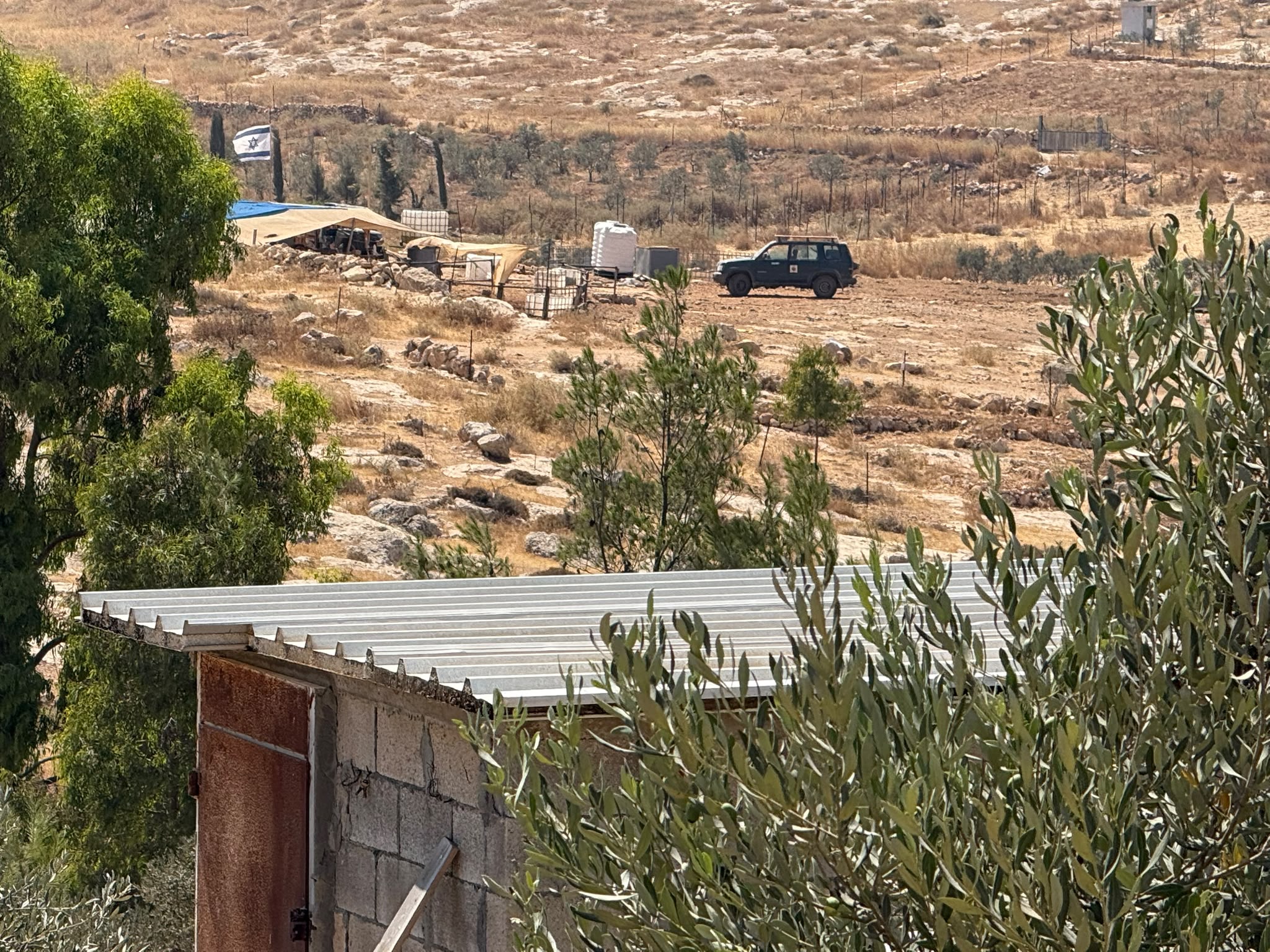 Muhammad D.Jul-23-2026The new settlement, starting June 1, 2026, opposite Khallet al-Humus.
-