
Qalandiya - A quiet morning
05.15. Still very dark, but already there were many people on the Israeli side: two groups were at prayer, one next to the parking lot and another at the entrance to the checkpoint building; the café was full.
Once inside the shed, we found there were no queues. The entrance to the leftmost sleeve was sealed off with a strip – presumably the turnstile was out of order. The other turnstiles were left open most of the time. All 5 checking stations were open and there were short lines there. Once again at station no.5, only people without packages could pass.

When we arrived the kiosk was still closed, but the beigel seller and cake seller were present. The beigel seller complained that the lights in the section where he works have been out of order for a long time. He has difficulty checking how much change to give customers. (Previously he had told us that he needed a cataract operation, but could not afford it.) The cake seller has opened a ‘branch’ inside the shed, with a young boy shouting his wares and doing brisk business.
We thought that maybe there were fewer people than usual because people from Bidu, Katan and Bet Surik could not come after the Har Adar incident, but it turned out that people did arrive from there.
When we arrived a dark-skinned man was sitting in a wheelchair deep inside the shed .Next to him were crutches and pieces of luggage. He had a blanket over his lap. One leg was amputated. We learned from him that he was from Gaza, had been hospitalized on the W. Bank and was now returning to Gaza. He said that in the hospital his money and documents had been stolen. He was waiting for the D.C.O. to open to get a permit – alone, without any help. As usual, we resorted to our indefatigable Hanna Barag for help! She, as usual, went to extraordinary lengths to do so, and a few hours later we learned that the man was on transport going to Erez checkpoint.
A film team from T.V. 2 arrived with the reporter Ohad Hemu. They filmed inside and out, and interviewed people. Hemu asked us if there were always so few people – he had never seen Qalandiya checkpoint so empty. We explained that this happened occasionally, but that usually there were long lines which sometimes even collapsed in chaos. We in turn asked if he knew of some Palestinian organization that could help the sick man, but he could not help. His report was to be presented on the evening news in Network 2.
Soon after 6, a replacement soldier came to the aquarium. At about 6.20 there came a policewoman, guard and the D.C.O. officer. There was no need to open the humanitarian gate. We asked the D.C.O. officer whether he could help the sick man. He did not seem over-interested, but said that the D.C.O. would open only at 8.30 and then he would enter. We asked the seller at the kiosk (which had meanwhile opened) to explain this to the man and to help him – in the hope that, without money or documents, he would nevertheless manage to get a permit and catch transport to Gaza. (As we saw above, it was later through Hanna Barag’s efforts that this could happen.)
Later, when it was light, we went outside to see the state of the building. Part of the parking lot is excavated, as well as a neighbouring plot that had served as an improvised parking lot.


We re-entered the shed and passed through the checking stations within 15 minutes.
Qalandiya Checkpoint / Atarot Pass (Jerusalem)
See all reports for this place-
Click here to watch a video from Qalandiya checkpoint up to mid 2019 Three kilometers south of Ramallah, in the heart of Palestinian population. Integrates into "Jerusalem Envelope" as part of Wall that separates between northern suburbs that were annexed to Jerusalem in 1967: Kafr Aqab, Semiramis and Qalandiya, and the villages of Ar-Ram and Bir Nabala, also north of Jerusalem, and the city itself. Some residents of Kafr Aqab, Semiramis and Qalandiya have Jerusalem ID cards. A terminal operated by Israel Police has functioned since early 2006. As of August 2006, northbound pedestrians are not checked. Southbound Palestinians must carry Jerusalem IDs; holders of Palestinian Authority IDs cannot pass without special permits. Vehicular traffic from Ramallah to other West Bank areas runs to the north of Qalandiya. In February 2019, the new facility of the checkpoint was inaugurated aiming to make it like a "border crossing". The bars and barbed wire fences were replaced with walls of perforated metal panels. The check is now performed at multiple stations for face recognition and the transfer of an e-card. The rate of passage has improved and its density has generally decreased, but lack of manpower and malfunctions cause periods of stress. The development and paving of the roads has not yet been completed, the traffic of cars and pedestrians is dangerous, and t the entire vicinity of the checkpoint is filthy. In 2020 a huge pedestrian bridge was built over the vehicle crossing with severe mobility restrictions (steep stairs, long and winding route). The pedestrian access from public transport to the checkpoint from the north (Ramallah direction) is unclear, and there have been cases of people, especially people with disabilities, who accidentally reached the vehicle crossing and were shot by the soldiers at the checkpoint. In the summer of 2021, work began on a new, sunken entrance road from Qalandiya that will lead directly to Road 443 towards Jerusalem and Tel Aviv. At the same time, the runways of the old Atarot airport were demolished and infrastructure was prepared for a large bus terminal. (updated October 2021)
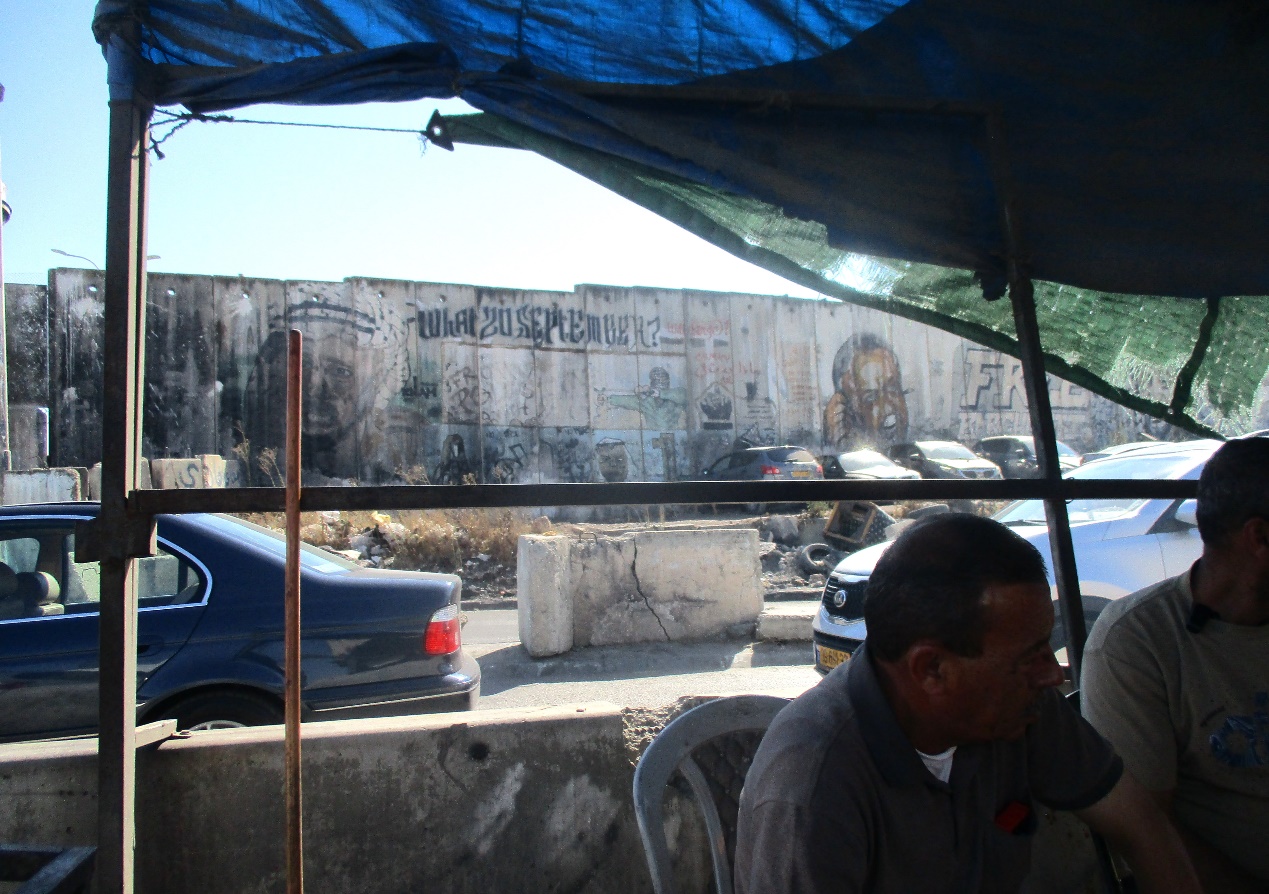 Tamar FleishmanJul-21-2026Qalandiya. Conversation in the shadow of the wall
-
