
Qalandiya
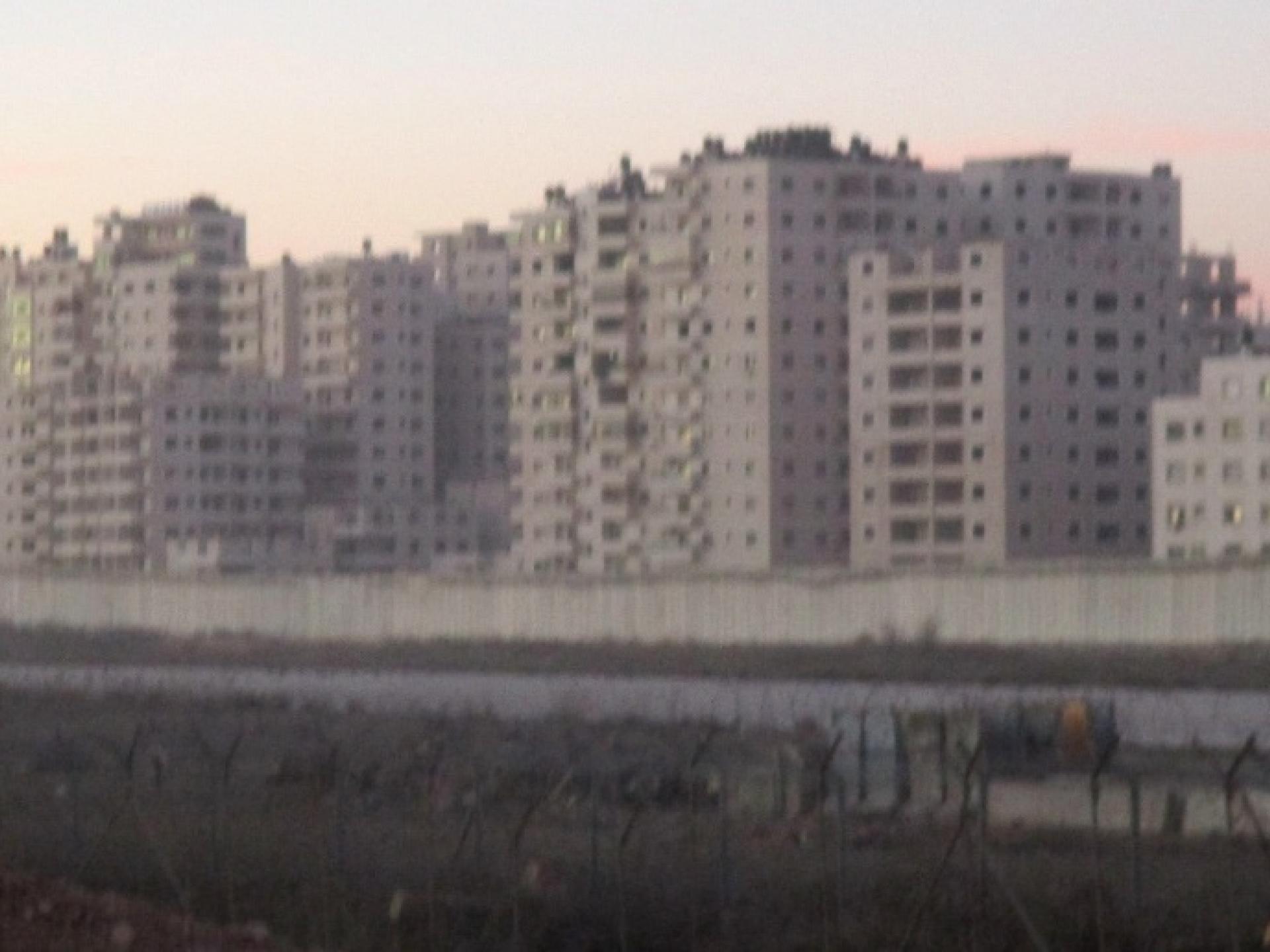
There, those are the buildings they intend to demolish, an acquaintance told me as he pointed towards a cluster of tall apartment buildings rising on the hill, on the inner side of the Separation Wall. The man named several families living on each floor and estimated how many people will remain homeless – many hundreds.
Why? Perhaps because of the absence of construction permits, or the supposed welfare of the Palestinians for whose sake a road is planned that will access the checkpoint and lighten up the heavy traffic, as it were. These are the pretexts for demolition and destruction.
In the meantime, the lives of Kufr ‘Aqab residents remain on hold until the court rules either in favor or against the demolition.
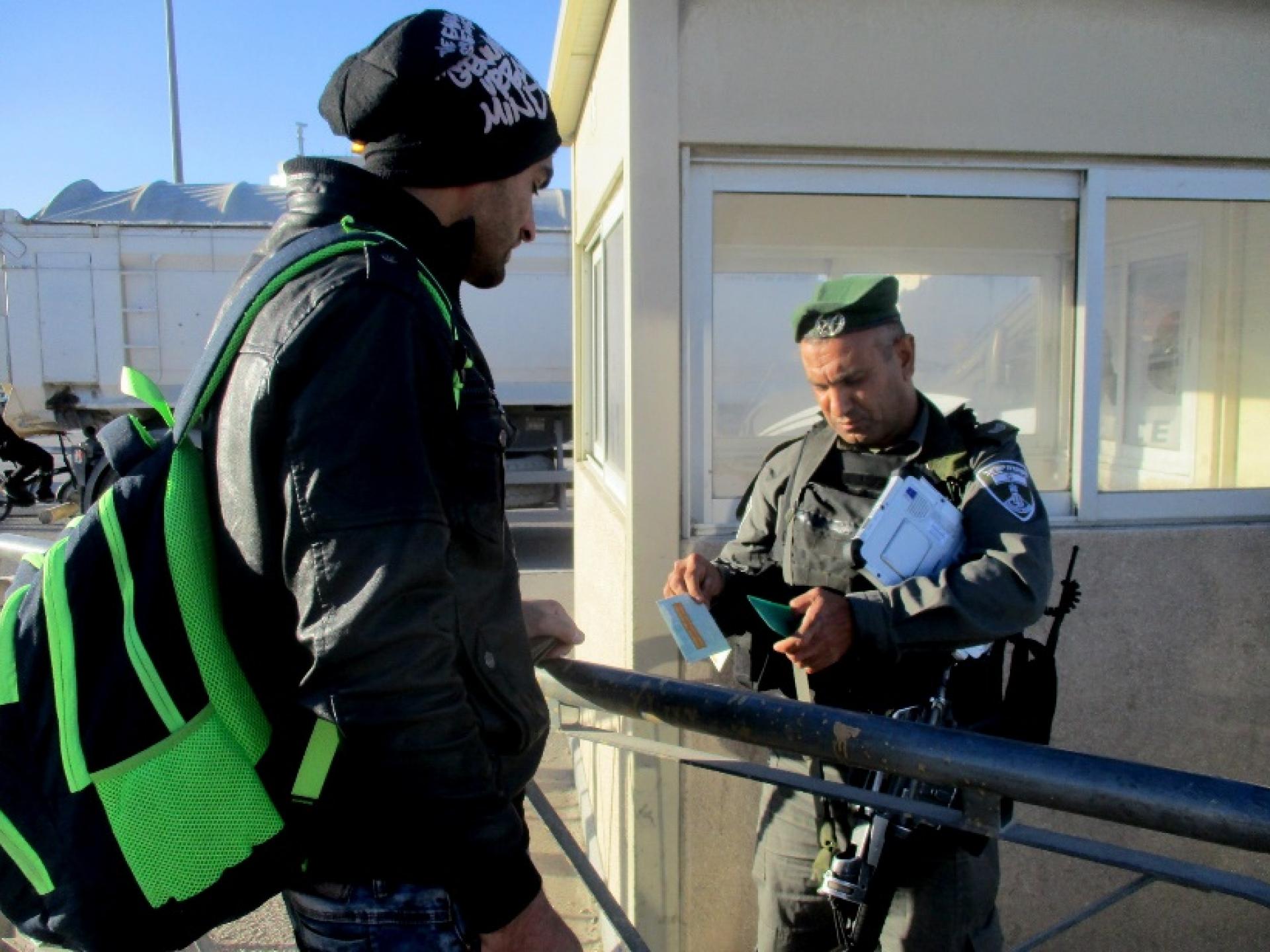
A group of Border Policemen commanded by an officer blocked some young men on their way to the West Bank at the end of their workday.
They were held up one by one, their IDs inspected, their licenses checked, questioned. But luckily for the Palestinians no fish were caught today…
The patients scheduled to return to Gaza left the checkpoint compound at the appointed hour, ‘escorted’ by rifles and women-soldiers. The Gaza Strip coordinator checked the lists he held, counted the people, and said: two are missing. Yes, said the woman-soldier – they have no tansiq, coordination paper. They should come tomorrow.
I asked where they were supposed to spend the night. That’s a problem. Perhaps in a Ramallah hotel? the soldier suggested. And if they cannot afford it? I insisted. That’s a problem, the soldier repeated.
I offered to call a friend with ties to Physicians for Human Rights who promised to solve such problems. Great, said the woman-soldier, and invited me inside to join them where the two persons denied transit were waiting. They were standing in the waiting shack in front of the offices, an elderly woman and a young man, busy making phone calls. He tried to get hold of Rafat of the Gaza DCO, the man who had assured him that there was no problem, but Rafat was not answering. She was calling acquaintances in the West Bank, perhaps one of them would put her up for the night.
After many minutes, Rafat called back, repeated that “everything was alright” and said that he sent the coordination paper by fax.
But everything was not alright:
- The DCO at Qalandiya has no fax machine.
- The transport had already left and according to instructions, it is the only way for them to return to Gaza.
Before I managed to call my friend, someone from somewhere in Ramallah agreed to put up the woman for the night, and not only her but the young man whom they as well as the woman do not know – before they had to share this bit of fate.
Qalandiya Checkpoint / Atarot Pass (Jerusalem)
See all reports for this place-
Click here to watch a video from Qalandiya checkpoint up to mid 2019 Three kilometers south of Ramallah, in the heart of Palestinian population. Integrates into "Jerusalem Envelope" as part of Wall that separates between northern suburbs that were annexed to Jerusalem in 1967: Kafr Aqab, Semiramis and Qalandiya, and the villages of Ar-Ram and Bir Nabala, also north of Jerusalem, and the city itself. Some residents of Kafr Aqab, Semiramis and Qalandiya have Jerusalem ID cards. A terminal operated by Israel Police has functioned since early 2006. As of August 2006, northbound pedestrians are not checked. Southbound Palestinians must carry Jerusalem IDs; holders of Palestinian Authority IDs cannot pass without special permits. Vehicular traffic from Ramallah to other West Bank areas runs to the north of Qalandiya. In February 2019, the new facility of the checkpoint was inaugurated aiming to make it like a "border crossing". The bars and barbed wire fences were replaced with walls of perforated metal panels. The check is now performed at multiple stations for face recognition and the transfer of an e-card. The rate of passage has improved and its density has generally decreased, but lack of manpower and malfunctions cause periods of stress. The development and paving of the roads has not yet been completed, the traffic of cars and pedestrians is dangerous, and t the entire vicinity of the checkpoint is filthy. In 2020 a huge pedestrian bridge was built over the vehicle crossing with severe mobility restrictions (steep stairs, long and winding route). The pedestrian access from public transport to the checkpoint from the north (Ramallah direction) is unclear, and there have been cases of people, especially people with disabilities, who accidentally reached the vehicle crossing and were shot by the soldiers at the checkpoint. In the summer of 2021, work began on a new, sunken entrance road from Qalandiya that will lead directly to Road 443 towards Jerusalem and Tel Aviv. At the same time, the runways of the old Atarot airport were demolished and infrastructure was prepared for a large bus terminal. (updated October 2021)
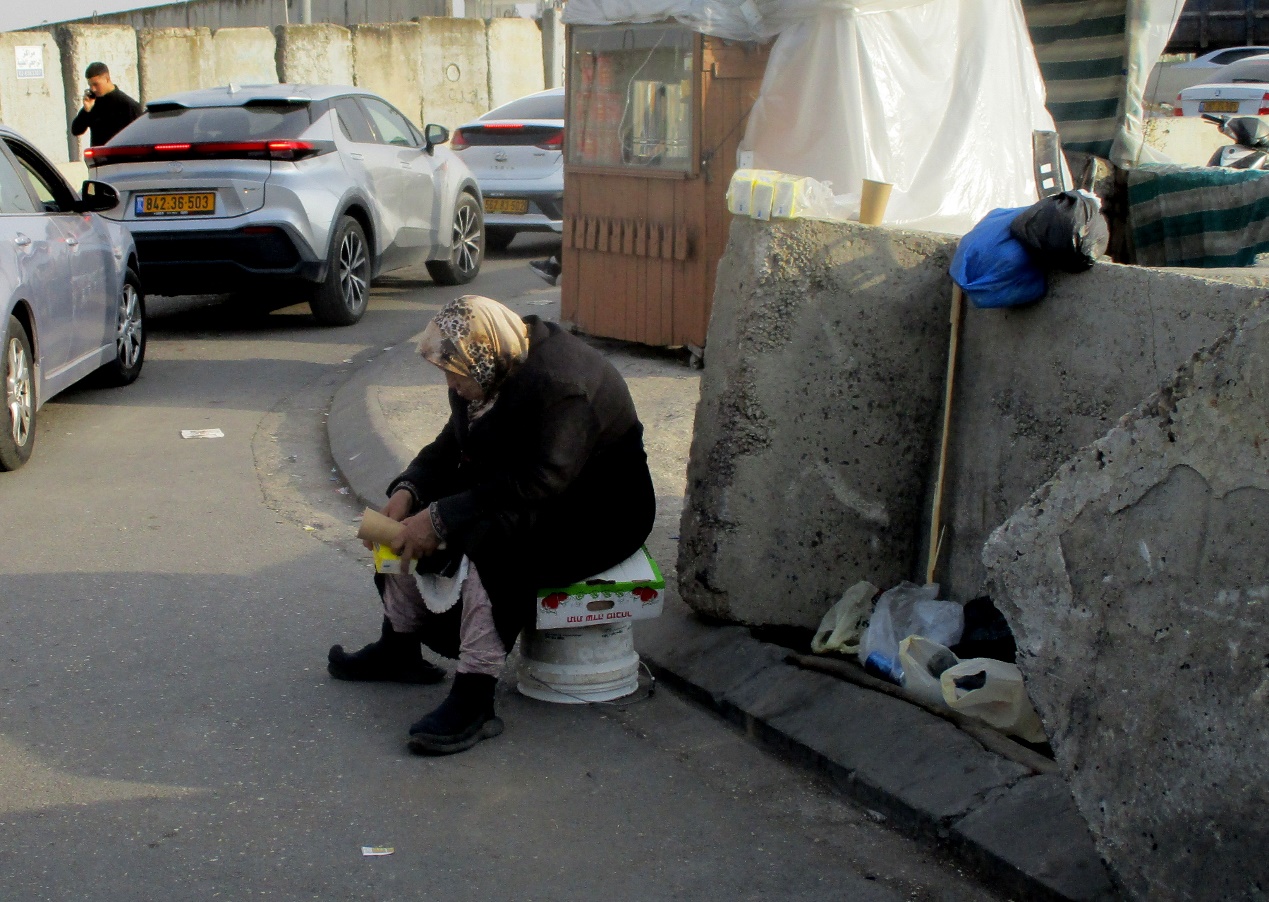 Tamar FleishmanOct-11-2026Qalandiya. Female Beggar
-
