
'Anin, Barta'a-Reihan, Ya'bed-Dotan
14:00 – We drove by Reihan – Barta’a Checkpoint. Shula, who had not been to the Palestinian side of the checkpoint for a long time, was amazed at the crowded parking lots. We drove through Emricha and the new fence is in place and the gate to the shortcut to Yaabed is still locked.
14:10 – Yaabed Dotan Checkpoint
The checkpoint was not manned and traffic was flowing.
14:20 – The road leading to TulKarem was still filled with deep cracks after the turnoff to Hermesh. A car drove through and bumped over the cracks, but we did not manage to photograph the car passing over the cracks.
14:30 – Reihan – Barta’a Checkpoint, Palestinian Side
People are already coming back from work. A shipping container under the shed is being used as a kiosk and the other is in the process of being built. The other container was being used for prayers. People also told us about H. (See report from 19.12.2017) and they had different versions of the story. Eventually we heard that he was tried for stabbing someone and was now in prison in Jenin. People reported that after a sulha would take place between the two families involved he would be sentenced to four months in prison. It is a sad business. We wondered what had happened in H.’s life to cause him to do such a deed.
14:45 – On our way to the vehicle checkpoint a female security guard stopped us to check our car and we waited. On our way out we gave a ride to two women who were also going to the A’anin Checkpoint.
15:00 – A’anin Checkpoint
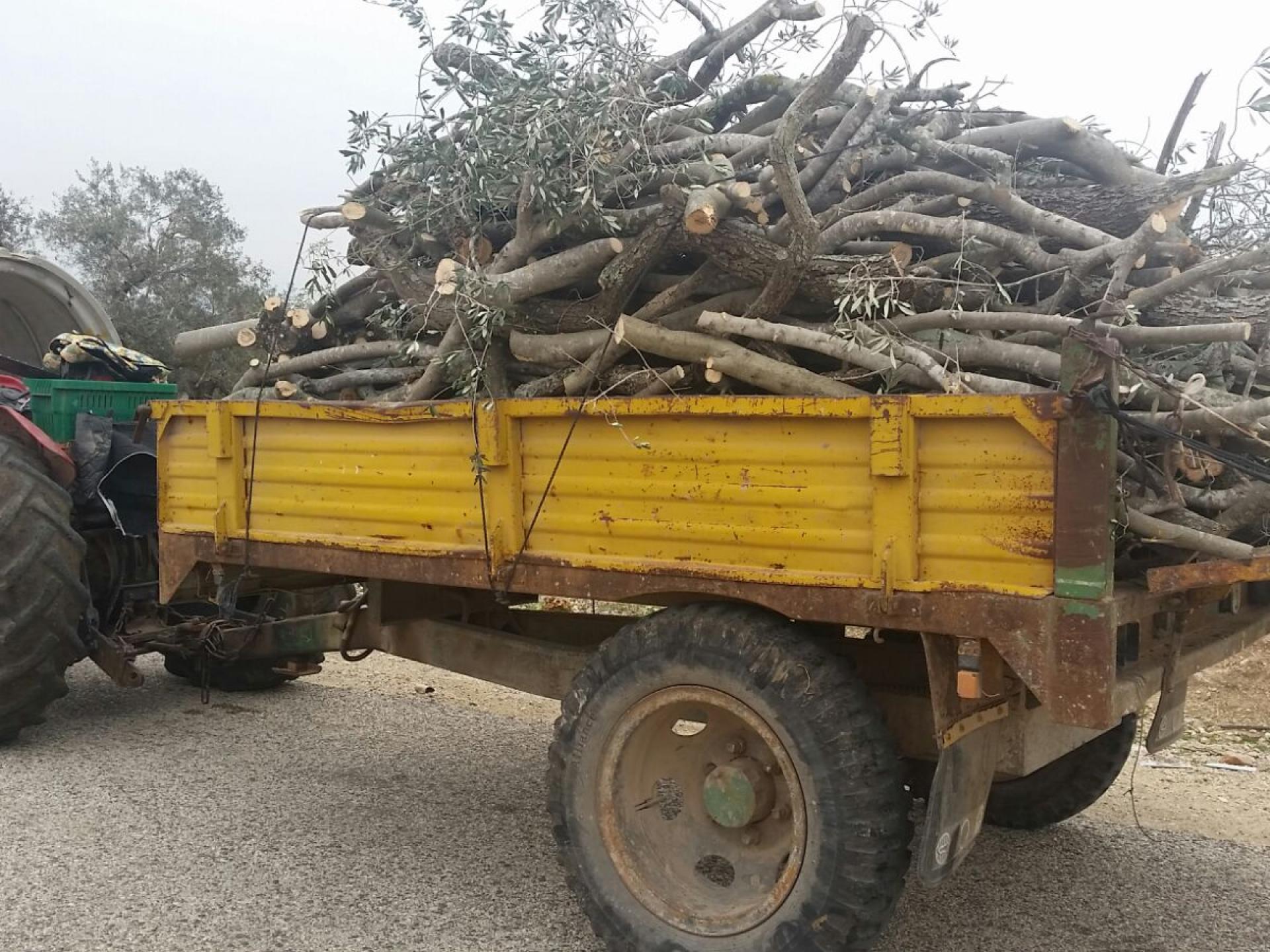
Five tractors, about 20 men, and four women – includeing the women we had brought – were waiting to cross. One of the tractors was loaded with olive branches with the leaves still clinging to them. Other tractors had ploughs attached to them. After about seven minutes two policemen and two police women arrived and slowly opened the gates to the checkpoint and turned on the laptop computer. After another ten minutes the first person was called to cross. People entered in groups of three while a policeman checked their documents and a policewoman guarded him. Another policeman and woman stood near the people who were crossing with drawn weapons – the epitome of feminism and equality.
15:25 – One of the policemen came to lock the gate. I told him that there were another five minutes remaining until the checkpoint was due to close. He looked at his phone and said that I was right, and asked where we were from. A short discussion began. His viewpoint was quite different than ours, but he listened politely and spoke to us quietly.
15:30 – The military police locked the gates and left for Tibeh – Romana Checkpoint. We drove home.
'Anin checkpoint (214)
See all reports for this place-
'Anin checkpoint (214)
'Anin checkpoint is located on the Separation Fence east of the Israeli community Mei Ami and close to the village of Anin in the West Bank. It is opened twice a week, morning and afternoon, on days with shorter light time, for Anin farmers whose olive groves have been separated from the village by the fence it became difficult to cultivate their land. Transit permits are only issued to those who can produce ownership documents for their caged-in land, and sometimes only to the head of the family or his widow, eldest son, and children. Sometimes the inheritors lose their right to tend to the family’s land. The permits are eked out and are re-issued only with difficulty. 55-year-old persons may cross the checkpoint (into Israel) without special permits. During the olive harvest season (about one month around October) the checkpoint is open daily and more transit permits are issued. Names of persons eligible to cross are held in the soldiers’ computers. In July 2007, a sweeping instruction was issued, stating that whoever does not return to the village through this checkpoint in the afternoon will be stripped of his transit permit when he shows up there next time. Since 2019, the checkpoint has not been allways locked with the seam-line zone gate (1 of 3 gates), and the fence around it has been broken in several sites.
-
Barta’a-Reihan Checkpoint
See all reports for this place-
This checkpoint is located on the Separation Fence route, east of the Palestinian town of East Barta’a. The latter is the largest Palestinian community inside the seam-line zone (Barta’a Enclave) in the northern West Bank. Western Barta’a, inside Israel, is adjacent to it. The Checkpoint is open all week from 5 a.m. to 9 p.m. Since mid-May 2007, the checkpoint has been managed by a civilian security company subordinate to the Ministry of Defense. People permitted to cross through this checkpoint into and from the West Bank are residents of Palestinian communities inside the Barta’a Enclave as well as West Bank Palestinian residents holding transit permit. Jewish settlers from Hermesh and Mevo Dotan cross here without inspection. A large, modern terminal is active here with 8 windows for document inspection and biometric tests (eyes and fingerprints). Usually only one or two of the 8 windows are in operation. Goods, up to medium commercial size, may pass here from the West Bank into the Barta’a Enclave. A permanent registered group of drives who have been approved by the may pass with farm produce. When the administration of the checkpoint was turned over to a civilian security firm, the Ya’abad-Mevo Dotan Junction became a permanent checkpoint. . It is manned by soldiers who sit in the watchtower and come down at random to inspect vehicles and passengers (February 2020).
-
Ya'bed-Dotan
See all reports for this place-
Ya’bed-Dotan
This checkpoint is located on road 585, at the crossroads of Mevo Dotan settler-colony / Jenin/ Ya’abad. It has an army watchtower (‘pillbox’ post) and concrete blocs that slow down vehicular traffic. It was erected when Barta’a Checkpoint, lying to the west on the Separation Fence, was privatized and its operation was passed over to civilian security personnel. Since December 2009 this checkpoint enables flow of Palestinian vehicular traffic towards the Barta’a Checkpoint. Seldom is it manned by soldiers sitting in the watchtower, who conduct random inspections of vehicles and passengers. (february 2020)
-