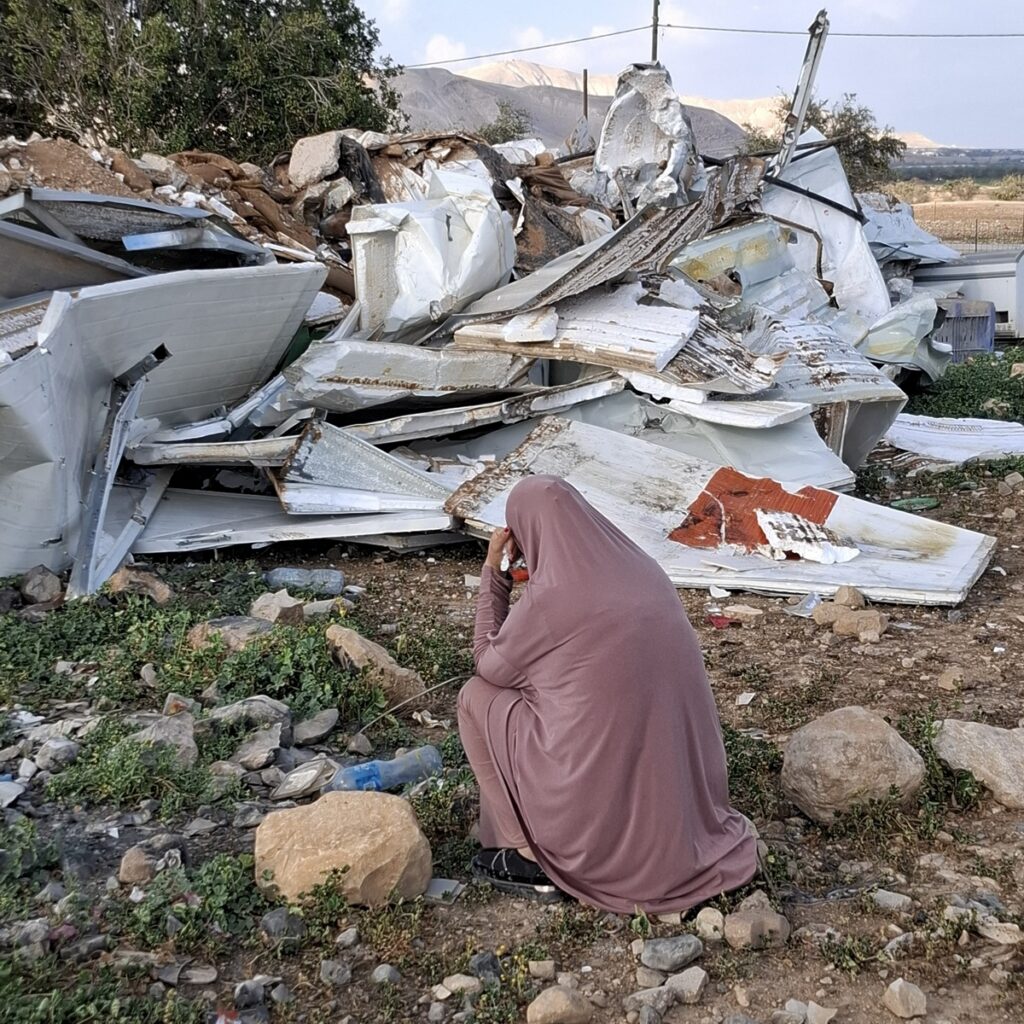
Qalandiya
Dense-to-impossible traffic of vehicles and dozens of vendors offering their old and new wares were all evidence of the hectic preparations on the eve of Eid Al Adha (Feast of Sacrifice).
Bassel, who brought his whole flock of sheep for sale, went to the extreme. Sheep every one of whose life was traditionally the ransom for Ismail whose father Abraham had taken (and not his only son) to be sacrificed to God.
Sheep every one of whose life was traditionally the ransom for Ismail whose father Abraham had taken (and not his only son) to be sacrificed to God.
Perhaps the concept expressed by the Jewish prayer repeated three times – “This is my exchange, this is my substitute, this is my atonement. This rooster (hen) will go to its death, while I will enter and proceed to a good long life and to peace” – is a better idea
than the mass slaughter and carnage?
When the Erez Checkpoint crossing into and out of the Gaza Strip is closed without reason, the Army Spokesperson answers journalist Yaniv Kubovitch: “It is a symbolic gesture”. One cannot help asking, symbolic for whom? Against whom? What has Israel still got to prove except win the old phallic race over whose is bigger?
This closure applies to those exiting the Gaza Strip. The authorities did enable the return of those those who needed to get back home there after receiving medical treatment in the West Bank. Which just goes to show the extent of the ongoing policy to cage in and strangle and restrict the Palestinians as much as possible.
Among the patients making their way home was Rahaf, a 6-year old girl. She doesn’t hear you, said her father when I asked the smiling girl for her name. Rahaf continued smiling and showed me the scar behind her right earlobe, from the surgery she underwent in a Bethlehem hospital in the attempt to give her back at least partial hearing.
Rahaf was not born deaf. She lost her hearing as a result of the Israeli bombings close to their home in Rafah.
Crossing the checkpoint at a time of no pressure, when only one track is open, after standing motionless inline for a while, means that after ten motionless minutes one needs to scurry over to another track, because the one we were waiting for was closed and another track became the only one active. Entrance to the inspection area is carried out in the ‘holy trinity’ system, three by three, and the line grows and so does waiting time, and all is quiet. Only one young man has reached the limits of his patience and yelled: “Soldier, soldier!” An elderly man hushed him up, claiming that one mustn’t irritate the soldiers because if they get angry no one will get through.

Qalandiya Checkpoint / Atarot Pass (Jerusalem)
See all reports for this place-
Click here to watch a video from Qalandiya checkpoint up to mid 2019 Three kilometers south of Ramallah, in the heart of Palestinian population. Integrates into "Jerusalem Envelope" as part of Wall that separates between northern suburbs that were annexed to Jerusalem in 1967: Kafr Aqab, Semiramis and Qalandiya, and the villages of Ar-Ram and Bir Nabala, also north of Jerusalem, and the city itself. Some residents of Kafr Aqab, Semiramis and Qalandiya have Jerusalem ID cards. A terminal operated by Israel Police has functioned since early 2006. As of August 2006, northbound pedestrians are not checked. Southbound Palestinians must carry Jerusalem IDs; holders of Palestinian Authority IDs cannot pass without special permits. Vehicular traffic from Ramallah to other West Bank areas runs to the north of Qalandiya. In February 2019, the new facility of the checkpoint was inaugurated aiming to make it like a "border crossing". The bars and barbed wire fences were replaced with walls of perforated metal panels. The check is now performed at multiple stations for face recognition and the transfer of an e-card. The rate of passage has improved and its density has generally decreased, but lack of manpower and malfunctions cause periods of stress. The development and paving of the roads has not yet been completed, the traffic of cars and pedestrians is dangerous, and t the entire vicinity of the checkpoint is filthy. In 2020 a huge pedestrian bridge was built over the vehicle crossing with severe mobility restrictions (steep stairs, long and winding route). The pedestrian access from public transport to the checkpoint from the north (Ramallah direction) is unclear, and there have been cases of people, especially people with disabilities, who accidentally reached the vehicle crossing and were shot by the soldiers at the checkpoint. In the summer of 2021, work began on a new, sunken entrance road from Qalandiya that will lead directly to Road 443 towards Jerusalem and Tel Aviv. At the same time, the runways of the old Atarot airport were demolished and infrastructure was prepared for a large bus terminal. (updated October 2021)
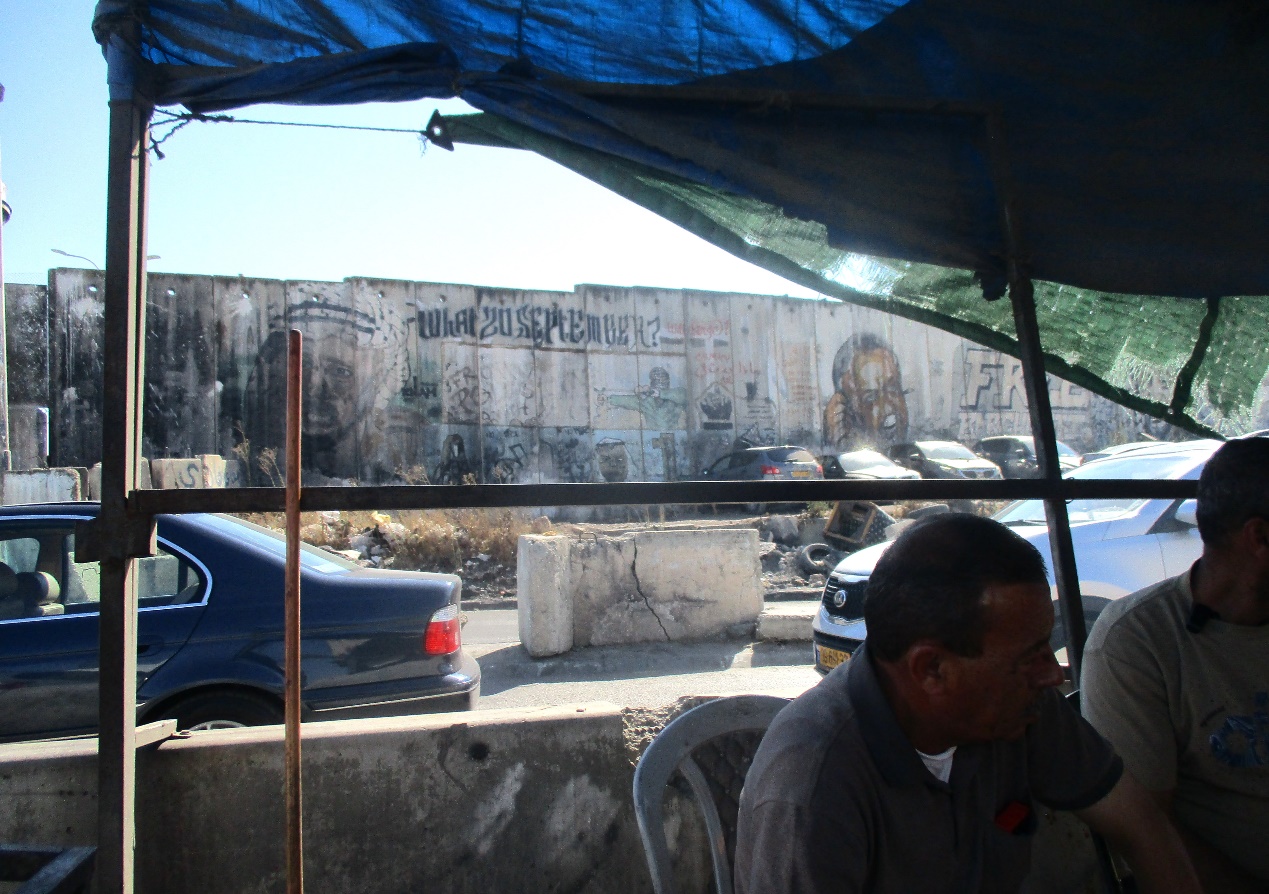 Tamar FleishmanJul-21-2026Qalandiya. Conversation in the shadow of the wall
-