
'Einabus, Beit Furik, Huwwara, Yasuf, Za'tara (Tapuah)
10:35 Huwwara
Soldiers are posted at all the bus stops used by settlers.
The checkpoint at the entrance to Huwwara is manned by soldiers in both directions. Rigorous inspections are apparently conducted at the entrance to and exit from Nablus, because a traffic jam of about 20 vehicles at the entrance to Nablus is visible from a distance. We planned to look more closely when we returned from Beit Furiq, but when we passed again we saw vehicles entering and exiting the city without inspections.
10:50 Beit Furik
We showed up at the municipality without an appointment but the head of the municipality welcomed us. (Although he annoyed me. When he realized I’m an Arab he asked why my head wasn’t covered, pointing at a employee nearby and saying “Like her!” I replied I don’t believe a woman should conceal her hair – to the contrary.)
He told us that on Thursday, December 13, settlers arrived in the wake of the incidents in Efrat to pray and demonstrate at the Beit Furik checkpoint, early in the morning and during the day.
Residents of Beit Furik weren’t able to reach Nablus that day. Workers who aren’t permitted to travel on the apartheid road (formerly known as the Madison route) linking Huwwara directly with the West Bank and intended only for the use of settlers from Alon Moreh and Itamar and other Israelis must go through the Beit Furik checkpoint to Nablus and exit to the West Bank through the Huwwara checkpoint. They were turned away by the soldiers protecting the settlers demonstrating. They were forced to return home and lost a day of work.
The head of the municipality said that the checkpoint’s closure by soldiers isn’t anything new, but a regular occurrence. Almost weekly, and sometimes twice a week, settlers arrive at night to pray at Joseph’s Tomb and the army closes the Beit Furik checkpoint, and then workers who can reach the West Bank only via that checkpoint and through Nablus lose a day of work because they aren’t able to arrive in time at the Eyal/Qalqilya checkpoint to reach their jobs in Israel.
11:30 We left. We passed the checkpoint where a military jeep and soldiers stood but traffic passed between Beit Furik and Nablus in both directions without inspections.
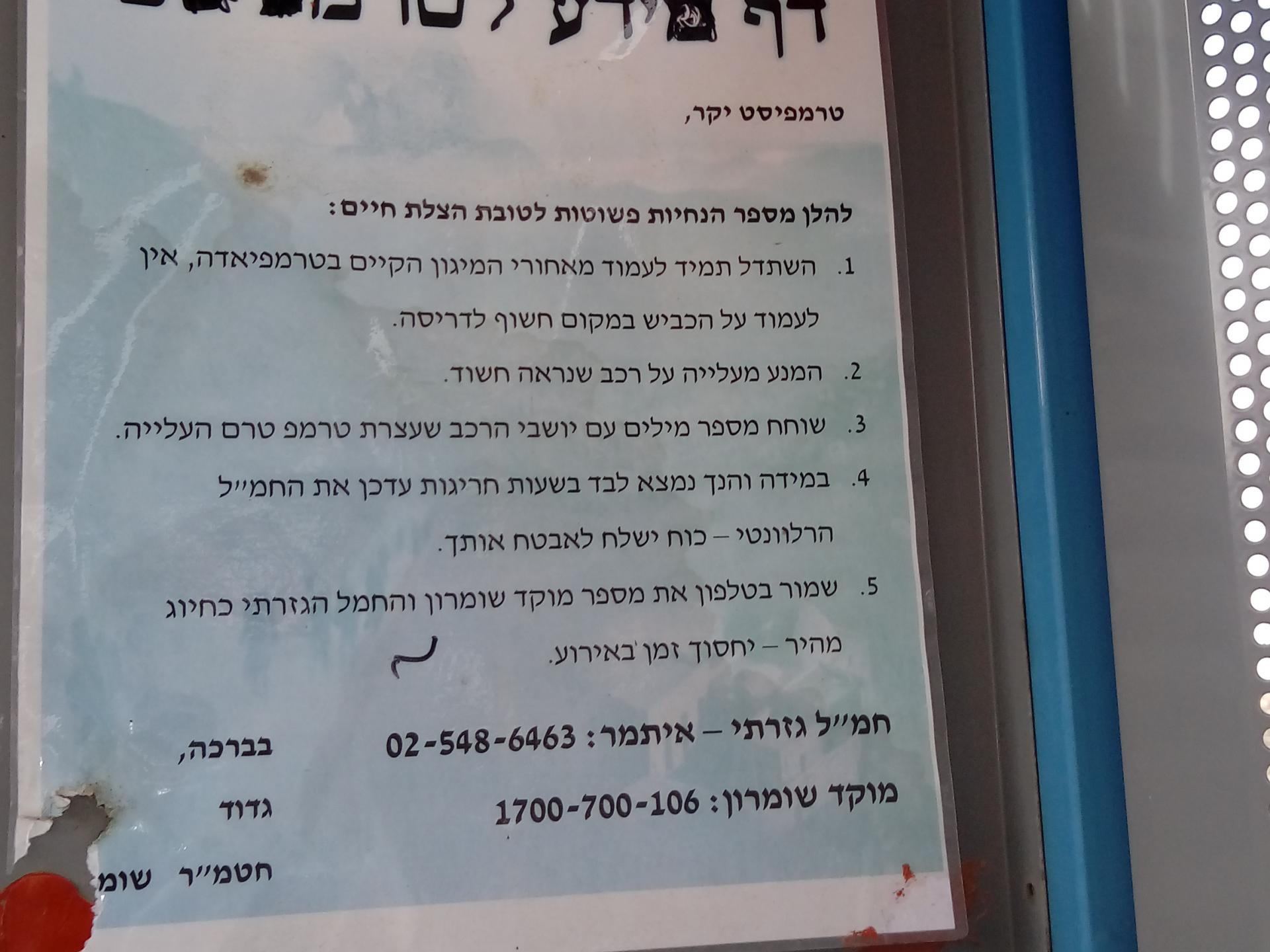
11:45 We stopped at a bus stop. We saw a prominent notice addressed to hitchhikers. The text demonstrates the symbiosis between the settlers and the Civil Administration and emphasizes an additional aspect of the occupation and the need for the IDF to closely control conditions in order to protect the settlers. The text speaks for itself!!!
“Notice to hitchhikers
Here are a few simple instructions that could save your life.
- Always stand behind the barrier installed at the hitchhiking station. Don’t stand in the road where you could be run over.
- Avoid getting into a vehicle that appears suspicious.
- Exchange a few words with the people in the vehicle before you get in.
- If you’re alone at an unusual hour, notify the appropriate situation room. A force will be sent to protect you.
- Keep the phone numbers of the Shomron central office and the situation room in your speed-dial list – you’ll save time during an incident.”
The notice provides the two phone numbers and was issued by a battalion of the Shomron regional brigade.
12:20 Einabus
We drove to the municipality and met the head, Abu Ihab, who told us how they suffer daily from the settlers. Settlers from Yizhar, backed by the army, descend to the village and prevent them from working their lands, move freely through the village and throw rocks.
That’s part of their daily routine.
He told us his own story – the army confiscated a tractor operated by his son in the village because he apparently worked too close to the Yizhar settlement. They needed an attorney in order to reclaim it a month later and, of course, pay a fine and storage fees. He also told us that in March the army entered their home, searched, emptied all the wardrobes and closets and arrested his son. The Palestinian Authority provided an attorney who got the son released after six months in jail.
14:00 Za’tara
When we left Einabus I telephoned Munir, a B’Tselem investigator, who told me of a hate crime and damage to vehicles in Yasuf the previous night.
We decided to go there. On the way we passed the Za’tara checkpoint. It was manned by many soldiers but we didn’t see traffic being stopped or cars driving from Nablus to Ramallah or in the opposite direction.
14:15 Yasuf
Settlers descended to the village in the early morning hours, punctured tires, broke windshields and sprayed slogans on the wall of the mosque and the cars – “The People of Israel Live,” a star of David, etc.
Eighteen vehicles parked on the village’s main road were damaged.
By the time we arrived some of the vehicles had already been taken to the garage for repair.
'Einabus
See all reports for this place-
'Einabus
A village in the Nablus district, west of Hawara, numbering about 3,000 people. 85% of the village's land in Area B, 15% in Area C. 114 dunams of its land were expropriated to establish the violent settlement of Yitzhar and its outposts. Due to the proximity and violence of the settlers sitting on the top of the mountain to invade the village lands, the inhabitants of Einabus regularly suffer from harassment by settlers throwing stones, smashing windows, cutting down olive groves, as well as arson of vehicles and fields. All these were intensified in the second decade of the 21st century.
-
Beit Furik checkpoint
See all reports for this place-
One of the three internal checkpoints that closed on the city of Nablus - Beit Furik to the east, Hawara to the south, Beit Iba to the west. The checkpoint is located at the junction of Roads 557 (an apartheid road that was forbidden for Palestinians), leading to the Itamar and Alon Morea settlements and Road 5487. The checkpoint was established in 2001 for pedestrians and vehicles; The opening hours were short and the transition was slow and very problematic.Allegedly, the checkpoint is intended to monitor the movement to and from Nablus of the residents of Beit Furik and Beit Dajan, being the only opening outside their villages. Since May 2009 the checkpoint is open 24 hours a day, the military presence is limited, vehicles can pass through it without inspections, except for random inspections. (Updated April 2010)
-
Huwwara
See all reports for this place-
The Huwwara checkpoint is an internal checkpoint south of the city of Nablus, at the intersection of Roads 60 and 5077 (between the settlements of Bracha and Itamar). This checkpoint was one of the four permanent checkpoints that closed on Nablus (Beit Furik and Awarta checkpoints to the east and the Beit Iba checkpoint to the west). It was a pedestrian-only barrier. As MachsomWatch volunteers, we watched therre since 2001 two shifts a day - morning and noon, the thousands of Palestinians leaving Nablus and waiting for hours in queues to reach anywhere else in the West Bank, from the other side of the checkpoint the destination could only be reached by public transport. In early June 2009, as part of the easing of Palestinian traffic in the West Bank, the checkpoint was opened to vehicular traffic. The passage was free, with occasional military presence in the guard tower. Also, there were vehicle inspections from time to time. Since the massacre on 7.10.2023, the checkpoint has been closed to Palestinians.
On February 26, 2023, about 400 settlers attacked the town's residents for 5 hours and set fire to property, such as houses and cars. Disturbances occurred in response to a shooting of two Jewish residents of Har Bracha by a Palestinian Terrorist. The soldiers stationed in the town did not prevent the arson and rescued Palestinian families from their homes only after they were set on fire. No one was punished and Finance Minister Smotrich stated that "the State of Israel should wipe out Hawara." Left and center organizations organized solidarity demonstrations and support actions for the residents of Hawara.Hawara continued to be in the headlines in all the months that followed: more pogroms by the settlers, attacks by Palestinians and a massive presence of the army in the town. It amounted to a de facto curfew of commerce and life in the center of the city. On October 5, 2023, MK Zvi established a Sukkah in the center of Hawara and hundreds of settlers backed the army blocked the main road and held prayers in the heart of the town all night and the next day. On Saturday, October 7, 23 The "Swords of Iron" war began with an attack by Hamas on settlements surrounding Gaza in the face of a poor presence of the IDF. Much criticism has been made of the withdrawal of military forces from the area surrounding Gaza and their placement in the West Bank, and in the Hawara and Samaria region in particular, as a shield for the settlers who were taking over and rioting.
On November 12, 2023, the first section of the Hawara bypass road intended for Israeli traffic only was opened. In this way, the settlers can bypass the road that goes through the center of Hawara, which is the main artery for traffic from the Nablus area to Ramallah and the south of the West Bank. For the construction of the road, the Civil Administration expropriated 406 dunams of private land belonging to Palestinians from the nearby villages. The settlers are not satisfied with this at the moment, and demand to also travel through Hawara itself in order to demonstrate presence and control.(updated November 2023)
. Shoshi AnbarMay-18-2025Huwara: The old houses in Area C
-
Yasuf
See all reports for this place-
Yasuf The village numbers 2,500 residents, and in the neighboring village of Iskaka about 1,500. Yasuf suffers from low water supply and intermittent flow - although the population has more than doubled since the Oslo Accords, the 12 cubic meters set in 1996, sometimes even less, are alternated between the two villages, summer and winter .Permits to complete the harvest are only given for a few days, and there are often roadblocks on the way to the groves and the settlers, mostly fr/om Tapuah, try to drive the harvesters away. Since 2006, the settlements have been expanded threefold from their original location, and the harassments are numerous - including vandalism of cars and spraying of hate-inscriptions on the mosque. The settlers from Kfar Tapuach took control of land belonging to the residents and planted their own trees, and the army does not allow the villagers to approach these plots.
-
Za'tara (Tapuah)
See all reports for this place-
Za'tara (Tapuah) Za'tara is an internal checkpoint in the heart of the West Bank, at the intersection of Road 60 and Road 505 (Trans-Samaria), east of the Tapuah settlement. This checkpoint is the "border" marked by the IDF between the north and south of the West Bank, in accordance with the policy of separation between the two parts of the West Bank that has been in place since December 2005. At the Za'tara checkpoint, there are separate routes for Israelis and Palestinians. In the route for Israelis, there are no inspections and the route for Palestinians inspects. The queue lengthens and shortens suits. The checkpoint is open 24 hours a day. The checkpoint is partially staffed and the people who pass through it are checked at random.
 Shoshi AnbarSep-27-2023Za'atra (Tapuah Intersection). Signs
-