
Qalandiya - Our first watch at the new checkpoint
A stormy, rainy morning. As we struggled with our umbrellas we passed the café (near the parking lot on the Israel side) which was crowded. The entrance to the old checkpoint was marked off with a yellow ribbon, but people crept under it so as to shelter from the rain before rushing to their buses. We passed to the Palestinian side, also rushing for shelter under the cover of the new building.
In the pictures that Ina took yesterday we saw the falafel stand and the new small kiosk on the pavement outside. Today the falafel stand was under the overhanging cover of the building. The kiosk and beigel seller were banished. Later we visited the kiosk at the parking lot and the owner, Iman, told us that they were not allowed to put a kiosk at the entrance to the checkpoint itself, although they had been told previously that they were given permission. So they have to be satisfied with the kiosk at the parking lot. The beigel seller, Abu Ramzi, has had to move close to Qalandiya itself. Next visit, when it is not raining, we will visit him.
At one point a policeman and guard came out. We could not hear what the policeman was saying on his phone, but there was something about 1st March. Perhaps by then (in two days’ time) the falafel stand would also be banished. Meanwhile the falafel seller has found a protected spot near the (sign to) the toilets, for frying.
The toilets themselves – which, we had been told, would be open – are closed. It looks as if these will be the same ones (refurbished, we hope!) that served the old checkpoint.
The old checkpoint is abandoned and, as others have noted, it’s nice to see a closed checkpoint…
Of course no one longs for the old checkpoint, but we should point out that there they had litter bins (not always recognized), a drinking tap, and benches – which we don’t see here. A guard told us that there will be bins in future. The policeman, on the other hand, said “There are some inside.” Then they left and we heard him murmur “sluts.” As we didn’t hear him exactly, we trust that he wasn’t referring to us!
We stayed about an hour, talking with people who were all pleased. Passage takes a few minutes, no need for a humanitarian gate as everyone enters easily and quickly. People allow themselves to linger a bit, eat falafel, chat, and pray. We assume that in time people will start arriving later, instead of in the past when one never knew how long one would have to wait in a queue. We were told that for seniors who pass without permits and can enter Jerusalem only after 8, the computer simply does not open the automatic doors before then. Presumably they, too, will understand this and start arriving just before 8.
In the new checkpoint there are three entrances each to a slalom which leads to a turnstile and then inside. When we arrived the leftmost turnstile was still closed, and we told people arriving not to use that entrance. Later, this one also opened.
At 6.30 we entered. We passed the first turnstile (now open) and reached the first hall. We saw there is a partition which can be closed between parts of the hall. Presumably at a later hour, when the D.C.O. and offices open, they close this partition and direct the traffic there, to the left (eastern) section.
In the hall are a number of entrances through turnstiles to the checking stations. Soldiers sitting in a cubicle control the turnstiles and admit 5 people at a time. There is a private company worker standing behind the screening machine, helping people put their bags on plastic trays! Then they pass through their personal screening and collect their screened belongings, the soldiers open a second turnstile and they reach the passage. When we entered we started photographing. When we were between the two turnstiles, next to the screening machine, a guard and a D.C.O. officer appeared through a side door next to the turnstile. “Ah, it’s you,” they said when they saw us. Apparently they had been called because we were filming. They asked us not to photograph because it was a security estalishment. So in future we won’t be able to bring pictures from the inside of the new checkpoint.
After we passed that turnstile we reached a hall with the electronic equipment. A Palestinian with a magnetic card approaches the stand and places his card as one does for the bus or train, and looks at a camera. The computer identifies him and the transparent doors open. This week we saw on the news that similar stations are to be installed at Ben Gurion Airport. So Qalandiya beats Ben Gurion – would you believe it!
We, not having magnetic identity cards, passed through a manned station, and exited immediately. There are many soldiers and guards present, probably because all is new. Going out one passes through the exit of the old checkpoint. The old checking stations are marked off with yellow tape. Interesting to know what will be their fate..,.
No doubt that the situation at the new checkpoint is vastly improved and we hope this will happen soon in Bethlehem. We doubt that it will be necessary for Machsomwatch to come here every week, as in the past. But we continue to pray for the day when the new checkpoint will also be abandoned and people will be free to go where they wish …
Qalandiya Checkpoint / Atarot Pass (Jerusalem)
See all reports for this place-
Click here to watch a video from Qalandiya checkpoint up to mid 2019 Three kilometers south of Ramallah, in the heart of Palestinian population. Integrates into "Jerusalem Envelope" as part of Wall that separates between northern suburbs that were annexed to Jerusalem in 1967: Kafr Aqab, Semiramis and Qalandiya, and the villages of Ar-Ram and Bir Nabala, also north of Jerusalem, and the city itself. Some residents of Kafr Aqab, Semiramis and Qalandiya have Jerusalem ID cards. A terminal operated by Israel Police has functioned since early 2006. As of August 2006, northbound pedestrians are not checked. Southbound Palestinians must carry Jerusalem IDs; holders of Palestinian Authority IDs cannot pass without special permits. Vehicular traffic from Ramallah to other West Bank areas runs to the north of Qalandiya. In February 2019, the new facility of the checkpoint was inaugurated aiming to make it like a "border crossing". The bars and barbed wire fences were replaced with walls of perforated metal panels. The check is now performed at multiple stations for face recognition and the transfer of an e-card. The rate of passage has improved and its density has generally decreased, but lack of manpower and malfunctions cause periods of stress. The development and paving of the roads has not yet been completed, the traffic of cars and pedestrians is dangerous, and t the entire vicinity of the checkpoint is filthy. In 2020 a huge pedestrian bridge was built over the vehicle crossing with severe mobility restrictions (steep stairs, long and winding route). The pedestrian access from public transport to the checkpoint from the north (Ramallah direction) is unclear, and there have been cases of people, especially people with disabilities, who accidentally reached the vehicle crossing and were shot by the soldiers at the checkpoint. In the summer of 2021, work began on a new, sunken entrance road from Qalandiya that will lead directly to Road 443 towards Jerusalem and Tel Aviv. At the same time, the runways of the old Atarot airport were demolished and infrastructure was prepared for a large bus terminal. (updated October 2021)
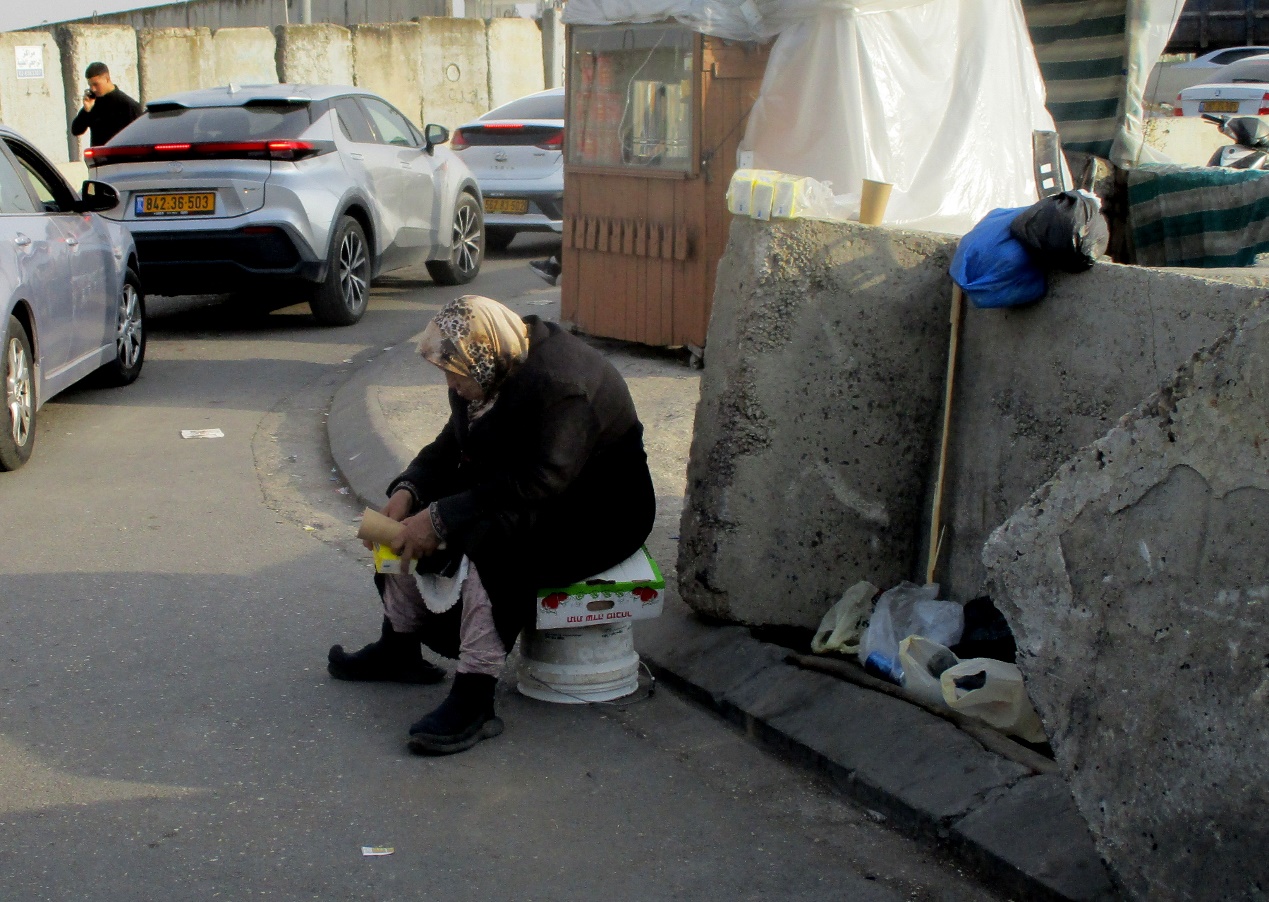 Tamar FleishmanOct-11-2026Qalandiya. Female Beggar
-
