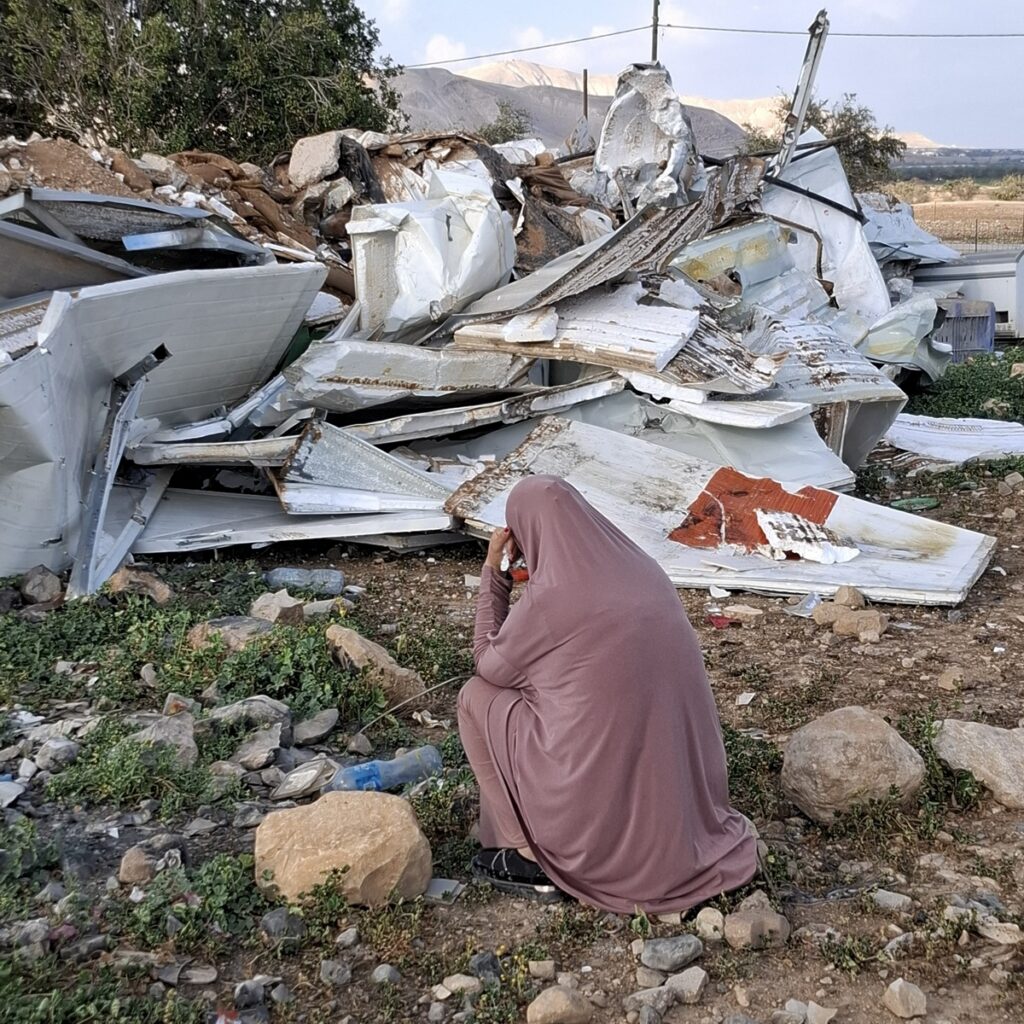
Palestinian shepherds are prohibited from accessing the grazing lands; only settlers are allowed
I accompanied Sarah Carmeli (a colleague who escorts shepherds) to escort the Palestinian shepherds H. and S., this time in a different direction – deep into the wadis. Soldiers in a jeep stopped us on the path and didn’t allow us to join the shepherds. They detained us for more than two and a half hours, claiming we’re in the middle of a firing range, even though the settlers freely move around there, and on Friday and Saturday there’s no military activity in this area.
Seven soldiers in two vehicles guarded us and four Palestinian residents of the nearby town of Tamun. They’d come to enjoy the outdoors and Friday’s day off. We didn’t demand to continue in order not to create problems for the Palestinian shepherds who went on with their flocks unhindered, without us. At one point we were told we could go but we didn’t want to leave the detained Palestinians by themselves. We were all asked for our ID cards, which were photographed, and at 12 noon we were given printed pages with no letterhead containing all our names, including the Palestinians’. The soldiers demanded we all sign confirming we’re aware we’re in a firing area, and if we come again we’ll be subject to trial. The soldiers also showed us (and forbade us from photographing) military maps on which the area we were in was marked as a firing area, even though we insisted that wasn’t the case on Friday and Saturday.
The Palestinians had no choice but to sign; otherwise, they would have been arrested. They were promised they could continue to visit relatives living in nearby encampments. We Israelis refused to sign and the soldiers didn’t insist. Apparently, the signatures were their own idea and had no other validity.
At one point the shepherds called and reported settlers were in the area riding a dune buggy. We walked to the hill in order to join them. This time the settlers didn’t drive into the midst of the flock and didn’t set the dogs on them.
14:00 The flocks and shepherds returned to the encampment; we parted and drove home in great despair. The various lords of the land are taking it over dunum by dunum, one goat after another, and nothing stops them. And the Palestinians aren’t even allowed to enjoy some time in a natural setting.
Jordan Valley
See all reports for this place-
Jordan Valley The Jordan Valley is the eastern strip of the West Bank. Its area consists of almost a third of the West Bank area. About 10,000 settlers live there, about 65,000 Palestinian residents in the villages and towns. In addition, about 15,000 are scattered in small shepherd communities. These communities are living in severe distress because of two types of harassment: the military declaring some of their living areas, as fire zones, evicting them for long hours from their residence to the scorching heat of the summer and the bitter cold of the winter. The other type is abuse by rioters who cling to the grazing areas of the shepherd communities, and the declared fire areas (without being deported). The many groundwaters in the Jordan Valley belong to Mekorot and are not available to Palestinians living in the Jordan Valley. The Palestinians bring water to their needs in high-cost followers.
 Rachel AfekAug-20-2026Samra. Baby Chick
-