
A kindergarten opposite tree uprooting in Umm al Kheir


Purpose: A meeting in Umm al-Kheir with Aziz on the subject of reopening the kindergarten. Fatma, i the school principal at Zanuta who also organizes the training of kindergarten teachers in Hashim-al-Daraj.
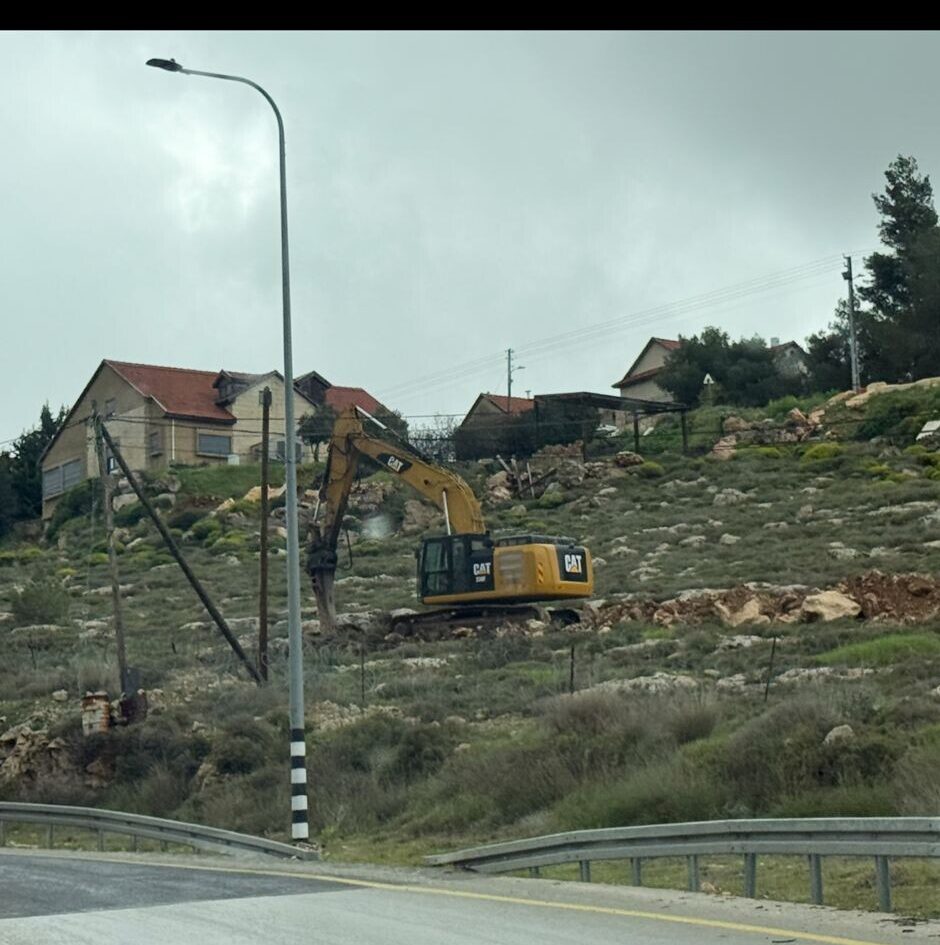
Road 317: Traffic is sparse. Under Asael – an unauthorized outpost in the chain of outposts in the hilltop heads along the road – the Israeli Electric Company is pulling power lines to reach the unauthorized outpost. This electricity line will probably connect to the electricity lines for the settlements. Palestinian villages have separate lines (if any).
In front of Ma’on, we saw bulldozers, tractors and a police car. Muhammad immediately guessed there was a demolition somewhere. Indeed, when we arrived at Umm al-Kheir we were told that yesterday the authorities uprooted 600 trees in the area beyond Umm al-Hir (east). The area is a nature reserve, with trees 16 years old. Today they uprooted 300 trees in the area near Degeiga (also beyond Umm al-Kheir), and destroyed 2 water cisterns stored with rainwater (in the middle of summer, in the desert!). Everyone in this area knows that the land is exposed to the sun, there is no shade, and there is almost no natural vegetation. It breaks one’s heart ! We also tried to understand the rationale behind all these resources invested in uprooting trees. No one had an explanation.
A meeting about the kindergarten in Umm al-Kheir: The meeting is attended by Aziz from Umm al-Kheir, Fatma, the principal of the school at Zanuta, Muhammad, and Mira. Later Dalal, who served as kindergarten teacher, joined the school until it was closed a year or more ago. Hamed from Hebron was to participate, but was abroad.
History of the Garden: In the past, a kindergarten was run in Umm al-Kheir, with kindergarten teachers Dalal, Ikhlas and Naama from Umm al-Kheir. The kindergarten was supported by the village group, and we carried out a number of activities there and helped with the equipment. The kindergarten operated in a building belonging to Yusuf, the mukhtar of Hashim al-Daraj. In the wake of an internal conflict, Yusuf withdrew his consent to give this area for the kindergarten , so it was closed (the building stands empty and neglected). Umm al-Kheir is divided into two separate sections, one just below the Carmel settlement, and the other facing more towards the desert. The kindergarten structure stands right in the middle, between the two parts.)
Later, residents of Umm al-Kheir in the area bordering the settlement of Carmel tried to build a garden in their section: They built a small playground and a structure from an old bus and a trailer, but these were demolished, and the efforts were unsuccessful.
Now Aziz decided to promote the kindergarten issue, so we held the meeting. The goal is to maintain a multi-age kindergarten – ages 3, 4 and 5. We discussed the various possibilities. It seems that in order to receive support from the Palestinian Authority, it can include only children from the age of five, and only within the framework of the local school (because this is Area C, which is under Israeli control, but the agreement is that the authority is responsible for the schools). There are 2 schools, but there is no place for a kindergarten. Therefore, the options are either a garden in the structure of Yusuf, which will serve the two parts of Umm al-Kheir – about 45 children, or a garden only in the part where Aziz lived, under the Carmel settlement, about 12 children. Aziz is now renovating a trailer building and an old bus building, setting up an impressive playground, and framing the fence. The renovation, very impressive, is supported by various foundations, including NGOs and YMCA. They hope that the renovated compound is protected from demolition because they have been able to submit a development plan to the Civil Administration. Even this submission is an achievement, because in the past the administration refused to accept such programs. They hope that the very submission of the plan, first, already determines that this is Palestinian territory, and now the discussion is only about its borders. Second, it protects them from demolition. Let us hope that it is so. The greatest threat to them is from the Regavim organization that is working against them.
In the coming weeks there will be a meeting with Yusuf, also with Hamed – we will try to work with Fatma, and perhaps someone from our organization. If they agree on the structure of Yusuf, it will be excellent. Then, with the help of Hamed, they will also arrange transportation for children, because the distances are great. If there is no agreement, the garden will be opened in a limited format, only in the compound below Carmel settlement. We hope to get into the picture, however, with the help of the teachers and Fatma, organizing activities, and helping with equipment.
South Hebron Hills
See all reports for this place-
South Hebron Hills
South Hebron Hills is a large area in the West Bank's southern part.
Yatta is a major city in this area: right in the border zone between the fertile region of Hebron and its surroundings and the desert of the Hebron Hills. Yatta has about 64,000 inhabitants.
The surrounding villages are called Masafer Yatta (Yatta's daughter villages). Their inhabitants subsist on livestock and agriculture. Agriculture is possible only in small plots, especially near streams. Most of the area consists of rocky terraces.Since the beginning of the 1980s, many settlements have been established on the agricultural land cultivated by the Palestinians in the South Hebron Hills region: Carmel, Maon, Susia, Masadot Yehuda, Othniel, and more. Since the settlements were established and Palestinians cultivation areas have been reduced; the residents of the South Hebron Hills have been suffering from harassment by the settlers. Attempts to evict and demolish houses have continued, along with withholding water and electricity. The military and police usually refrain from intervening in violent incidents between settlers and Palestinians do not enforce the law when it comes to the investigation of extensive violent Jewish settlers. The harassment in the South Hebron Hills includes attacking and attempting to burn residential tents, harassing dogs, harming herds, and preventing access to pastures.
There are several checkpoints in the South Hebron Hills, on Routes 317 and 60. In most of them, no military presence is apparent, but rather an array of pillboxes monitor the villages. Roadblocks are frequently set up according to the settlers and the army's needs. These are located at the Zif Junction, the Dura-al Fawwar crossing, and the Sheep Junction at the southern entrance to Hebron.
Updated April 2022
 MuhammadFeb-24-2026South Hebron Hill, Beit Hagai: Paving an internal security road
-