
Palestinian Jordan valley: A Visit to our Friends from the Shepherds’ Community
We left Rosh HaAyin at 09:00. The car was loaded with rugs that I had collected during the past week from members of Machsom Watch. We met Sharon near the junction at the settlement of Hemdat. An army vehicle was parked next to her large car and three soldiers, one of whom was a lieutenant who tried to find out why she was sitting on the roof of her car (video attached). Sharon explained that she was watching a Palestinian shepherd with his flock, because that is what members of Ta’ayush do in the Jordan Valley to prevent them from being harassed by settlers. When the officer asked whether or not she had noticed that she was in a closed military zone she answered that there was no sign saying that the area was closed. In addition, no one had stopped the settler who was roaming around freely with his dog, and he was evidently the one who had called the soldiers, who now listen to orders given by the settlers.
We parked and moved to Sharon’s car. The officer immediately announced that we were being stopped. Why? There was no answer. He asked us for our ID cards. We announced that we present our ID cards only to policemen and not to soldiers. He responded by declaring: “All right, in that case I’ll call the police,” and proceeded to do so.
We stood on the side of the road for an hour and a half. The officer wanted to know what we were doing there This was a golden opportunity to explain to the soldiers about the concept of human rights, the importance of human rights organizations such as Machsom Watch in upholding a democratic government. He asked us why we were defending Palestinian shepherds who graze their flocks on Israeli land. We explained that this was not Israel’s land and that was a surprise to them. They didn’t know that this area was conquered by Israel in 1967 but no government had ever officially annexed it to the State of Israel. We had the impression that they truly didn’t know what we were talking about and were genuinely interested.
After an hour and a half of “learning” the officer said that the police couldn’t come and he would suffice with us letting him photograph our ID cards. We agreed to this immediately and hurried to complete the tasks for which we had come to the valley in the morning.
We began with a visit to Hiam (beneath the new settlement in back of Maskiot. The family lives in an extremely meager tent. She has a disabled child whom she locks inside the tent so that he will not wander into the road. After we had seen last week that the children slept on the bare earth, we brought large rugs to cover the floor that were donated by members of Machsom Watch. She always hosts us outside the tent and some distance away – perhaps because of her disabled child. We could see her pleasure at receiving the rugs by the look on her face. She served us cold water and store-bought cookies that she had evidently bought especially for us. We thanked her and left.
We drove on to Ras Al Achmar. The Guchia Gate was open and this time the road was not muddy and the trip was simpler. Radia’s family lives far from the road and on the way we passed irrigated fields of green onions whose green color stood out against the yellow and brown of the hills at this time of year.
We gave them a sum or money to cover the expenses of the two daughters’ studies. We talked about their studies and were impressed with Najia’s impressive matriculation certificate that ranged from 8.7 – 10. It is hard to imagine that the young women were able to study and prepare for examinations under the difficult conditions in which they live, and it is amazing that they wish to continue studying.
From Ras El Achmar we drove north to Yusuf. Dafna wanted to talk to him about an educational project how it was progressing.
We left Sharon at Makhul, and she drove north to bring Hiam a mobile phone that we forgot to give her. Dafna and I continued south to Humsa. We visited Z.’s family who live on the hill. Two weeks ago their herd became ill and sixty sheep died. Z. told us about it and explained that the illness was evidently due to faulty inoculations that were administered by the veterinarian from the Palestinian Authority.
The family was extremely happy to see Dafna who had not visited them for some time, and were very excited. We were once again aware how much the Palestinians in the Jordan valley love Dafna and know about her activities.
We then drove to the Jiftlik and visited the K. family. We saw the beautiful S. and saw that she was still traumatized by the fatal accident in which her baby daughter had been killed. We photographed all the papers from the hospital because they want an Israeli attorney to deal with the lawsuit for physical injury against the insurance company of the Israeli drivers who caused the accident.
By that time it was late and we returned home after it was already dark.
Jordan Valley
See all reports for this place-
Jordan Valley The Jordan Valley is the eastern strip of the West Bank. Its area consists of almost a third of the West Bank area. About 10,000 settlers live there, about 65,000 Palestinian residents in the villages and towns. In addition, about 15,000 are scattered in small shepherd communities. These communities are living in severe distress because of two types of harassment: the military declaring some of their living areas, as fire zones, evicting them for long hours from their residence to the scorching heat of the summer and the bitter cold of the winter. The other type is abuse by rioters who cling to the grazing areas of the shepherd communities, and the declared fire areas (without being deported). The many groundwaters in the Jordan Valley belong to Mekorot and are not available to Palestinians living in the Jordan Valley. The Palestinians bring water to their needs in high-cost followers.
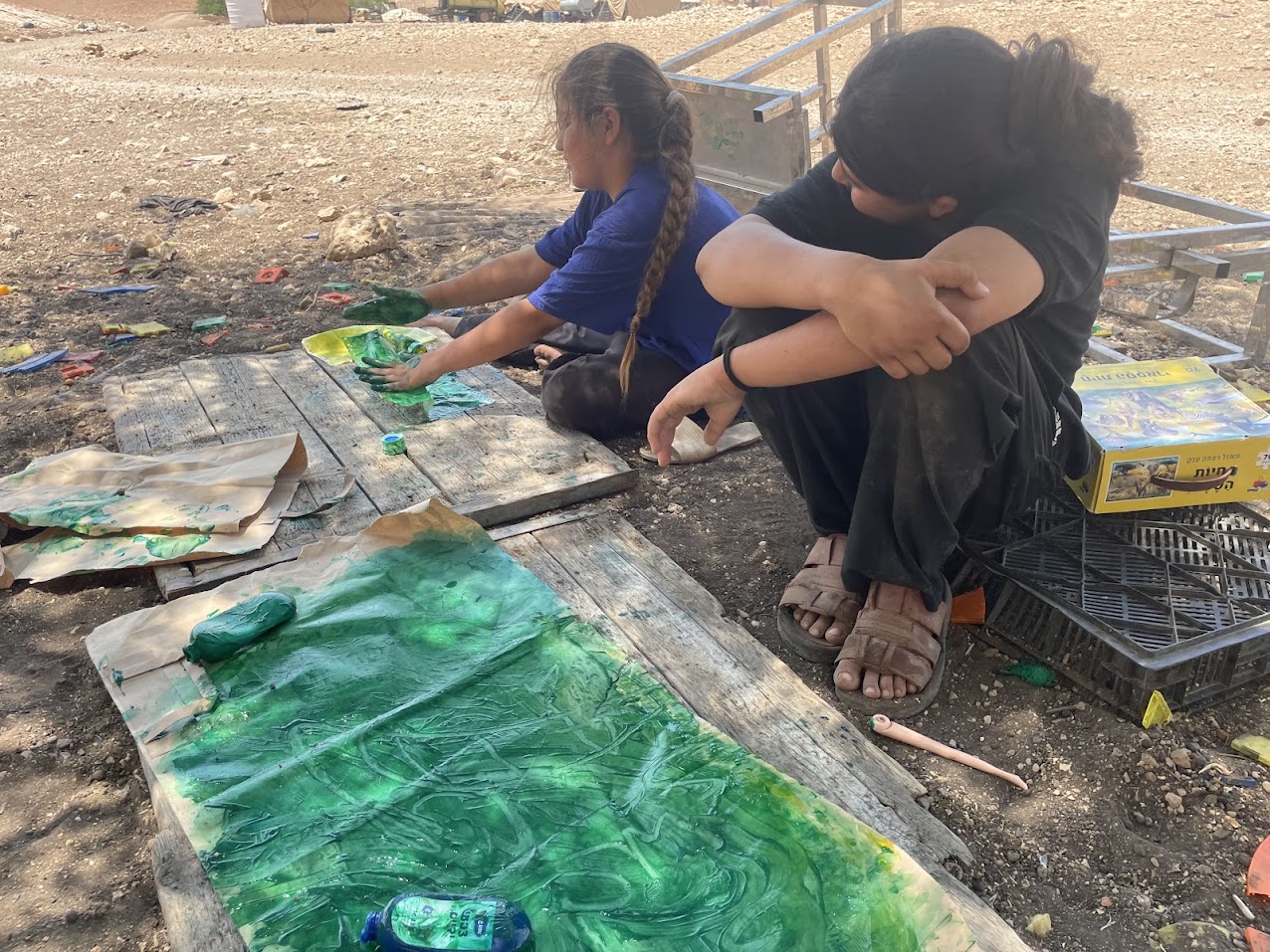 Rachel AfekJun-11-2026Samra. "I want to paint the tree so it remembers us when we are gone," said the girl with the braid
-
Khalet Makhul
See all reports for this place-
Khalet Makhul
A small settlement of a shepherd community located on the way to the settlement of Hemdat. Two nearby outposts make life miserable for the Palestinians, who make a living from grazing, and the army backs the settlers. As a result, the possible grazing areas are getting smaller.
The local children attend school in the settlement of Ein Al-Beida. Long lines of 3 hours sometimes stretch out at the Hamra and Tayasir checkpoints leading to the town of Tubas, making it difficult to get water, supplies, and sell the cheese, milk, and meat that the residents produce for their living.
Following a deadly attack at the Tayasir checkpoint in February 2025, the checkpoint was closed completely for the time being.
(Updated March 2025)
-