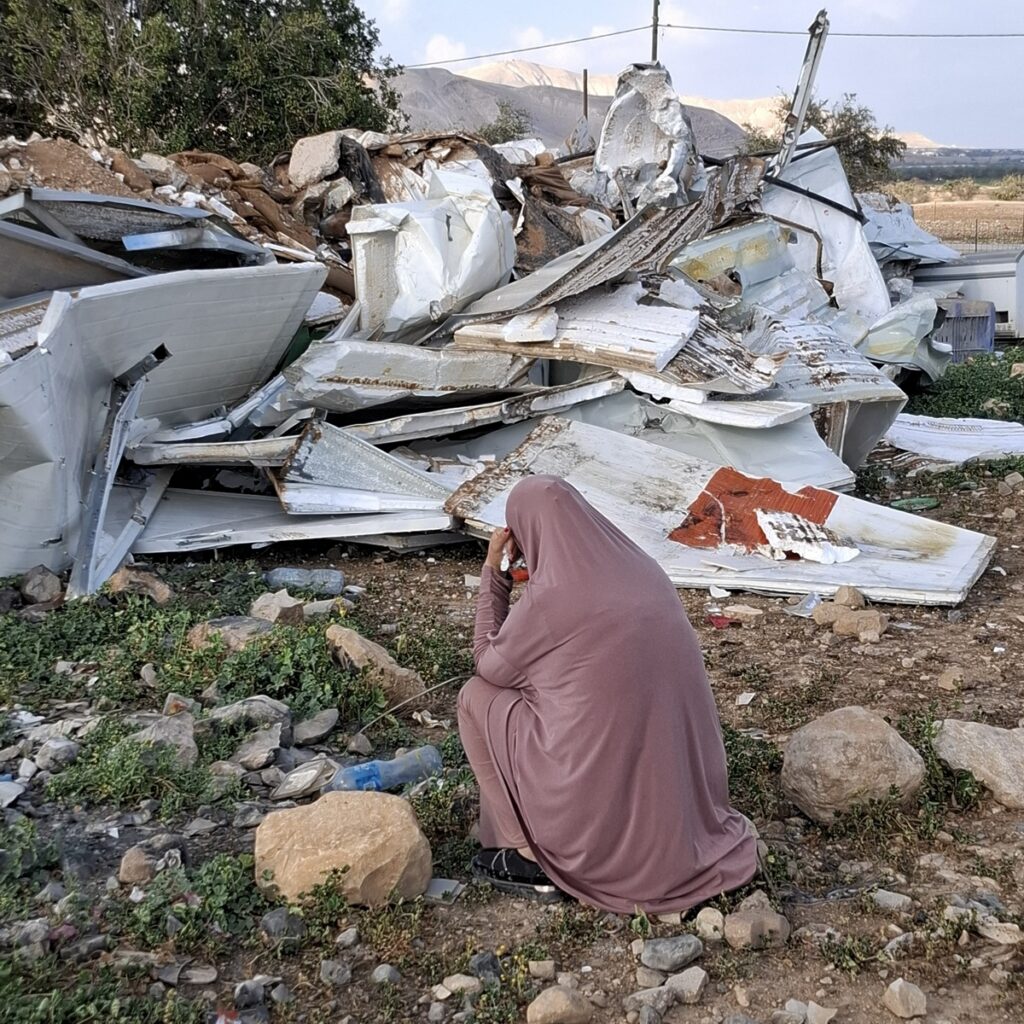
Khursa - with a pillbox in its midst

Another day of fighting in the Gaza Strip. An endless round that leaves the Palestinians and Jews alike in despair between the sea and the Jordan. Bibi who wants to escape the trial … … Islamic Jihad …. doesn’t want to be an interpreter, but all the Palestinians we met today feel the same and how one of them said now would be a turn of revenge again.
We did not want to enter Hebron (I did not have the strength to meet with the violence of settlers), so we passed the Negohot checkpoint and drove until Khursa, we left for Highway 60 and returned home.
The Negohot settlement is spreading and stealing agricultural areas of the Palestinians in the area.
The marking of the hiking trail is an attempt by the settlers to become part of the official Israeli hiking trail. We also found signs of long trenches and we have no idea why they were dug. We passed this on to Dror Arkes to find out.
A pillbox sits in the heart of the town of Hursa. According to the words of the neighbors four times a day the soldiers come down but not at regular times
erect a barrier. The soldiers at the checkpoint are now a mixed battalion of girls and boys and the Palestinians complain that they are the worst. (Whoever thought it was feminism, was wrong). Each battalion that comes comes in four months of line. Both this morning and yesterday and yesterday, searches were carried out in the houses next to the pillbox.
At six in the morning, they enter the family home, wake everyone up, put them in one room of the house and search the rest of the house. No one is arrested, it takes about an hour and everyone is released. All this is just to prove who is in control and who is in control and who is in power.
I did not stop saying that there are Israelis of another kind …. I don’t think this morning it made a difference and not to me either
What else can we do or not do and the occupation is alive and kicking and kills all the time.
Khursa / Al Marajem
See all reports for this place-
Khursa / Al Marajam
Khursa is a small village of about 2,500 inhabitants in Area A, on a hill on the way to Negohot settlement. At the end of September 2017, a pillbox watchtower was set up in the heart of the village, adjacent to the village's diwan, which is a sort of community center for celebrations such as weddings, or used as mourning tent. The army declared the place a closed military zone. In 2018, we saw another aggravation: a barrier of about 50 m, which divides the road into two, and a prohibition on passing vehicles, and then also a prohibition on pedestrians, who have to walk around on a dirt road - during winter on a mud road. Since the checkpoint was established, the army has required special permits to hold an event in Diwan and the permits must be requested at least two days in advance. Of course, the dying are not always cooperative ...together with the villagers we wondered what the meaning of this strange barrier in Area A, which is supposed to be under full control of the Palestinian Authority. Conclusion: It seems that in order to secure the way to the Negohot, the residents are forced to live with a closed military zone and a watchtower in the village center, and suffer many restrictions. (From Watch Checkpoint reports).
Recently, the Israeli authorities began, in the middle of the night, to pave a new bypass road from the nearby village Fuqeiqis to Negohot, Trying to establish facts and aiming to enlarge the settlement.
Updated in April 2021 by Anat T.
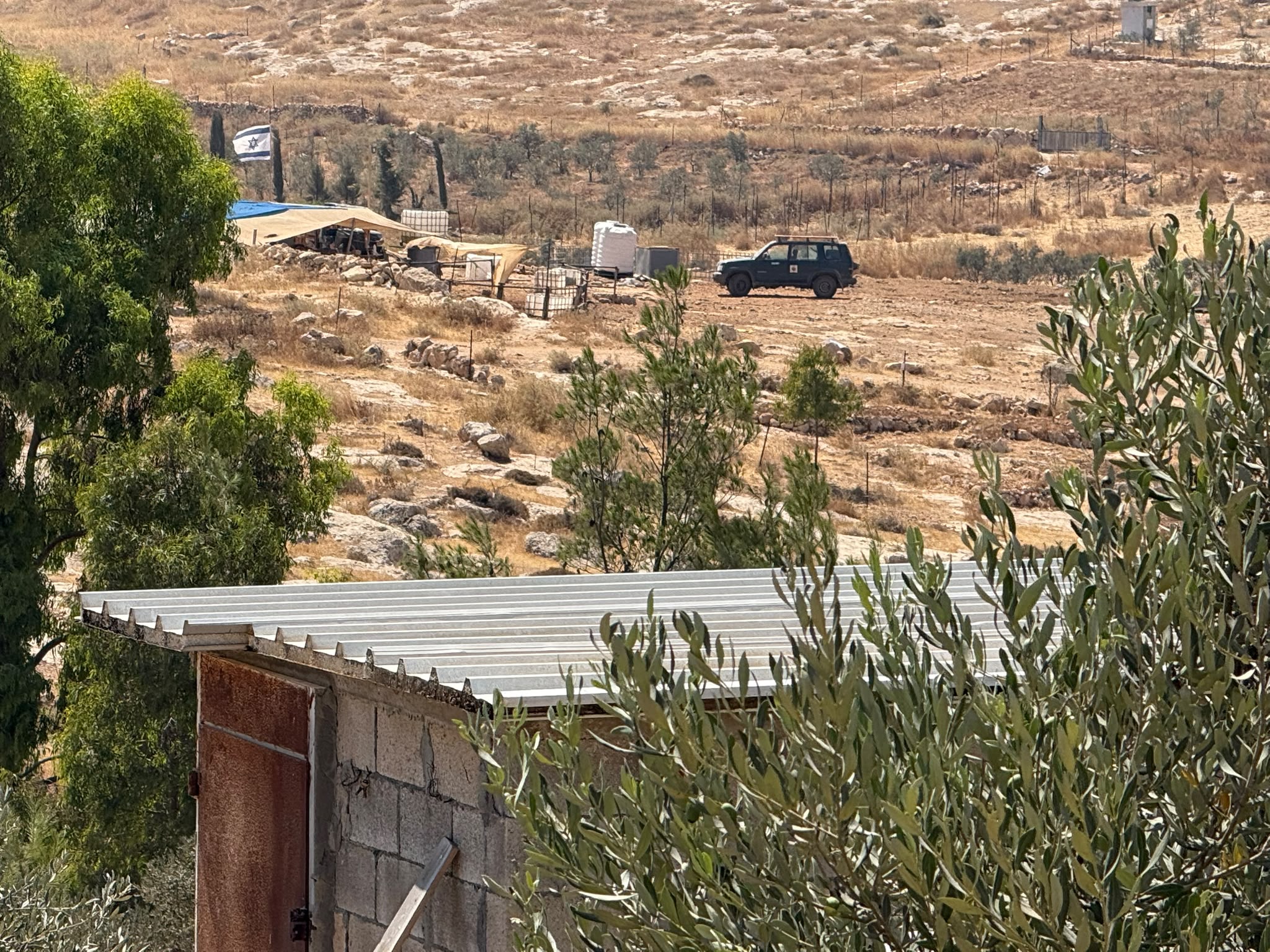 Muhammad D.Jul-23-2026The new settlement, starting June 1, 2026, opposite Khallet al-Humus.
-
South Hebron Hills
See all reports for this place-
South Hebron Hills
South Hebron Hills is a large area in the West Bank's southern part.
Yatta is a major city in this area: right in the border zone between the fertile region of Hebron and its surroundings and the desert of the Hebron Hills. Yatta has about 64,000 inhabitants.
The surrounding villages are called Masafer Yatta (Yatta's daughter villages). Their inhabitants subsist on livestock and agriculture. Agriculture is possible only in small plots, especially near streams. Most of the area consists of rocky terraces.Since the beginning of the 1980s, many settlements have been established on the agricultural land cultivated by the Palestinians in the South Hebron Hills region: Carmel, Maon, Susia, Masadot Yehuda, Othniel, and more. Since the settlements were established and Palestinians cultivation areas have been reduced; the residents of the South Hebron Hills have been suffering from harassment by the settlers. Attempts to evict and demolish houses have continued, along with withholding water and electricity. The military and police usually refrain from intervening in violent incidents between settlers and Palestinians do not enforce the law when it comes to the investigation of extensive violent Jewish settlers. The harassment in the South Hebron Hills includes attacking and attempting to burn residential tents, harassing dogs, harming herds, and preventing access to pastures.
There are several checkpoints in the South Hebron Hills, on Routes 317 and 60. In most of them, no military presence is apparent, but rather an array of pillboxes monitor the villages. Roadblocks are frequently set up according to the settlers and the army's needs. These are located at the Zif Junction, the Dura-al Fawwar crossing, and the Sheep Junction at the southern entrance to Hebron.
Updated April 2022
Muhammad D.Jul-23-2026The new settlement, starting June 1, 2026, opposite Khallet al-Humus.
-