
Hebron, Sansana (Meitar Crossing)
Road 60: At the east exit from the Meitar crossing in the direction of Shema onwards, accumulation of cars, and workers in glowing vests collect garbage in quantities into large bags. “Gate 11”.(free pedestrian crossing) becames routine.
Hebron: After the 160 bend, before we turn left at the Border Police checkpoint on the way to the Cave of the Patriarchs, we notice a large shade spread behind the checkpoint, part of the park connecting the cave complex and the large parking lot on the other side. The house which the settlers took over on the other side of the parking lot, officially known as the “House of the Patriarchs”, teaches us that the expanding Jewish space is intended by its very creation for the existence of “expand the your tent” as the Prophet’s article. Some Palestinian girls are seen crossing this space, carrying large containers of soup, which are distributed in the Al Ibrahimi Mosque, a symbol of the shrinking life of their people. Also on the other side of the above-expanding space, on a street now called “Hebron Valley”, to the left of Rachel and Leah’s house, near the soldiers’ stand, is a checkpoint for vehicles. To the west of the shop of Abed the area is closed to all cars.
Shuhada Street: West of Gross Square, after the checkpoint, is a Palestinian market in the Abu Snena neighborhood which is closed to us.
At the entrance to Beit Hadassah, a group of soldiers + men in civilian clothes. M. Identifies a GSS jeep, and guesses that there is a visit by some senior figure. The current unit in the city: Nahal.
In front of the House of the Patriarchs, a group of about 30 men and women soldiers receive an explanation from an officer. According to the black visor caps it is clear that they are on a study tour on behalf of the army. As I approached, another officer came out to sniff out who I was. I said I’m not from Hebron, what is it exactly?
Are they going to serve in Hebron? No, he replied, they would serve in the military prosecutor’s officer and the officer guiding them on the tour was also from the prosecutor’s office. I heard only some of the things, legal explanations. Why at this time it is not legally possible to evict the settlers from this house. Apparently I am getting old and tired, because I did not shout after them what was stuck in my throat, that the best of our educated youth should now learning how to train every creep of the occupation.
The axis of worshipers between Kiryat Arba and Hebron: Along the Palestinian houses on its southern side, a new fence, which creates space for Jewish worshipers and only for Jews to walk on Saturdays and holidays, while the path for pedestrians to Palestinians is close to their homes. In front of each house, there is an opening in the fence for entry and exit on foot. There is nothing at all said about the family car. This is how the occupation works: not a week goes by without some creative innovation that burns the occupation in the mind again and again. There is no routine to get used to because the occupier is the master of the dominant narrative and changes it at will
At the junction of Shuyukh Square, in the direction of Hebron, the gate is open, but for some reason 4 soldiers are standing next to the concrete blocks.
Hebron
See all reports for this place-
According to Wye Plantation Accords (1997), Hebron is divided in two: H1 is under Palestinian Authority control, H2 is under Israeli control. In Hebron there are 170,000 Palestinian citizens, 60,000 of them in H2. Between the two areas are permanent checkpoints, manned at all hours, preventing Palestinian movement between them and controlling passage of permit holders such as teachers and schoolchildren. Some 800 Jews live in Avraham Avinu Quarter and Tel Rumeida, on Givat HaAvot and in the wholesale market.
Checkpoints observed in H2:
- Bet Hameriva CP- manned with a pillbox
- Kapisha quarter CP (the northern side of Zion axis) - manned with a pillbox
- The 160 turn CP (the southern side of Zion axis) - manned with a pillbox
- Avraham Avinu quarter - watch station
- The pharmacy CP - checking inside a caravan with a magnometer
- Tarpat (1929) CP - checking inside a caravan with a magnometer
- Tel Rumeida CP - guarding station
- Beit Hadassah CP - guarding station
Three checkpoints around the Tomb of the Patriarchs
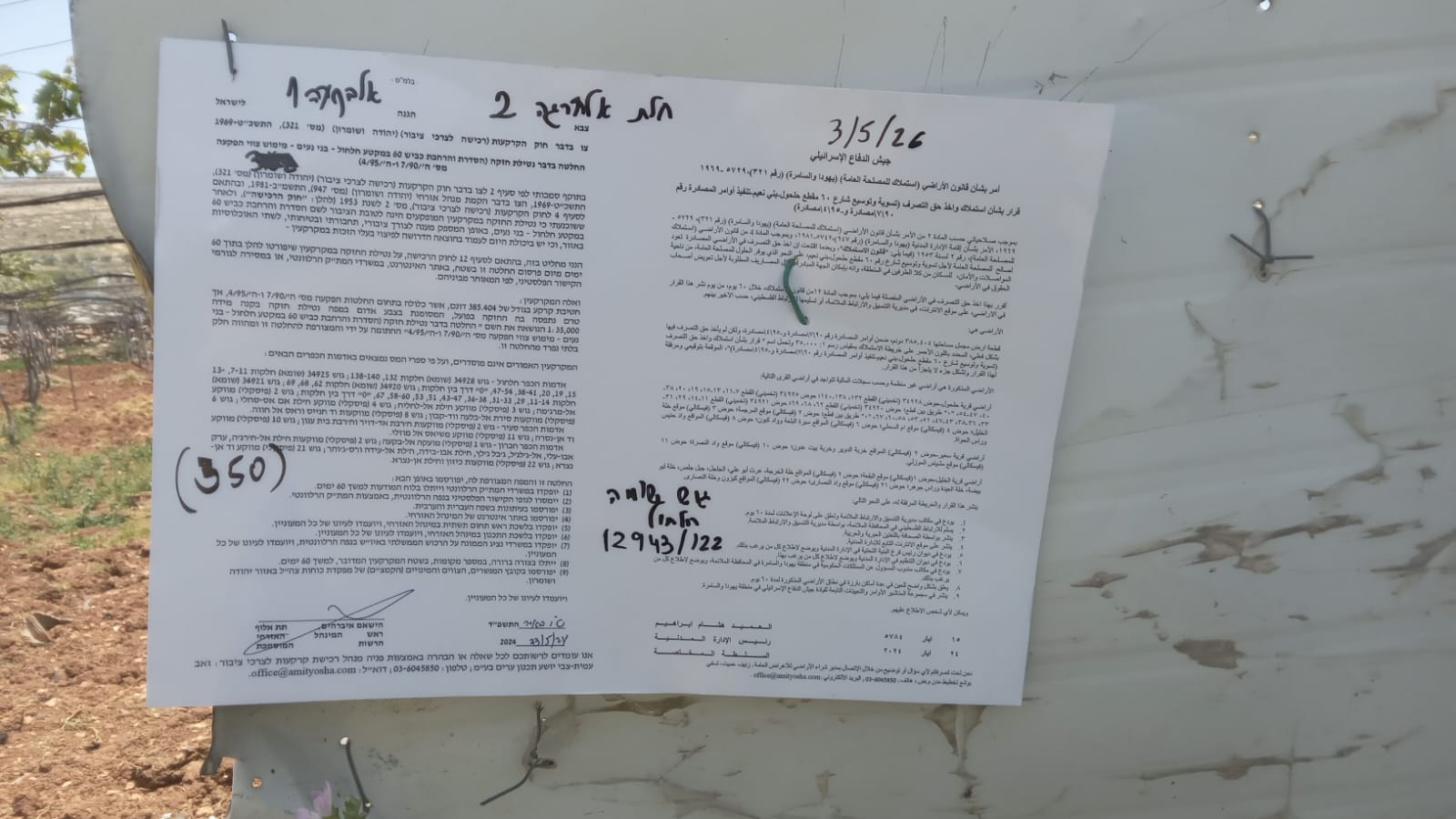 Muhammad D.May-13-2026Hebron - Request for compensation for land expropriation
-
Meitar checkpoint / Sansana
See all reports for this place-
Meitar Checkpoint / Sansana The checkpoint is located on the Green Line and serves as a border crossing between Israel and the West Bank. It is managed by the Border Crossing Authority of the Defense Ministry. It is comprised of sections for the transfer of goods as well as a vehicle checkpoint (intended for holders of blue identity cards, foreign nationals or diplomats and international organizations). Passing of Palestinians is prohibited, except for those with entry permits to Israel. Palestinians are permitted to cross on foot only. The crossing has a DCO / DCL / DCL / DCL (District Coordination Office), a customs unit, supervision, and a police unit. In the last year, a breach has been opened in the fence, not far from the crossing. This breach is known to all, including the army. There does not appear to be any interest in blocking it, probably as it permits needed Palestinian workers without the bureaucratic permits to get to work in Israel. Food stalls and a parking area economy have been created, but incidents of violent abuse by border police have also been recorded. Updated April 2022
-
