
Qalandiya - The long queues are back


After finding long lines at Qalandiya last week, we returned this week. Together with our colleagues, we will do a weekly watch again.
We parked on the Israel side and made our way on the tiring pedestrian bridge to the Palestinian side. By the time we come out on the Palestinian side, it is 6.20-6.25.
This time, too, we were greeted by long lines. The rightmost entrance of the three did not open and disappointed people waiting there gave up and joined the other two lines. At least the lines did not collapse, but they were very long.
The beigel seller, Abu Ramzi, was standing at the entrance to the parking area facing Qalandiya camp. Here he can manage to sell to drivers waiting in the car checkpoint line. We gave him the money we had collected towards his coming cataract operation and wished him a quick recovery. From him and passers-by we heard that the queuing situation has been consistently bad lately. When we turned around to face the building we saw the middle line had reached right into the public transport area
We went to the kiosk for tea. There Mohammad told us that at about 5 a.m. the line from the eastern-most entrance reached all the way to the kiosk which is outside the checkpoint area. Our conclusion is that we will have to resume coming earlier, as in the ‘old’ days.
When we returned to the building at about 7 there were no long lines extending beyond the entrances. This time the middle entrance was closed and disappointed people were moving from one entrance to another. At 7.15 we joined the righthand one. We passed the first turnstile quickly but there were long lines waiting for the parcels-checking machines as not all 6 were working. At one point they were admitting people one at a time, instead of 5 as usual, for some unknown reason. And then suddenly, they allowed 10 people at one go, and afterward different numbers each time. It was hard to see the logic. Perhaps the checkers get reports about the load at the electronic document-checking machines?
When we reached this stage, there were no delays, but only a small number of checking posts were active. In total, we passed in less than 20 minutes.
On the way back on the bridge we noticed below people had got off a bus on the western side of the vehicles checkpoint, the lane meant for public transport. When the bus arrives, people alight and present their documents. We are told that only holders of blue i.d. cards are allowed to use public transport. After the bus itself is checked they can enter it again. If the bus has to enter the parking lot to the west of the checkpoint to collect more passengers – the boom is lifted and the ground released, for the bus to pass. In a building on the west side is a route with turnstiles to pass through, but at present, it is done outside.
Further along, were a few totally empty ones. So why aren’t they placed nearer, and why is the trash not cleared more frequently? The people there – the beigel-sellers and taxi drivers – tell us that they have complained and asked the municipality to clear, but in vain.
They complain, too, that the bus stops have no roof and that the toilets are closed and anyway unusable. But anyone who urinates outside the closed toilets gets a police report.
Qalandiya Checkpoint / Atarot Pass (Jerusalem)
See all reports for this place-
Click here to watch a video from Qalandiya checkpoint up to mid 2019 Three kilometers south of Ramallah, in the heart of Palestinian population. Integrates into "Jerusalem Envelope" as part of Wall that separates between northern suburbs that were annexed to Jerusalem in 1967: Kafr Aqab, Semiramis and Qalandiya, and the villages of Ar-Ram and Bir Nabala, also north of Jerusalem, and the city itself. Some residents of Kafr Aqab, Semiramis and Qalandiya have Jerusalem ID cards. A terminal operated by Israel Police has functioned since early 2006. As of August 2006, northbound pedestrians are not checked. Southbound Palestinians must carry Jerusalem IDs; holders of Palestinian Authority IDs cannot pass without special permits. Vehicular traffic from Ramallah to other West Bank areas runs to the north of Qalandiya. In February 2019, the new facility of the checkpoint was inaugurated aiming to make it like a "border crossing". The bars and barbed wire fences were replaced with walls of perforated metal panels. The check is now performed at multiple stations for face recognition and the transfer of an e-card. The rate of passage has improved and its density has generally decreased, but lack of manpower and malfunctions cause periods of stress. The development and paving of the roads has not yet been completed, the traffic of cars and pedestrians is dangerous, and t the entire vicinity of the checkpoint is filthy. In 2020 a huge pedestrian bridge was built over the vehicle crossing with severe mobility restrictions (steep stairs, long and winding route). The pedestrian access from public transport to the checkpoint from the north (Ramallah direction) is unclear, and there have been cases of people, especially people with disabilities, who accidentally reached the vehicle crossing and were shot by the soldiers at the checkpoint. In the summer of 2021, work began on a new, sunken entrance road from Qalandiya that will lead directly to Road 443 towards Jerusalem and Tel Aviv. At the same time, the runways of the old Atarot airport were demolished and infrastructure was prepared for a large bus terminal. (updated October 2021)
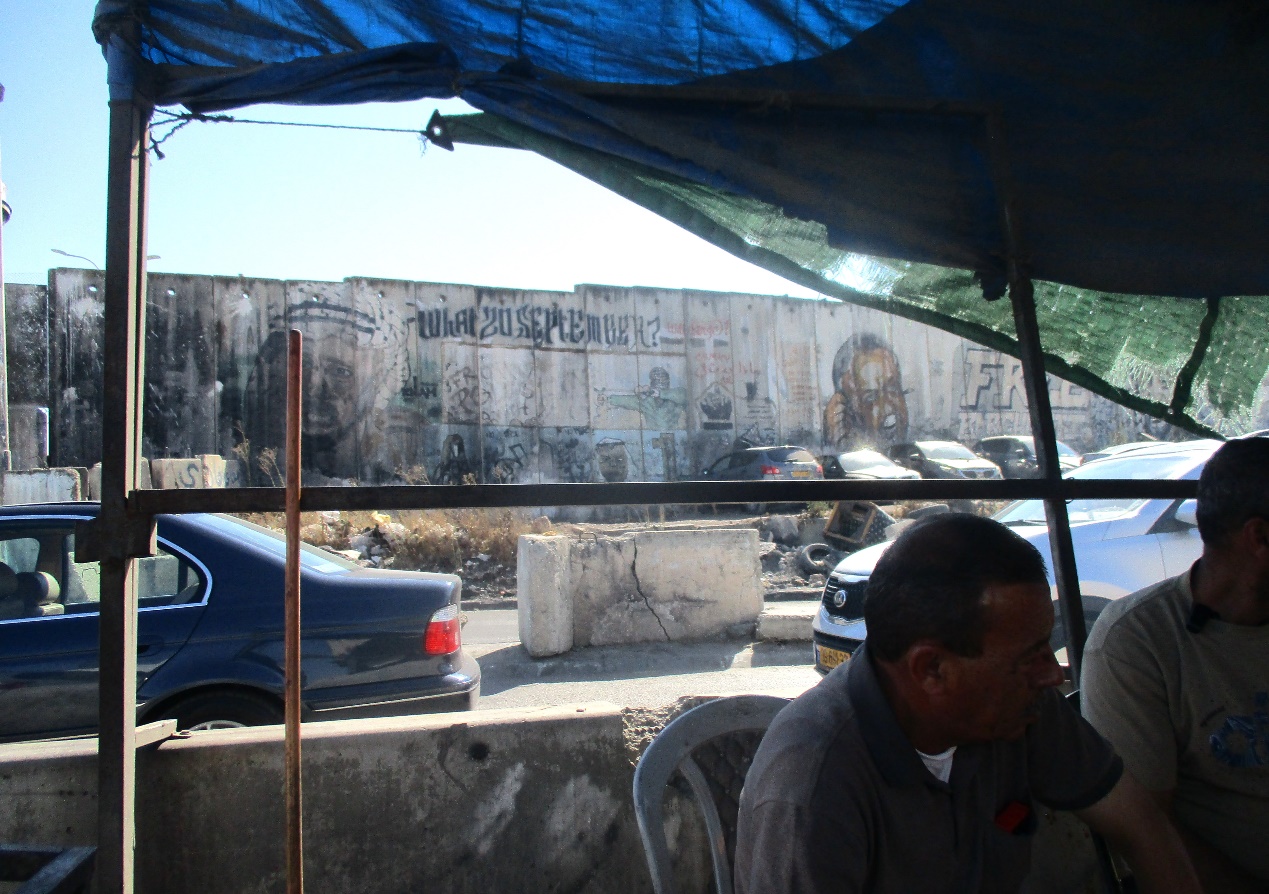 Tamar FleishmanJul-21-2026Qalandiya. Conversation in the shadow of the wall
-
