
Qalandiya - a baby with cancer is transferred by back-to-back procedure to hospital
“We’re waiting for a cancer patient from Jenin so we can deliver him to Augusta Victoria Hospital on Mount Scopus, East Jerusalem” said the members of the Jerusalem Red Crescent medical team waiting in their parked ambulance on the roadside of the vehicle checkpoint at Qalandiya.
I waited with them.
We waited for a long time. We spent the time talking about the change of place where patients are transferred between ambulances, about the vaccinations, and more.
But nothing prepared me for the fact that the cancer patient we were waiting for was an 11-month-old baby.
Porath, ill with cancer, was taken out of the ambulance in his mother’s arms, his scrawny arm pierced by a plastic tube where the IV would enter his body.

Back-to-back procedure (between ambulances) took place by the book. There was no transgression or harassment that is not written in the procedure book.
Present were the two medical teams – one from Jenin and one from East Jerusalem, the two ambulances, two stretchers, soldiers and security guards, guns, and in the midst of all of these – a sick baby and his mom.
The procedure of baggage inspection was also followed to a T. The mother had to hand Porath over to a member of the medical team and present the content of her bags to a soldier. For who knows what a woman might smuggle in her bag, when fate has given her the blow and she is on her way to be with her sick child in his hospital bed…
There was nothing left for me but to answer the man and myself that nothing changes, nothings helps and that with the years, despair just gets deeper and the situation worse.

I do not accuse the occupation mechanism and its regulations of Porath’s cancer. The illness is a blow of fate. The occupation regulations are guilty of forcibly detaching the baby and his mother from the city that is the center of their lives, from the rest of the family and especially the father who is left behind with his concern and longing – since that father is attributed to a sector considered dangerous by those who set the policy for transit permits, he is excluded from caring for his ill child.
Furthermore – in spite of the existence of hospitals in the West Bank and the Gaza Strip, and in spite of their dedicated medical teams, the Civil Administration prevents passing on equipment vital for radiation treatments, and forces Porath and other patients like him to receive life-sustaining treatments in East Jerusalem.
Further along the way, beyond the apartheid wall, opposite the refugee camp, a taxi driver said to me that he has seen me come there for years now, taking pictures, asking questions, listening, and saying that I write about the occupation. “But does any of this help? Is something changing around here?”
Qalandiya Checkpoint / Atarot Pass (Jerusalem)
See all reports for this place-
Click here to watch a video from Qalandiya checkpoint up to mid 2019 Three kilometers south of Ramallah, in the heart of Palestinian population. Integrates into "Jerusalem Envelope" as part of Wall that separates between northern suburbs that were annexed to Jerusalem in 1967: Kafr Aqab, Semiramis and Qalandiya, and the villages of Ar-Ram and Bir Nabala, also north of Jerusalem, and the city itself. Some residents of Kafr Aqab, Semiramis and Qalandiya have Jerusalem ID cards. A terminal operated by Israel Police has functioned since early 2006. As of August 2006, northbound pedestrians are not checked. Southbound Palestinians must carry Jerusalem IDs; holders of Palestinian Authority IDs cannot pass without special permits. Vehicular traffic from Ramallah to other West Bank areas runs to the north of Qalandiya. In February 2019, the new facility of the checkpoint was inaugurated aiming to make it like a "border crossing". The bars and barbed wire fences were replaced with walls of perforated metal panels. The check is now performed at multiple stations for face recognition and the transfer of an e-card. The rate of passage has improved and its density has generally decreased, but lack of manpower and malfunctions cause periods of stress. The development and paving of the roads has not yet been completed, the traffic of cars and pedestrians is dangerous, and t the entire vicinity of the checkpoint is filthy. In 2020 a huge pedestrian bridge was built over the vehicle crossing with severe mobility restrictions (steep stairs, long and winding route). The pedestrian access from public transport to the checkpoint from the north (Ramallah direction) is unclear, and there have been cases of people, especially people with disabilities, who accidentally reached the vehicle crossing and were shot by the soldiers at the checkpoint. In the summer of 2021, work began on a new, sunken entrance road from Qalandiya that will lead directly to Road 443 towards Jerusalem and Tel Aviv. At the same time, the runways of the old Atarot airport were demolished and infrastructure was prepared for a large bus terminal. (updated October 2021)
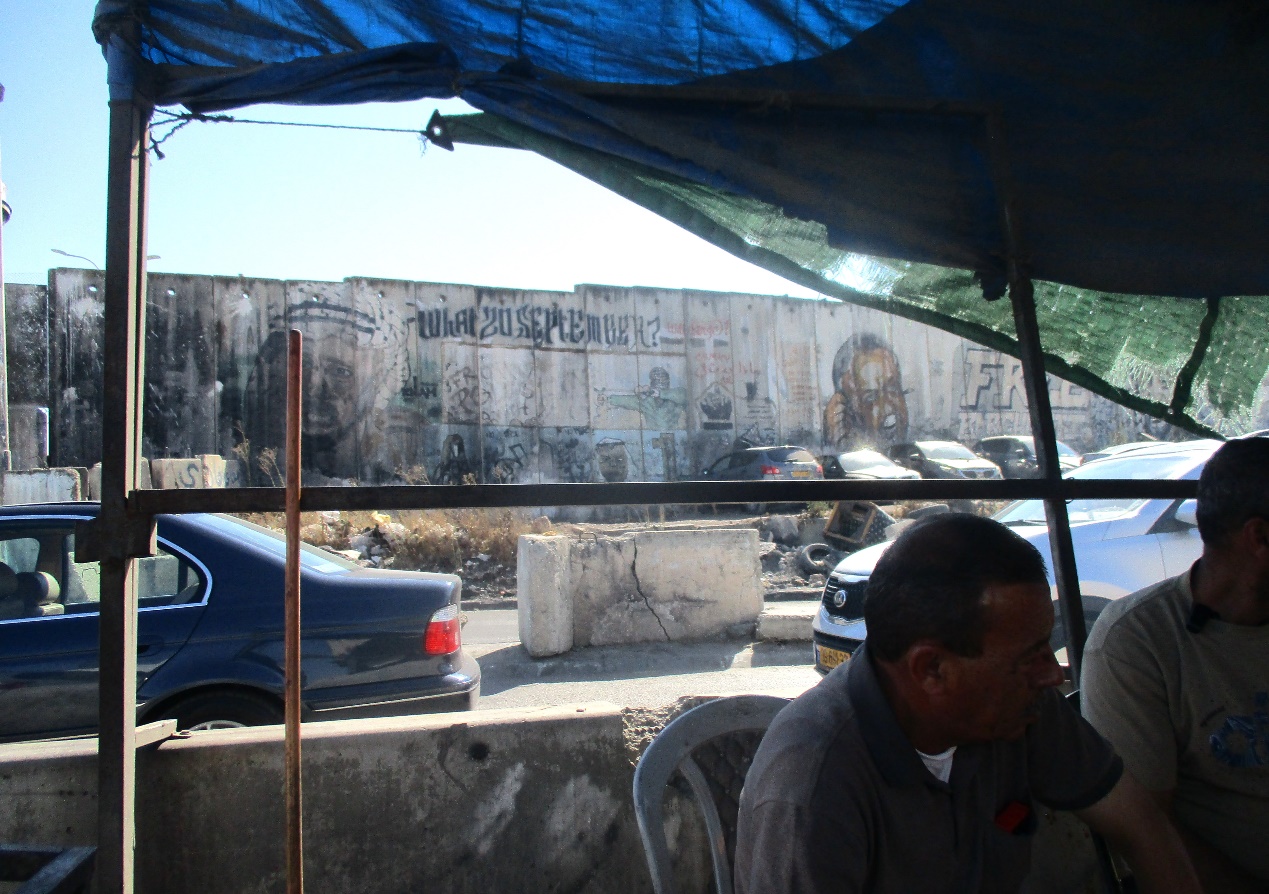 Tamar FleishmanJul-21-2026Qalandiya. Conversation in the shadow of the wall
-
