
South Hebron Hills - pillboxes as a "means to improve IDF's hold on threatened areas"


At the Meitar checkpoint, the parking lot was full. The passage is as usual . Extensive work is being done on Route 60, hopefully for the well-being of the Palestinians as well. We did not see any special movement of the army and all the entrances to the villages were open.
Following an article I saw on the IDF website from July 12, 2017, entitled “The Engineering Revolution in Judea and Samaria: A Special Look at Innovations Against Terrorism in the Judean Sector,” including the building called “Pillbox,” we decided to follow the pillbox buildings and see how they fit into the landscape and the people who live there.
Some quotes from the article on the IDF website that explain the background to the IDF construction in the southern Hebron Mountains.
“Due to the operational challenges facing the forces operating in the sector by night and day, senior members of the brigade, led by its commander, Col. Itzik Cohen, decided to adopt a new concept called “Magen Avot”.
“Its purpose is to ensure the stability and security of the residents of the area and to improve the IDF’s grip on the threatened areas.”
“This perception stems from the understanding that in order to prevent terrorist incidents in the Jewish community, it must be thwarted from inside the enemy’s territory,” say brigade officials, explaining: “The fighters will work more in security areas in threatened areas so as to strengthen the hold of the army in certain areas and to see that the settlers are not threatened by terrorism”
“The fighters will work more in the security areas in the threatened areas in order to increase the army’s hold on points intended for disaster and to ensure that terrorism does not harm civilians.”
“One of the main tools on which the concept of “Magen Avot” is based is the use of engineering means, designed to create a safe space for action for IDF fighters in order to carry out ongoing security work as effectively as possible.”
“The engineering effort is an integral effort which stems from the concept itself,” explains Major Pesach, the engineering officer in the Judea Brigade. “These days we are in the midst of an engineering revolution throughout the division. We take care to study the sectoral history that is continuous in complex security incidents, and to give it an engineering response in the way outlined by the new concept that defines for us that laying a proper engineering infrastructure can change reality and lead to a breakthrough in the fight against terrorism.“
From the Meitar checkpoint we continued on Route 60 and to the first pillbox on our way which was on the way up to Abda. The checkpoint was open and it appears that the pillbox is unmanned but remain as a presence between the village houses in the background.
Further down the road, at the Al-Fawwar-Dura junction, is another pillbox that is always manned and soldiers leave it to make rolling checkpoints . This time everything was open and the soldiers were not seen at the intersection.
We continued on Route 60 and to the next pillbox which is at Beit Hagai. A small building overlooking Road 60 and located on the outskirts of the settlement.
Further down the road in front of the Judea Squadron is the reservoir of concrete blocks with which the army is blocking access roads to the villages.
The next pillbox on the way is at the Sheep junction, where the sheep market takes place.
After the sheep junction, we turned onto the 356 road at the Beit Hagai junction. Just before the Zif junction we went down a dirt road that led to a pillbox. The pillbox itself is unmanned, but we met an officer and a soldier in a jeep who probably came to see if everything was okay there. After a short conversation they continued on their way and we were left to watch the spectacular view: Pillbox, barbed wire fences and flowering almonds.
We continued on our way back through road 317 and there at the junction with the road that leads to Yatir forest. it has the highest pillbox in the area.
Architecture of occupation. The pillboxes are everywhere and even when unmanned they are present. The building materials of the occupier are concrete and iron, the building materials of the occupier are sheets, sheets of cloth or nylon and tires.
Dura Al-Fawwar Junction
See all reports for this place-
Junction on Route 60: west - the town of El Dura, east - the Al Fawwar refugee camp. There is a manned pillbox at the junction. From time to time the army sets up flying checkpoints at the entrance to El Fawwar and Al Dura. Al-Fawwar is a large refugee camp (7,000 inhabitants in 2007) established in 1949 to accommodate Palestinian refugees from Be'er Sheva and Beit Jubrin and environs. There are many incidents of stone-throwing. In the vicinity of the pillbox there are excellent agricultural areas, Farmers set up stalls adjacent to the plots close to the road. In recent months the civil administration has set up dirt embankments thereby blocking access to the stalls, and making it impossible for the farmers to sell their vegetables. Updated April 2021, Michal T.
-
Hakvasim (sheep) Junction
See all reports for this place-
One of the roadblocks (earthworks, rocks, concrete blocks or iron gates) that prevent transit of vehicles to Route 60 in the southern West Bank and block the southern entrance to Hebron. A manned pillbox supervises the place.
-
Meitar checkpoint / Sansana
See all reports for this place-
Meitar Checkpoint / Sansana The checkpoint is located on the Green Line and serves as a border crossing between Israel and the West Bank. It is managed by the Border Crossing Authority of the Defense Ministry. It is comprised of sections for the transfer of goods as well as a vehicle checkpoint (intended for holders of blue identity cards, foreign nationals or diplomats and international organizations). Passing of Palestinians is prohibited, except for those with entry permits to Israel. Palestinians are permitted to cross on foot only. The crossing has a DCO / DCL / DCL / DCL (District Coordination Office), a customs unit, supervision, and a police unit. In the last year, a breach has been opened in the fence, not far from the crossing. This breach is known to all, including the army. There does not appear to be any interest in blocking it, probably as it permits needed Palestinian workers without the bureaucratic permits to get to work in Israel. Food stalls and a parking area economy have been created, but incidents of violent abuse by border police have also been recorded. Updated April 2022
-
South Hebron Hills
See all reports for this place-
South Hebron Hills
South Hebron Hills is a large area in the West Bank's southern part.
Yatta is a major city in this area: right in the border zone between the fertile region of Hebron and its surroundings and the desert of the Hebron Hills. Yatta has about 64,000 inhabitants.
The surrounding villages are called Masafer Yatta (Yatta's daughter villages). Their inhabitants subsist on livestock and agriculture. Agriculture is possible only in small plots, especially near streams. Most of the area consists of rocky terraces.Since the beginning of the 1980s, many settlements have been established on the agricultural land cultivated by the Palestinians in the South Hebron Hills region: Carmel, Maon, Susia, Masadot Yehuda, Othniel, and more. Since the settlements were established and Palestinians cultivation areas have been reduced; the residents of the South Hebron Hills have been suffering from harassment by the settlers. Attempts to evict and demolish houses have continued, along with withholding water and electricity. The military and police usually refrain from intervening in violent incidents between settlers and Palestinians do not enforce the law when it comes to the investigation of extensive violent Jewish settlers. The harassment in the South Hebron Hills includes attacking and attempting to burn residential tents, harassing dogs, harming herds, and preventing access to pastures.
There are several checkpoints in the South Hebron Hills, on Routes 317 and 60. In most of them, no military presence is apparent, but rather an array of pillboxes monitor the villages. Roadblocks are frequently set up according to the settlers and the army's needs. These are located at the Zif Junction, the Dura-al Fawwar crossing, and the Sheep Junction at the southern entrance to Hebron.
Updated April 2022
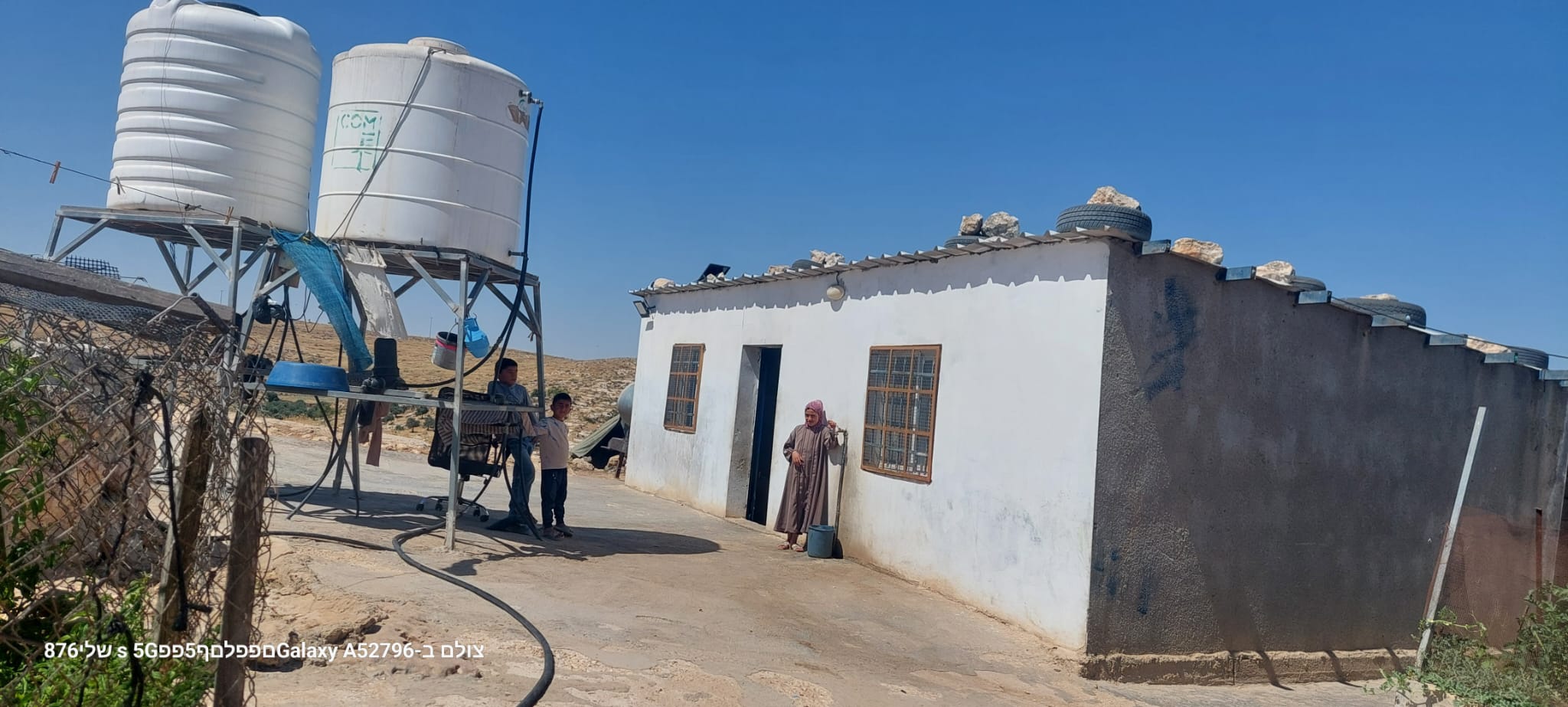 Michal TsadikJun-21-2026Sha'ab al-Butum - the residential complex of the Najjar family
-