
Qalandiya - second Friday of ramadan
Nothing now resembles the Ramadan Fridays of recent years.
This is a different Ramadan month, and not because of the Covid-19 pandemic.
First sight is an illusion, as if there is no one trying to get to pray at the Al Aqsa Mosque.
The sight from the bridge only reinforces this illusion of a void.
It was no easy feat, getting over there, to the front of the refugee camp or what the Israeli army names the “red zone”.
Even Alex, top-commander at the site, who last week approved of my going there, said no-no. Alex said that it’s dangerous for you there today – words of a security guard to me.
I was fortunate and did sneak over there, to mix with the men and women who came from all over the West Bank with Al Aqsa as their destination.
In the background of everything that was happening there, both at the inspection posts and in the encounter of Palestinians and Israeli soldiers and police armed to the teeth, was the flame (Lehava in Hebrew, also name of the ultra-rightist racist Jewish organization) that was ignited and burnt in Jerusalem last night.
All that is going on just strengthens my feeling that the pandemic is only an excuse.
An excuse to block the road, to change criteria, not to enable freedom of worship, an excuse for callousness, for the very thin traffic of those who managed to make their way through and between the armed officials on their way to their destination, and an excuse for the word lawara – Arabic for “back off!” heard over and over again on the PA system.
This time there was no gender preference. Everyone passed or did not pass on the eastern side of the compound. Specifically, today both women and men pass here, answered an officer when I asked about the change of regulations. I did – who did not understand this separation in the past – did not understand this specificity, but perhaps that’s only me. Only holders of blue (Israeli) IDs were allowed to pass to the western side of the compound, leading to Ramallah, although many women were crowding there and waiting, for in the past women of all ages passed here with no inspection.

There appeared to be more people armed with guns than with prayer rugs.
It was a chaos of forces – from soldiers to police to Border Police to DCO officials and even special police forces. They were all standing there to prevent the women from passing through.
One could not ignore the desperate cry of a woman: I want to pray, I want to pray that shafted the air, nor the woman who turned her head up while continuing to murmur a quiet prayer.


נדמה שהיו בשטח יותר חמושים ברובים מחמושים בשטיחי תפילה.
היה בליל של כוחות, החל מחיילים/ות, עבור לשוטרים/ות, לשוטרי/ות מג”ב, נציגי/ות מתק ואפילו איש יס”ם. כולם כולם עמדו איתנים למנוע מהנשים לעבור.
אי אפשר היה להתעלם מקריאת אישה נואשת: I want to pray, I want to pray שפילחה את האוויר ומאישה שנשאה ראשה למרום כשפיה לא חדל מלמלמל תפילה חרישיות.
Qalandiya Checkpoint / Atarot Pass (Jerusalem)
See all reports for this place-
Click here to watch a video from Qalandiya checkpoint up to mid 2019 Three kilometers south of Ramallah, in the heart of Palestinian population. Integrates into "Jerusalem Envelope" as part of Wall that separates between northern suburbs that were annexed to Jerusalem in 1967: Kafr Aqab, Semiramis and Qalandiya, and the villages of Ar-Ram and Bir Nabala, also north of Jerusalem, and the city itself. Some residents of Kafr Aqab, Semiramis and Qalandiya have Jerusalem ID cards. A terminal operated by Israel Police has functioned since early 2006. As of August 2006, northbound pedestrians are not checked. Southbound Palestinians must carry Jerusalem IDs; holders of Palestinian Authority IDs cannot pass without special permits. Vehicular traffic from Ramallah to other West Bank areas runs to the north of Qalandiya. In February 2019, the new facility of the checkpoint was inaugurated aiming to make it like a "border crossing". The bars and barbed wire fences were replaced with walls of perforated metal panels. The check is now performed at multiple stations for face recognition and the transfer of an e-card. The rate of passage has improved and its density has generally decreased, but lack of manpower and malfunctions cause periods of stress. The development and paving of the roads has not yet been completed, the traffic of cars and pedestrians is dangerous, and t the entire vicinity of the checkpoint is filthy. In 2020 a huge pedestrian bridge was built over the vehicle crossing with severe mobility restrictions (steep stairs, long and winding route). The pedestrian access from public transport to the checkpoint from the north (Ramallah direction) is unclear, and there have been cases of people, especially people with disabilities, who accidentally reached the vehicle crossing and were shot by the soldiers at the checkpoint. In the summer of 2021, work began on a new, sunken entrance road from Qalandiya that will lead directly to Road 443 towards Jerusalem and Tel Aviv. At the same time, the runways of the old Atarot airport were demolished and infrastructure was prepared for a large bus terminal. (updated October 2021)
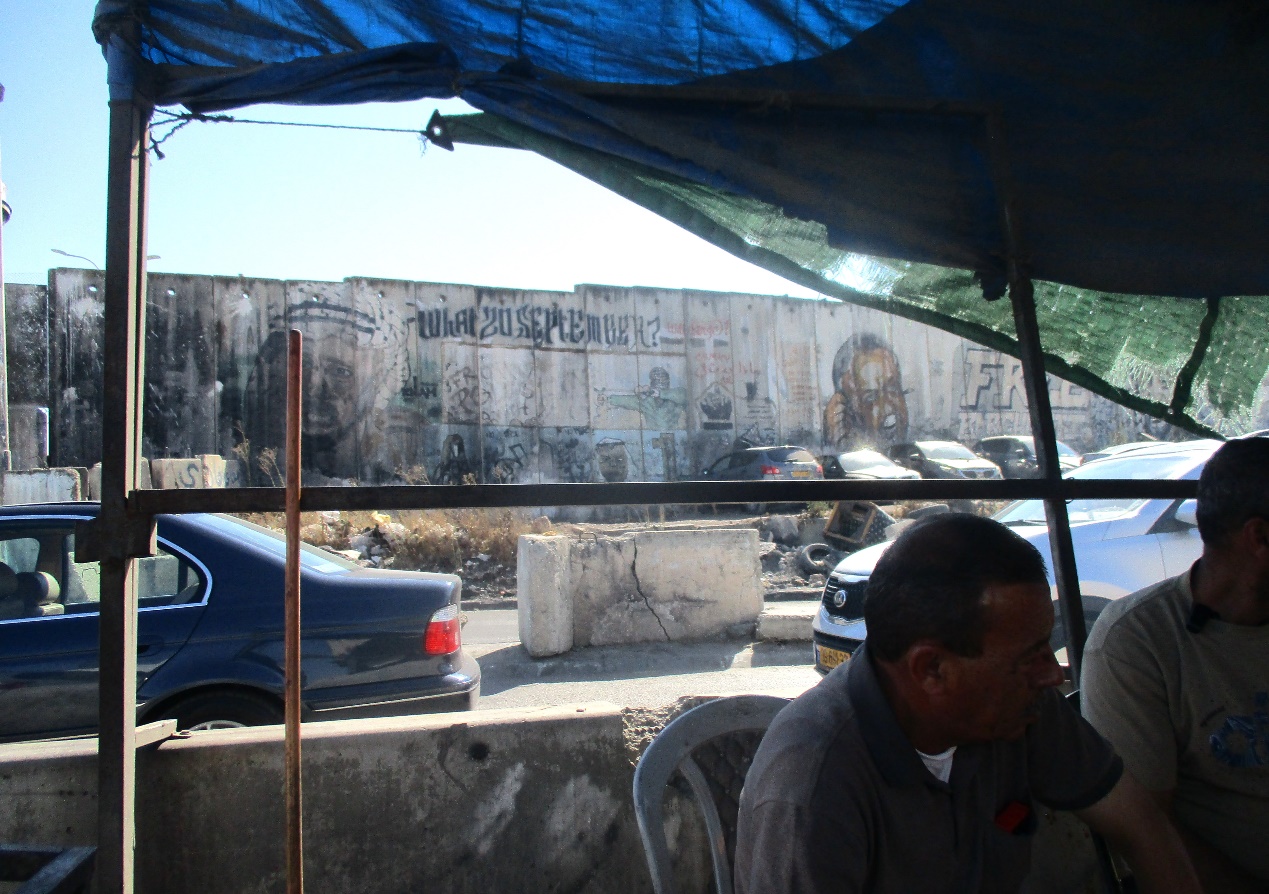 Tamar FleishmanJul-21-2026Qalandiya. Conversation in the shadow of the wall
-
