
East Barta'a junction: The Market disappeared

“The soldiers came and fired 15 bullets! No, no rubber! I swear, live bullets! In my mother!”
15:00 – Junction of East Barta’a
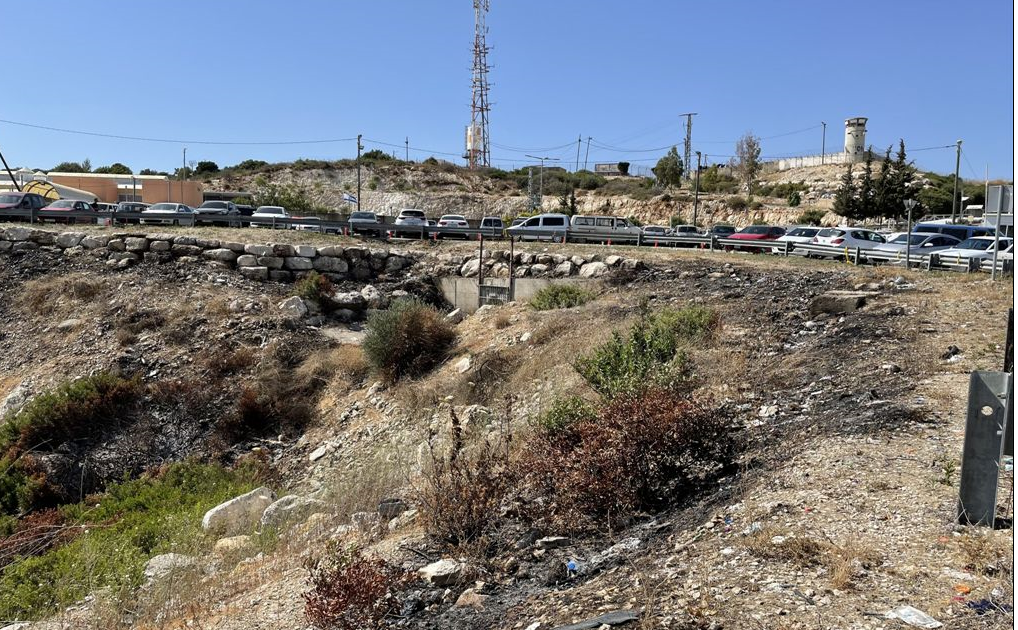
The scenery has changed completely. There isn’t a shred left of the improvised market. In its place, cars are parked on two sides of the road. The transport vehicles also disappeared. It appears that some of the famous breaches in the fence have been sealed. Further down the road, a large group of women with some small children walk on the side of the road in the blazing sun. We tried to find out where they came from. With hand signals, they answered us, “From there.”
We continue to Machsom Barta’a. Workers in groups are already going down the long sleeve (the enclosed passage to the terminal) that twists until the Palestinian parking lot beneath the terminal. A girl of about 10 walks alone down the descent of the sleeve. A sign from el Nave Farm is spread out on a long sheet with an eye-popping inscription: “The People of Israel Lives” and next to it, a flag, of course.
15:10 – Ya’bed-Dotan Checkpoint
The traffic flows with no delays. Drivers honk and wave hello. A soldier who comes down to us from his pillbox is very worried about us and declares immediately that he knows who we are: Five years ago, in the pre-army program at Kibbutz Nahshon, they received a lecture from one of our members. Without a doubt, it was Hagit B. “We remember you, Hagit.”
15:30 – Barta’a-Reihan Checkpoint, The Palestinian Side
The slope under the parking lot that was covered with garbage, is burned. It’s possible that it was burned on purpose. The truck parking lot is empty. They tell us that the Jalama Checkpoint was re-opened today and therefore there is less transportation. For the private transport drivers, there is practically no work, perhaps 4 round trips a day.
16:00 – Tura-Shaked Checkpoint
The observers, a male and female soldier, cross from their permanent position on the raised cement blocks, to the old watch tower. It appears they enjoy being there. We had to call to them in a loud voice so they would pay attention to the cars that waited to cross. Two passengers on their way to the West Bank get out of their cars and are sent to the inspection room with their packages. Another innovation at this checkpoint. The female soldier in the tower calls to us: “Did you hear about the soldier who was stabbed yesterday in Jerusalem”? This was her way of showing her disgust at our presence.
An old acquaintance, C., who is always ready to include us in what is going on in the Occupied Territories, arrives with his brother. They are residents of Araka, which is located just opposite the Shaked Industrial Zone, past the separation fence. How did they pass the difficult days during the operation in Gaza? “Until the soldiers came, it was quiet. Why did they come to Araka, to create havoc”? A boy of 13 from Nezlat Sheikh Zeid, (a village next to Tura Checkpoint) got a bullet in his leg. C.’s father-in-law-in-law, who was also from Nezlat, “a lovely man, a good man,” rode with his son in a jeep to plant in the field. “The soldiers came and shot 15 bullets! No! Not rubber bullets! My Life! My mother!” The father-in-law received two bullets in the leg and one in the shoulder.
Barta’a-Reihan Checkpoint
See all reports for this place-
This checkpoint is located on the Separation Fence route, east of the Palestinian town of East Barta’a. The latter is the largest Palestinian community inside the seam-line zone (Barta’a Enclave) in the northern West Bank. Western Barta’a, inside Israel, is adjacent to it. The Checkpoint is open all week from 5 a.m. to 9 p.m. Since mid-May 2007, the checkpoint has been managed by a civilian security company subordinate to the Ministry of Defense. People permitted to cross through this checkpoint into and from the West Bank are residents of Palestinian communities inside the Barta’a Enclave as well as West Bank Palestinian residents holding transit permit. Jewish settlers from Hermesh and Mevo Dotan cross here without inspection. A large, modern terminal is active here with 8 windows for document inspection and biometric tests (eyes and fingerprints). Usually only one or two of the 8 windows are in operation. Goods, up to medium commercial size, may pass here from the West Bank into the Barta’a Enclave. A permanent registered group of drives who have been approved by the may pass with farm produce. When the administration of the checkpoint was turned over to a civilian security firm, the Ya’abad-Mevo Dotan Junction became a permanent checkpoint. . It is manned by soldiers who sit in the watchtower and come down at random to inspect vehicles and passengers (February 2020).
-
East Barta'a Junction
See all reports for this place-
East Barta'a Junction
The main station at the eastern Barta'a junction (Roads 611/6115).
A junction without special activities became about April 2020 a bustling center of transportation to workplaces in Israel, following the free passage through loopholes in the nearby separation fence.
Palestinian workers from all over the West Bank gather here every morning, without transit permits and often without masks. The army is turning a blind eye and the occupation is losing control.
There is also no shortage of coffee and pastry stalls.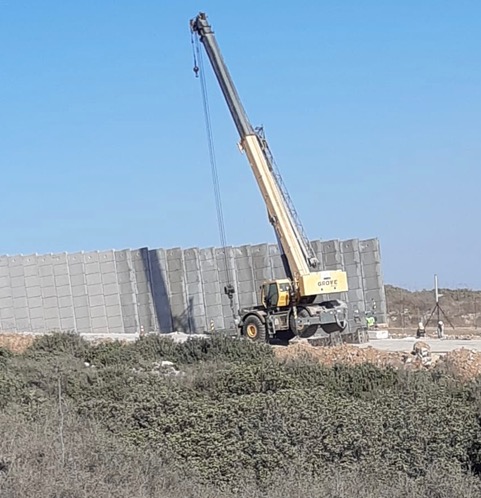 Hagar DrorSep-26-2023Barta'a: rapid construction of the separation fence
-
Tura-Shaked
See all reports for this place-
Tura-Shaked
This is a fabric of life* checkpoint through which pedestrians, cabs and private cars (since 2008) pass to and from the West Bank and the Seam-line Zone to and from the industrical zone near the settler-colony Shaked, schools and kindergartens, and Jenin university campuses. The checkpoint is located between Tura village inside the West Bank and the village of Dahar Al Malah inside the enclave of the Seam-line Zone. It is opened twice a day, between 7 a.m. and 10 a.m., and from 12 noon to 7 p.m. People crossing it (at times even kindergarten children) are inspected in a bungalow with a magnometer. Names of those allowed to cross it appear in a list held by the soldiers. Usually traffic here is scant.
- fabric of life roads and checkpoints, as defined by the Terminals Authority in the Ministry of Defense (fabric of life is a laundered name that does not actually describe any kind of humanitarian purpose) are intended for Palestinians only. These roads and checkpoints have been built on lands appropriated from their Palestinian owners, including tunnels, bypass roads, and tracks passing under bridges. Thus traffic can flow between the West Bank and its separated parts that are not in any kind of territorial contiguity with it. Mostly there are no permanent checkpoint on these roads but rather ‘flying’ checkpoints, check-posts or surprise barriers. At Toura, a small (less than one dunam) and sleepy checkpoint has been established, which has filled up with the years with nearly .every means of supervision and surveillance that the Israeli military occupation has produced. (February 2020)
 Mar-21-2022Anin Checkpoint: A magnificent breach in the center of the checkpoint
-
Ya'bed-Dotan
See all reports for this place-
Ya’bed-Dotan
This checkpoint is located on road 585, at the crossroads of Mevo Dotan settler-colony / Jenin/ Ya’abad. It has an army watchtower (‘pillbox’ post) and concrete blocs that slow down vehicular traffic. It was erected when Barta’a Checkpoint, lying to the west on the Separation Fence, was privatized and its operation was passed over to civilian security personnel. Since December 2009 this checkpoint enables flow of Palestinian vehicular traffic towards the Barta’a Checkpoint. Seldom is it manned by soldiers sitting in the watchtower, who conduct random inspections of vehicles and passengers. (february 2020)
-
