
Falamiya CP - the fence is broken and the way is free

One of the purposes of this shift was to acquaint our guest with the agricultural checkpoints and with life in the villages of the West Bank. We passed by way of the Eliyahu Checkpoint with explanations about the separation fence and the seamline zone.
At Azzun we were hosted in O.’s new flat. We met his wife and two of his sons. We then continued to Kafr Jimal. We stopped at Z.’s grocery for a conversation about the situation. He would very much like to tour Israel a bit, but following the warfare at Gaza the age of those allowed to enter Israel without a permit has been raised to 60.
We arrived at Falamiya North Checkpoint (914) at nearly 13:30. A considerable number of private cars were parked there. At the pump garden we talked with the workers who said that the gate was supposed to be opened at 13:30 but that lately the soldiers were often late. Sometimes they arrived in the morning instead of at 06:00 or 06:30, at 08:00. But this does not detain the farmers as the road is breached. Indeed, when we approached the checkpoint we saw that parts of the fence, to the right and to the left, in all three fences, were missing. The way was open even for tractors.
After waiting some time without seeing any Palestinians approaching the checkpoint, we left because of timetable compulsions, and thus didn’t wait for the soldiers.
We continued to the Jayyus North Checkpoint (935) in order to show the guest the beautifully tended plots in the area which had been returned, after the fence had been moved to the west following a high court of justice order. We returned by way of the system road and Jiyus. There we stopped to buy fruit from a man who told us in fluent Hebrew that in the past he had worked in Israel, in building. By the car we were asked by passers-by whether we had come to meet N.
At the Habla Checkpoint (1393) we arrived after its closure, which did not prevent a group of about six young men to pass to the other side by way of openings in the fences. We finished with a conversation and coffee at A. who explained to the visitor the situation in the area.
'Azzun
See all reports for this place-
Azoun (updated February 2019)
A Palestinian town situated in Area B (under civil Palestinian control and Israeli security control),
on road 5 between Nablus and Qalqiliya, east of Nabi Elias village. The inhabitants are allowed to construct and improve infrastructures. The Separation Fence has confiscated lands belonging to the town's people. In 2018 olive tree groves owned by one of its inhabitants were confiscated for the sake of paving a road to bypass Nabi Elias. Azoun population numbers 13,000, its economic state dire. Its infrastructures are poor, neglect and poverty rampant. In the meantime, the town council has completed paving an internal road for the inhabitants' welfare.
Because of its proximity to the Jewish settler-colony of Karnei Shomron and its outposts, the town suffers the intense presence of the Israeli army, especially at nighttime: soldiers enter homes, arrest suspects, trash the house and sometimes ruin it, as they do in numerous places in the West Bank. At times a checkpoint closes the entrance to the town, so no one can come in or get out.
-
Falamiya North (914)
See all reports for this place-
Falamiya North (914) Opens 3 times a day for about 40 minutes each time. This checkpoint has extremely important for all farmers in the area since the previous, Falamya checkpoint opening routine of continuously open for 12 hours has been discontinued. This took place after the separation fence was moved westward following the High Court of Justice.
-
Habla CP (1393)
See all reports for this place-
Habla CP (1393)
The Habla checkpoint (1393) was established on the lands of the residents of Qalqilya, on the short road that
connected it for centuries to the nearby town of Habla. The separation barrier intersects this road twice and cut off the residents of Qalqilya from their lands in the seam zone.(between the fence and the green line).
There is a passage under Road 55 that connects Qalqilya to the sabotage This agricultural barrier is used by the farmers and nursery owners established along Road 55 from the Green Line and on both sides of the kurkar road leading to the checkpoint.
This agricultural checkpoint serves the residents of Arab a-Ramadin al-Janoubi (detached from the West Bank), who pass through it to the West Bank and back to their homes. The opening hours (3 times a day) of this agricultural checkpoint are longer than usual, about an hour (recently shortened to 45 minutes), and are coordinated with the transportation hours of a-Ramadin children studying in the occupied in the West Bank.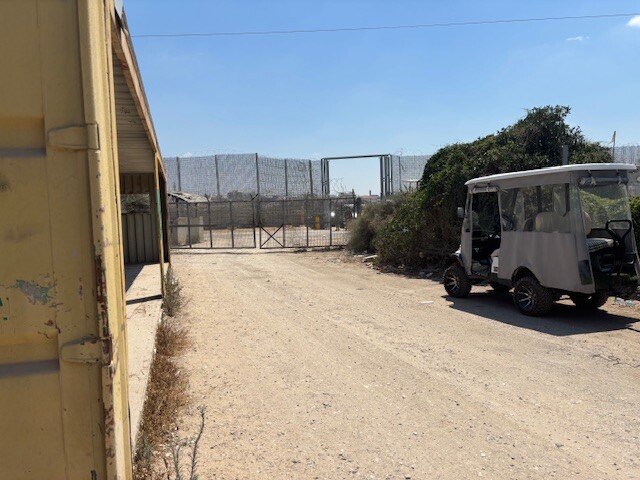 Nina SebaAug-18-2025Habla: The gate is in the process of closing
-