
Qalandiya - A pedestrian bridge that is difficult to cross
We arrived at the pedestrian checkpoint at 6:00, left at 7:00, and in between everything proceeded smoothly without incident. Two men approached us during the shift. One asked, “Where is Sylvia?” because he wanted to thank her, personally, for the help that her team extended to his wife, a year ago, by having her removed from the blacklist of people prevented from receiving a permit to enter Israel. We told him we would convey his thanks. The second man had a painful complaint about the pedestrian bridge built at Qalandiya and the means of accessing it. The bridge—which is the only way to reach and leave the pedestrian checkpoint is truly a Via Dolorosa for older people. He said that he has been phoning and sending letters to anyone capable of hearing or reading to explain the difficulties it creates, to no avail. So he asked us to describe the problem through our channel, in the hope of reaching those responsible for the checkpoint and the world at large.
First the description: the bridge extends over the area of the vehicle checkpoint where cars and trucks are checked. Its purpose is apparently to keep pedestrians from crossing the road there on their way to the building containing the pedestrian checkpoint. It also keeps pedestrians far from the soldiers who are carrying out the vehicle checks, as in the past unfortunate, including lethal, incidents occurred stemming from the possibility of approaching the soldiers. A pedestrian approaching the checkpoint from the south (East Jerusalem via Beit Hanina), has no way of entering it except to cross the bridge. The same is true for pedestrians coming from the north (the direction of Kafr Aqeb and Ramallah), who have been checked inside the pedestrian checkpoint before continuing on to East Jerusalem. Upon exiting this building, they have no choice but to cross the bridge to reach the area of the buses and taxis on the opposite side of the road. Also at that exit point is a locked gate. We have never seen it open and do not know what use it serves, though were it open it could serve as an alternate route for workers who are being picked up by their employers on the road south into East Jerusalem.
So what’s the problem? Essentially: older people, like the man who addressed us. The bridge is about two stories high. And the climb up is not easy, particularly because the steps are rather narrow for people moving in both directions, the younger and faster ones also attempting to pass the older and slower ones. There is also a ramp up to the bridge, wider than the steps, but you truly wouldn’t want to be the one accompanying an elderly man or woman up this ramp or, heaven forbid, pushing a wheelchair.
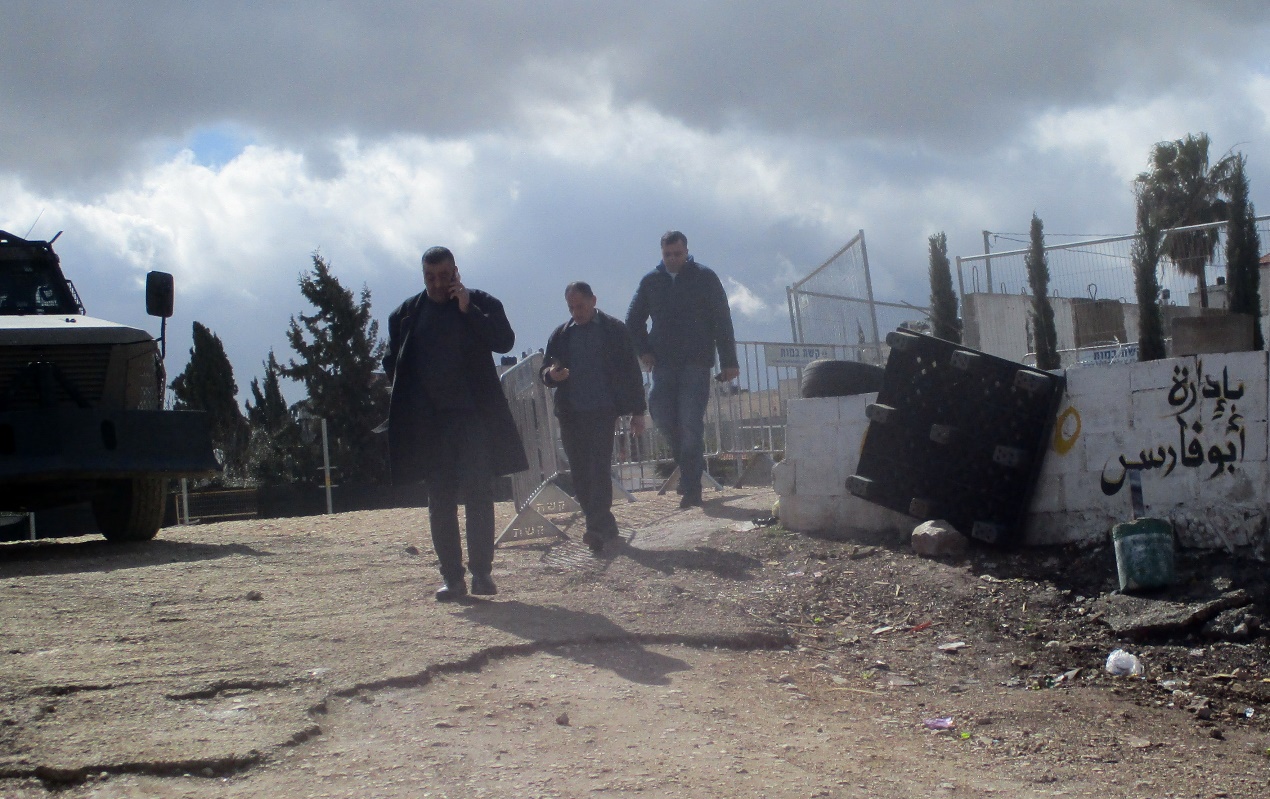
What’s more, anyone approaching the bridge on foot from the south, in order to reach the steps and the ramp, must negotiate a dirt field peppered with small stones that poke up through the ground and virtually invite being tripped on. Recently, this journey through the field has even been extended by blocking off a more convenient entrance to it. In short, whoever designed the bridge was apparently thinking less about serving people, especially older people, than about serving the occupation. One wonders whether anyone will address these difficulties.
Qalandiya Checkpoint / Atarot Pass (Jerusalem)
See all reports for this place-
Click here to watch a video from Qalandiya checkpoint up to mid 2019 Three kilometers south of Ramallah, in the heart of Palestinian population. Integrates into "Jerusalem Envelope" as part of Wall that separates between northern suburbs that were annexed to Jerusalem in 1967: Kafr Aqab, Semiramis and Qalandiya, and the villages of Ar-Ram and Bir Nabala, also north of Jerusalem, and the city itself. Some residents of Kafr Aqab, Semiramis and Qalandiya have Jerusalem ID cards. A terminal operated by Israel Police has functioned since early 2006. As of August 2006, northbound pedestrians are not checked. Southbound Palestinians must carry Jerusalem IDs; holders of Palestinian Authority IDs cannot pass without special permits. Vehicular traffic from Ramallah to other West Bank areas runs to the north of Qalandiya. In February 2019, the new facility of the checkpoint was inaugurated aiming to make it like a "border crossing". The bars and barbed wire fences were replaced with walls of perforated metal panels. The check is now performed at multiple stations for face recognition and the transfer of an e-card. The rate of passage has improved and its density has generally decreased, but lack of manpower and malfunctions cause periods of stress. The development and paving of the roads has not yet been completed, the traffic of cars and pedestrians is dangerous, and t the entire vicinity of the checkpoint is filthy. In 2020 a huge pedestrian bridge was built over the vehicle crossing with severe mobility restrictions (steep stairs, long and winding route). The pedestrian access from public transport to the checkpoint from the north (Ramallah direction) is unclear, and there have been cases of people, especially people with disabilities, who accidentally reached the vehicle crossing and were shot by the soldiers at the checkpoint. In the summer of 2021, work began on a new, sunken entrance road from Qalandiya that will lead directly to Road 443 towards Jerusalem and Tel Aviv. At the same time, the runways of the old Atarot airport were demolished and infrastructure was prepared for a large bus terminal. (updated October 2021)
 Tamar FleishmanFeb-27-2026Qalandiya: On the way to prayer
-