
Only one parched Olive tree at the Olive Checkpoint


Sheikh Sa’ad checkpoint
Female Medical students await their friend while passengers trickle at the checkpoint in both directions. There were no school kids today, but according to those we speak with – on weekday mornings there is a high density of passagers. Today there really are not many passers-by, which is why 4 Border Police soldiers probably allow themselves to gather outside, smoke and chatter. One remains inside, passing those waiting one by one, pausing in between. Customer service awareness in the checkpoint is not the highest!
The American Road to Silwan
The old American road was renovated and widened to a point just before turning into Silwan. And what next? All the narrow, congested and arduous ascent to the Mount of Olives? The pretzel seller at the intersection and his friends tell us that the houses further down the road (rising to Ras al-Amud) recieved demolition notices due to the widening of the road. They say they want to build a big bridge to the Mount of Olives. We contacted Nir Hasson and “Bimkom” with questions, and we will update later. In Silwan a quiet morning. In Batan al-Hawa they’re awaiting the outcome of the trials and the expected demolition orders. How can one live like this? Our young driver says that until the age of 7 he grew up in Silwan and he misses the neighborhood. He now lives in the Shuafat refugee camp, where criminal organizations are fighting each other over drug territories and there are no active police.
The Olive Barrier
At the intersection between a-Tour and the road ascending to the checkpoint, there is a jeep and next to it a policeman and a female Border Police officer, who check a young person’s ID with her tablet. (We’ve already mentioned that the culture of policewomen at the various checkpoints – insults our feminism). Why check here? We ask, the barrier is right up there. The answer is zealously uttered: “We maintain order throughout Jerusalem.” On the Palestinian side of Azaria, to which we pass at the checkpoint, the drivers say that the work is good in the morning, that many people have passed, and that their side doesn’t have Corona at all … nor is there a real queue. In the checkpoint stand three soldiers with the surprised and suspicious look of “What are you doing here?”. Really insulting that we are not mentioned at their job briefings …
Shuafat refugee camp checkpoint
Today as usual there is a traffic jam on the way to the checkpoint. One of the lanes is blocked by a bus whose passengers have been taken off until their ID checks are completed. As we go to speak with the passengers the security guards jump into high alert and stop the traffic altogether. We give up and go to the pedestrian crossing. The filth here is appalling, both inside and out. Today’s checkup includes both magnetometer and a manual bag check by the checkpoint commander and a female Border Police assistant. A personal example, he explains to us. We comment on the neglect and dirt at the checkpoint and he says it will be taken care of. Next time we’ll start at this checkpoint at 6:30.
Sheikh Jarrah
I called the father of the girl who was hit in the back by a stun grenade that penetrated her house through the window about two months ago. We tried to make an appointment with the girl, ask how she was and get an impression of what was happening in the neighborhood now. The father asked us to call in the morning and gave the wrong phone number of the Sheikh Jarrah’s committee chairman. This morning his phone is off and we didn’t want to barge in uninvited. But at least we saw that there are no barriers in Sheikh Sa’ad at all. That is, there are police fences on the side, but all the entrances and exits are wide open. Netanya, the tireless protester, could not believe her eyes. All aflutter, she called an acquaintance, who explained that fences are only placed now during demonstrations. We intend to return to Sheikh Jarrah.
Checkpoint Shu'afat camp / Anata-Shu'afat (Jerusalem)
See all reports for this place-
The Shu’afat checkpoint is located in the northern part of East Jerusalem at the exit from the village of Anata and the Shu’afat refugee camp, which are located in the area annexed to Jerusalem in 1967. The refugee camp borders the Shu’afat neighborhood to the west, Pisgat Ze’ev to the north, the French Hill neighborhood to the south and the planned expansion of Ma’aleh Adumim to E-1 in the east. It was established in 1966 for 1948 refugees from the West Bank and was populated after the Six Day War by persons who had been expelled from the Jewish Quarter. Today its population comprises some 25,000 people holding blue ID cards and some 15,000 people with Palestinian ID cards. The camp lacks adequate infrastructure and services, and suffers from poverty, neglect and overcrowding. All its buildings are connected to the public electricity and water infrastructure, but not all are connected to the sewer system. The camp’s services are provided by UNRWA, except for those such as health clinics and transportation of pupils to schools in Jerusalem. In 2005, the Israeli High Court of Justice rejected a suit by the residents requesting that the route of the separation fence be drawn such that the camp would remain on the Israeli side, but conditioned its approval of the route on the establishment of a convenient and rapid crossing facility for the inhabitants of the neighborhood, most of whom are residents of Jerusalem.
A temporary checkpoint operated there until December, 2011. It was extremely congested during rush hours, and dangerous for pedestrians (especially children) because of inadequate safety provisions. The new checkpoint was inaugurated south of the old one, for public and private transportation and for pedestrians, intended solely for the residents of the camp – holders of blue ID cards, and those with Palestinian ID cards who possess appropriate permits. There are five vehicle inspection stations at the checkpoint, and two for pedestrians (one of which is currently closed) where scanners have been installed but are not yet operating. According to the army, representatives of government agencies will also be present to provide services to residents of the neighbourhood. The pedestrian lanes are very long, located far from the small parking lots, and accessible through only a single revolving gate.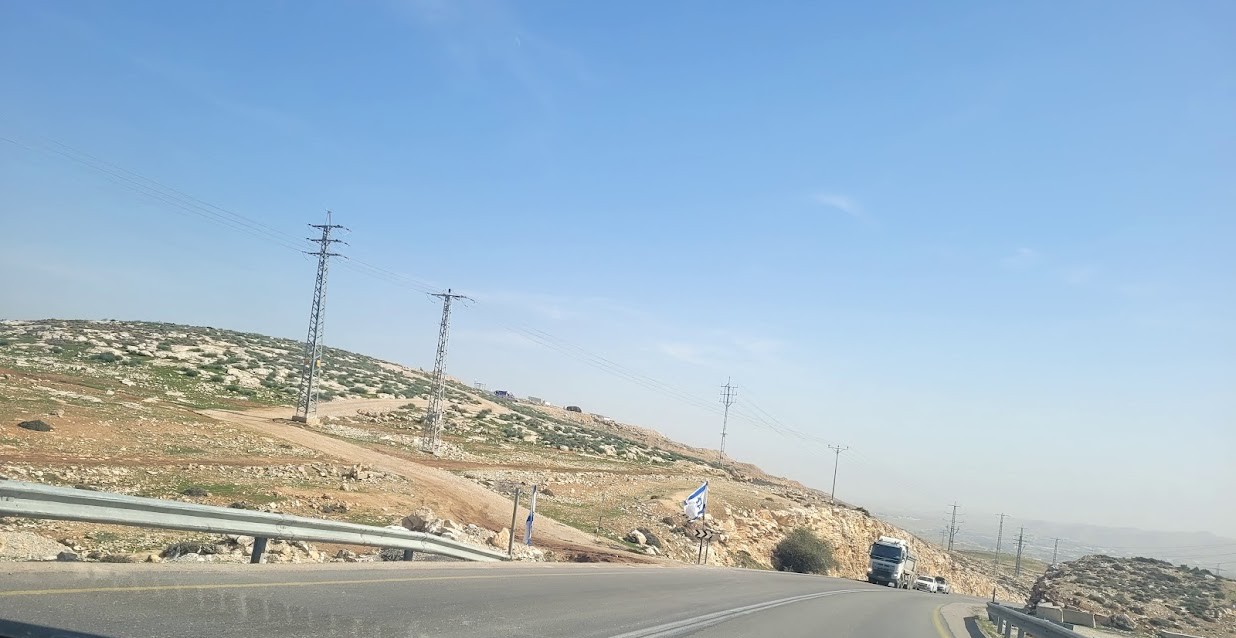 Anat TuegJan-25-2026Anata: A new outpost has been built south of the junction
-
Ras Abu Sbitan (Olive Terminal)
See all reports for this place-
A large checkpoint/crossing to the area of a-Tur, Abu Dis and the Old City; only for pedestrians. Located on Jerusalem’s municipal boundary.
One of the major crossings in Jerusalem’s central sector. It is located on the separation fence between the northern portion of the al-Ezariya neighborhood and the neighborhood of a-Tur and the rest of East Jerusalem. It is manned by Border Police soldiers and private security companies and operates 24 hours a day. Palestinians are forbidden to go through, other than permanent residents of East Jerusalem (holders of blue ID cards) and holders of work and commercial permits who are allowed through only on foot.
-
Sheikh Sa'ed
See all reports for this place-
A checkpoint limited to pedestrians, located on Jerusalem’s municipal boundary.
The checkpoint sits on the separation fence at the entrance to Sheikh Sa’ad, dividing it from its neighbourhood of Jabel Mukkabar. It’s manned by Border Police soldiers and private security companies and operates 24 hours a day. Palestinians are forbidden to go through, other than residents of Jabel Mukkabar or Sheikh Sa'ad who have permits. Both groups are permitted through only on foot. Residents of East Jerusalem who don’t live in Jabel Mukkabar are also allowed to cross to Sheikh Sa’ad, but not in the opposite direction; they must return through the Sawahira ash Sharqiya checkpoint.
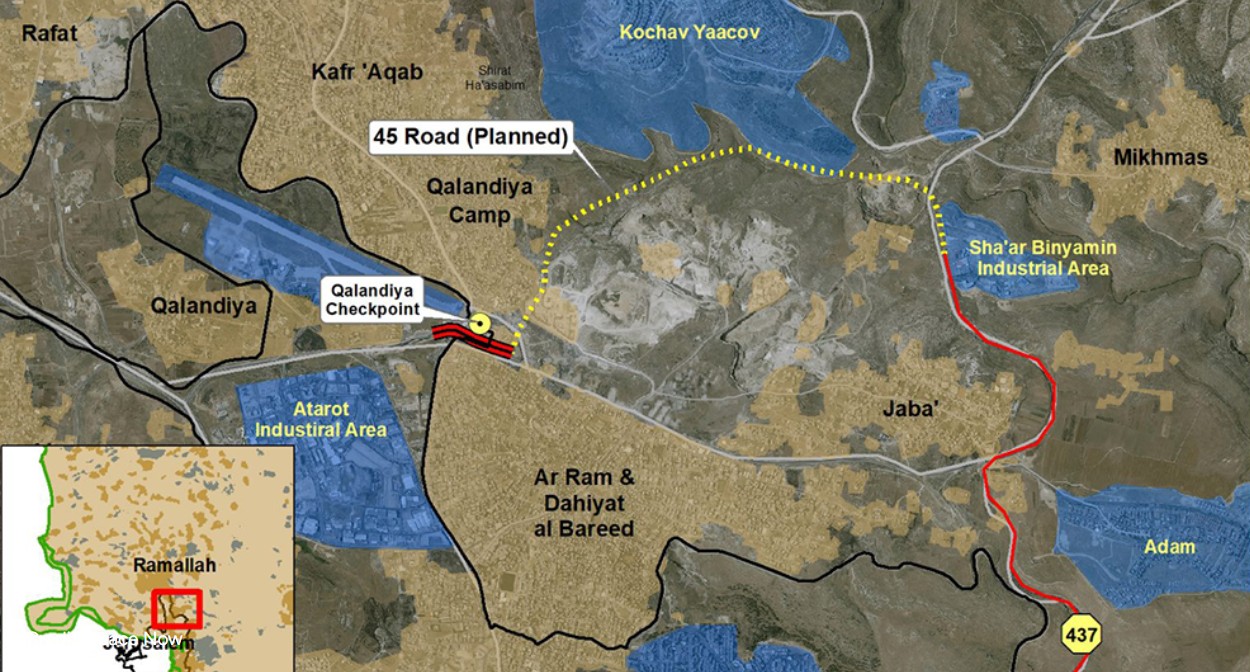 Anat TuegSep-9-2026Road 45. For Israelis only, from Road 60 near Kochav Ya'akov to the Qalandiya underpass
-
