
Qalandiya - Men were blocked even though they had a permit
When we arrived separately at the checkpoint around 6:00, we discovered that (in part due to the roadworks) there was no place to park on the Israeli side. The pay-for-parking lot we have been using for the past year or so is no longer allowed to accept cars, only trucks. Therefore I drove through the checkpoint to the Palestinian side and kept going until another parking lot came into view. The problem was that the drive up to it, on an unpaved path, is so steep that I was wary of trying (it was already raining) until one of the lot’s attendants spotted me and encouraged me on until I reached the top. I then called Virginia, told her where I’d be standing, waited by the side of the road until she found me, and we took that menacing path up together. Once there, however, we were told of a less daunting (lower) exit from the lot. The problem remained that at the end of the shift, in order to return, we either had to join the end of the traffic jam of cars and trucks waiting to drive through the vehicle checkpoint or take the roundabout road to the Hizmeh checkpoint, which is also crowded. We left at 7:00. It took me an hour to reach the exit from Route 60 at French Hill (and another hour home from there). Virginia faces a day’s work in her office after she leaves Qalandiya. This situation is problematic, to say the least.
The flow of people into the pedestrian checkpoint was quick and smooth throughout the time we stood there. But close to the end of the shift we were approached by a group of men who complained that although they had had no problem passing through the checkpoint yesterday, today they were blocked at the final stage of the process (scanning their entry permits). The soldiers in the security-check hall could not provide any explanation. A few of the men showed us their documents, including their vaccination certificates, which seemed to be in order. We recommended that they wait until 8:00 and then go to the DCO (which is in charge of issuing permits) to ask what the problem is. We also took the phone number of the man who volunteered to represent the group and told him that we would try to clarify if there had been any change in the Covid rules as a result of discovering the Omicron variant in the country and, if so, would be in touch with them.
When the representative called to report that the men had received no explanation or solution to their problem from the DCO, I consulted with Hanna B. and Sylvia and sent him the phone numbers for contacting Sylvia’s team together with Sylvia’s instructions (in Hebrew) to send it various documents via WhatsApp, so that our women could investigate the issue. Afterward, with the aid of a translation by one of Sylvia’s contacts, I was also able to send the phone numbers and instructions in Arabic both as text and a voice message. Since then any number of stressed-out people have called me asking for help, but I tell them they are better off talking to their representative, who has important information and can relay it in Arabic. We only hope some solution can be found soon.
Qalandiya Checkpoint / Atarot Pass (Jerusalem)
See all reports for this place-
Click here to watch a video from Qalandiya checkpoint up to mid 2019 Three kilometers south of Ramallah, in the heart of Palestinian population. Integrates into "Jerusalem Envelope" as part of Wall that separates between northern suburbs that were annexed to Jerusalem in 1967: Kafr Aqab, Semiramis and Qalandiya, and the villages of Ar-Ram and Bir Nabala, also north of Jerusalem, and the city itself. Some residents of Kafr Aqab, Semiramis and Qalandiya have Jerusalem ID cards. A terminal operated by Israel Police has functioned since early 2006. As of August 2006, northbound pedestrians are not checked. Southbound Palestinians must carry Jerusalem IDs; holders of Palestinian Authority IDs cannot pass without special permits. Vehicular traffic from Ramallah to other West Bank areas runs to the north of Qalandiya. In February 2019, the new facility of the checkpoint was inaugurated aiming to make it like a "border crossing". The bars and barbed wire fences were replaced with walls of perforated metal panels. The check is now performed at multiple stations for face recognition and the transfer of an e-card. The rate of passage has improved and its density has generally decreased, but lack of manpower and malfunctions cause periods of stress. The development and paving of the roads has not yet been completed, the traffic of cars and pedestrians is dangerous, and t the entire vicinity of the checkpoint is filthy. In 2020 a huge pedestrian bridge was built over the vehicle crossing with severe mobility restrictions (steep stairs, long and winding route). The pedestrian access from public transport to the checkpoint from the north (Ramallah direction) is unclear, and there have been cases of people, especially people with disabilities, who accidentally reached the vehicle crossing and were shot by the soldiers at the checkpoint. In the summer of 2021, work began on a new, sunken entrance road from Qalandiya that will lead directly to Road 443 towards Jerusalem and Tel Aviv. At the same time, the runways of the old Atarot airport were demolished and infrastructure was prepared for a large bus terminal. (updated October 2021)
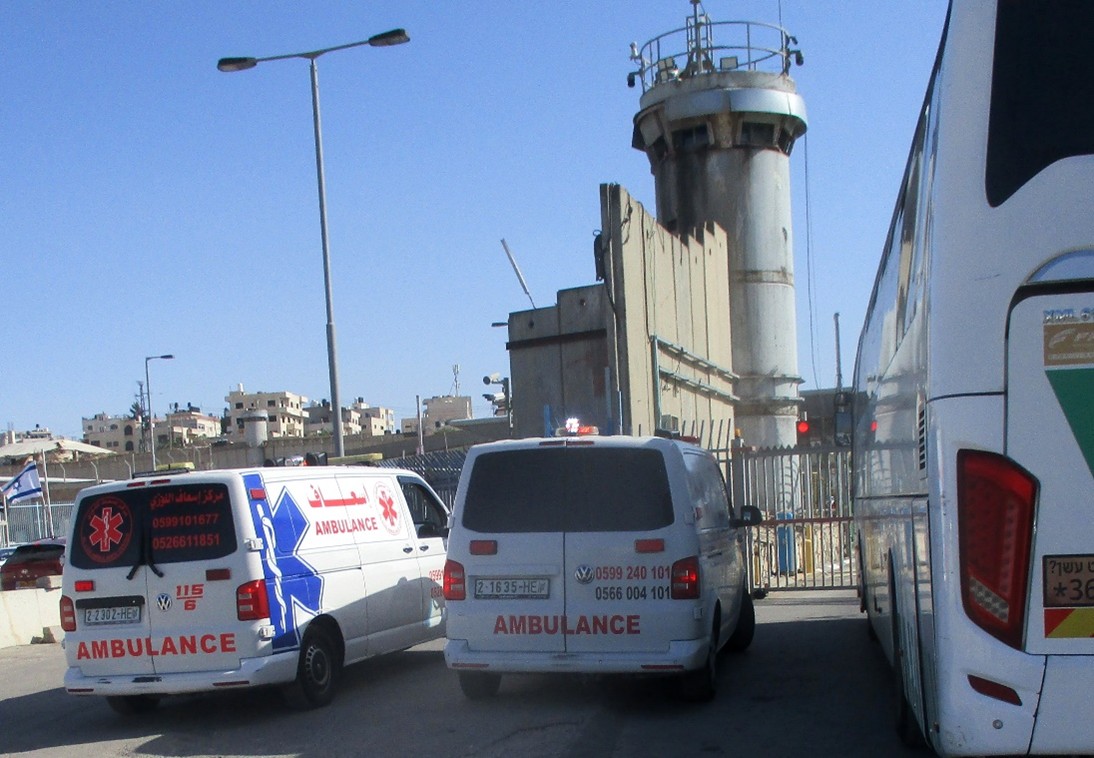 Tamar FleishmanMay-11-2026Qalandiya. Ambulances wait in front of a closed checkpoint
-