
Qalandiya - Friday Shift
Friday Shift
Following the recommendation of a Palestinian friend we went to the Qalandiya Checkpoint on a Friday and at 9:00 a.m. rather than 6:00 a.m. because Friday is the Palestinian day of rest and people are therefore transiting the checkpoint at a later hour in order to visit family, pray at the Al-Aqsa Mosque, go shopping, and the like. When we arrived just after 9:00, the parking area on the Palestinian side of the checkpoint was already much fuller than it had been the last time we were there, at 6:00 on a standard workday, when there is a strong flow of workers through the checkpoint.
Upon reaching the checkpoint building itself, we immediately saw that only one of the three entrances to the building was open, despite a steady flow of people arriving to pass through it. After about 10 minutes, when we saw that the “slalom” (the wavy, narrow route that leads from the open porch to the entrance to the building) was beginning to fill up, we got as close as we could to the turnstile at the end of the route, leading into the building itself, to see what was going in in the relatively small “waiting room” from which one finally enters the hall of the security check. And what we saw dismayed us: The room was almost entirely full of people—all but crushed together like sardines—at the height of the Omicron epidemic! Since the turnstile through which people enter the waiting room is controlled by soldiers who can see the situation there and regulate entrance to it, we could not fathom the logic behind the decision to allow it to become so unconscionably crowded.
Consequently, we decided not to insert ourselves into this health-threatening situation and, rather than go through the security check (for the sake of thoroughness) we returned to the parking lot on the Palestinian side. It was already after 10:00 and the lot was almost entirely full so that any West Bank Palestinian who intended to reach the checkpoint by car, park it (because cars with Palestinian licenses cannot enter Israel), cross through the pedestrian checkpoint (with an entry permit), and continue on to East Jerusalem by bus or taxi—let’s say for noontime prayers at Al-Aqsa—would have great difficulty finding a spot to park anywhere around the checkpoint.
Instead, we took the roundabout road to the Hizme Checkpoint (for Israeli vehicles only) to Pisgat Ze’ev, the Israeli neighborhood closest to Qalandiya, to look for a spot to park on the way to our usual, early-morning shift. From there we would take a taxi to the checkpoint and back, due to the sore lack of parking spots on the Israeli side of the checkpoint and the exasperating traffic jams on the only ways back to East Jerusalem at the time our early-morning shift usually ends: through Qalandiya’s vehicle checkpoint and on the road to the Hizme Checkpoint.
Qalandiya Checkpoint / Atarot Pass (Jerusalem)
See all reports for this place-
Click here to watch a video from Qalandiya checkpoint up to mid 2019 Three kilometers south of Ramallah, in the heart of Palestinian population. Integrates into "Jerusalem Envelope" as part of Wall that separates between northern suburbs that were annexed to Jerusalem in 1967: Kafr Aqab, Semiramis and Qalandiya, and the villages of Ar-Ram and Bir Nabala, also north of Jerusalem, and the city itself. Some residents of Kafr Aqab, Semiramis and Qalandiya have Jerusalem ID cards. A terminal operated by Israel Police has functioned since early 2006. As of August 2006, northbound pedestrians are not checked. Southbound Palestinians must carry Jerusalem IDs; holders of Palestinian Authority IDs cannot pass without special permits. Vehicular traffic from Ramallah to other West Bank areas runs to the north of Qalandiya. In February 2019, the new facility of the checkpoint was inaugurated aiming to make it like a "border crossing". The bars and barbed wire fences were replaced with walls of perforated metal panels. The check is now performed at multiple stations for face recognition and the transfer of an e-card. The rate of passage has improved and its density has generally decreased, but lack of manpower and malfunctions cause periods of stress. The development and paving of the roads has not yet been completed, the traffic of cars and pedestrians is dangerous, and t the entire vicinity of the checkpoint is filthy. In 2020 a huge pedestrian bridge was built over the vehicle crossing with severe mobility restrictions (steep stairs, long and winding route). The pedestrian access from public transport to the checkpoint from the north (Ramallah direction) is unclear, and there have been cases of people, especially people with disabilities, who accidentally reached the vehicle crossing and were shot by the soldiers at the checkpoint. In the summer of 2021, work began on a new, sunken entrance road from Qalandiya that will lead directly to Road 443 towards Jerusalem and Tel Aviv. At the same time, the runways of the old Atarot airport were demolished and infrastructure was prepared for a large bus terminal. (updated October 2021)
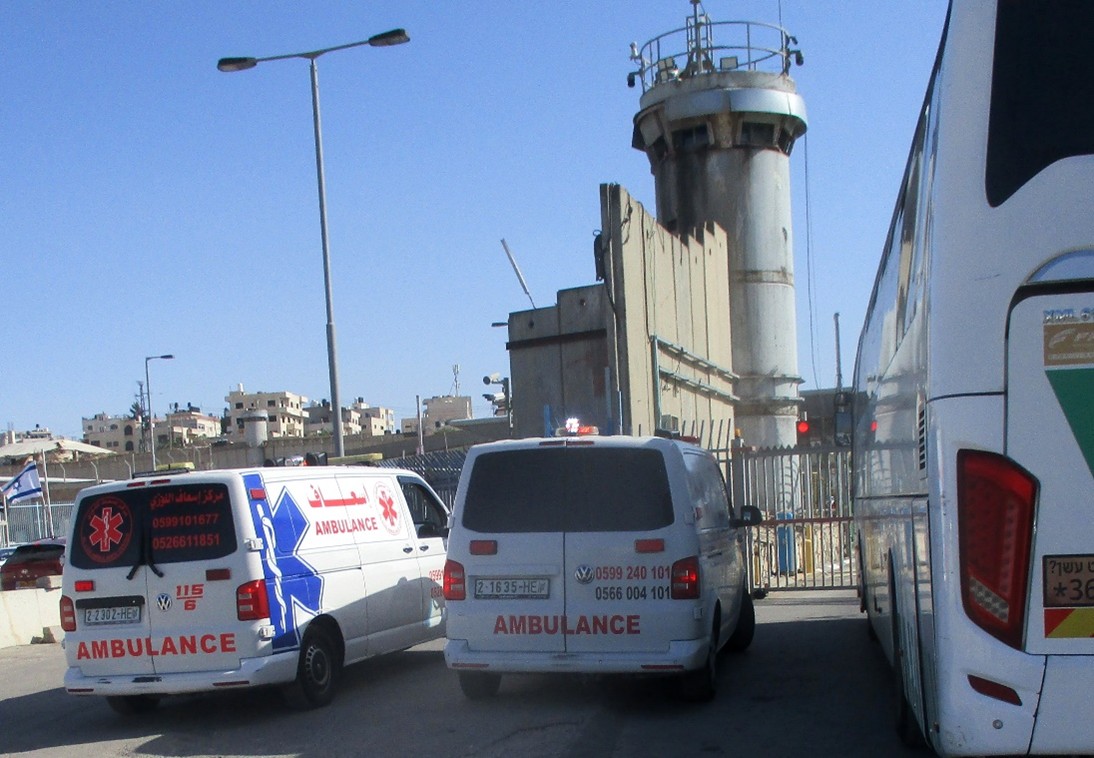 Tamar FleishmanMay-11-2026Qalandiya. Ambulances wait in front of a closed checkpoint
-