
Fassail, Jodan valley


We first took Maryam (already half-blind) to Jericho to receive injections in her eyes. Since we came early, we drove to meet Guy Hircsfeld who was accompanying Palestinian shepherds around Al Auja, defending them from the harassing colonist Omer Atidiya and his pals from the colonist outpost Mevo’ot Yericho. The green hills were spotted with the flocks of Bedouins living there for decades, ever since they were expelled from the Negev, and only the massive Jewish construction, Jewish olive groves, and restaurants wound this pastoral landscape.
We entered the city of Jericho from the east, a side unknown to us, so we needed driving instructions and received them from the local inhabitants – complete with a glad, inviting smile.
Unfortunately, because of her illness, Maryam will need more injections although her condition has greatly improved. It is heart-rending to see her enter the clinic confidently, and exit hurting, groping her way in total blindness, as she was when I first met her when the Israeli army demolished her home. After an hour and some aspirin, she felt better.
In Fasail the Civil Administration (the Israeli army’s arm in charge of hurting civil Palestinian society) demolished a structure 8 days earlier, and took the opportunity cut (with or without intention, during the demolition) the thin pipes that provide some water (once every 4 days!) to 7 families, including the families of Maryam, Tahreer, and Hajar – our acquaintances. 7 families left with not a drop of water. (Note how thin the pipes are in the photos that provide water to families of over10 persons each, unlike the thousands of cub. m. of water provided to the nearby colonies).
We drove on to the area east of Fasail – a firing zone that used to be the Palestinians’ grazing ground. A few months the shepherds complained that they have no more room to graze, for the colonist from the outpost on the hills (“Angels of Peace…”) arrives with their own cattle and sheep flocks and chases them away with armed threats or by summoning the army that chases away the Palestinians with its claim of a ‘firing zone’. In the past, the Palestinians would graze there although the entire vast area is a firing zone, as the army accepted this, or simply turned a blind eye. Only when it wished to hold maneuvers there (rarely) did it notify them and they then abstained from coming. Now the colonist says – “The whole area, from Ma’ale Efrayim to Al Auja – is mine!” (Which is of course absolute nonsense, but what can the shepherds do?). Today we saw many Palestinian flocks on the slopes, and not the colonist, but there are many signs of his presence, and we have seen him, his ATV, and his horses and cattle in the area many times in the past.
We did see that the Tomer colony has taken over the additional ground, fenced it in with barbed wire, and behind the fence is preparing a huge area for expansion. Later we passed by the Fatza’el colony and saw the same magnitude of massive construction. We hardly saw any colony on our way that didn’t show additional construction and land grab. Near Eli, for instance, we saw hill after hill – on every hilltop – a further extension of the colony. Shocking!
Finally, at the end of our potholed drive, we witnessed the water pump of Fatza’el 8, to which high-voltage pylons bring electric power. This means that 8 boring spots at least (there are probably more that we have not discovered yet) steal the water of the Fasail springs, an occupied Palestinian natural resource that international law forbids Israel from using, while the Palestinians are left with next to nothing (and even this tiny bit was robbed from them 8 days ago when Israel cut the thin pipe that supplied water to this community once every 4 days).
At the Fatza’el springs, we witnessed another 3 Israeli water pumps belonging to Mekorot (the Israeli water company), and many Palestinian families resting nearby. The local shepherds told us about the regular harassment by the colonist from above, threats, and attempt to expel them. Unfortunately, there are not enough accompaniers to protect the dozens of shepherds from Fasail, because all over the Palestinian Jordan Valley all Palestinian shepherds suffer from harsh violence by colonists of new, illegal outposts, while the veteran colonists join them from time to time, and even if not – turn a blind eye to their crimes, for these serve their interests well (chasing Palestinians from the entire Valley).
On our way home we wanted to visit Ras A-Teen, but a suspicious object on the road blocked our way, so instead, we visited the shepherds of En Rashash next to whom the same colonist, Elhanan, has erected his outpost “Angels of Peace” in a deserted army base. The location is on the higher plateau, on the eastern border of the Palestinian Jordan Valley, overlooking it. Downhill that criminal has erected a new ranch that controls all of Fasail’s grazing grounds, and from there he comes to perpetrate his crimes. Until a year-and-a-half ago we constantly accompanied shepherds from En Rashash (about 15 families), holding unending confrontations with him and with the army doing his bidding, as well as with the police. Finally, the Palestinians gave up and deserted the grazing grounds that had served them for many generations. At present they graze next to their encampment and due to overgrazing, nothing is left for the flock to eat by summer, and the owners need to purchase feed. Following the war in Ukraine, a steep rise in feed prices is anticipated, and one can hardly expect these shepherds to afford this.
A-Rashash
See all reports for this place-
A-Rashash was founded by the patriarch of the family, Haj Suleiman, who fled in 1948 from Tel Amal near Tivon. He leased land around the valley from one of the Palestinian residents and raised a glorious family that today consists of three family heads numbering about 100 people, with electricity from solar panels and water that they bring in trailer tanks from Ein Samia. There is no school there and the children attend an elementary school in the village of Duma, which is over the mountain at a distance of about 5 kilometers, and leave when they reach high school.
The daily life of the residents of the place consists of trying to avoid the machinations and damage of the settlers of the settlements and outposts that surround their village, and to protect the grazing lands of the sheep that remain in their possession. At the same time there is the constant threat of the orders of the civil government carried out by the army. About 3 years ago the residents decided to give up the extensive grazing areas and the access to the Ein Rashash spring and they graze around the encampment and buy feed for the sheep for a lot of money.
After the outpost hooligans managed to drive out the residents of Ras a Tin, Ein Samia and Kaboun, hence began the severe day-and-night harassment of of A Rashash. Since August 2023, the Jordan Valley activists have been holding 24/7 vigils in the pastoral communities to protect them and encourage them to stay on their land. There are refreshing responses, but not enough to provide the residents with long-term protection. You are Welcome to join.
-
Fasa'il
See all reports for this place-
An old community of shepherds in the Jordan Valley that is located between settlements and is exposed to the demolition of its residential buildings at times by the army and the abuses of the settlers. King Herod founded the city of Fatza'elis in 8 BC, and named it after his older brother, Petzal. The permanent settlement in the place began with Bedouins who migrated to the area as early as the 1950s after being expelled from the Tel Arad area. Over the years, additional Bedouin residents who were expelled from other places in the Jordan Valley joined. Areas that were declared as fire areas or state lands . As part of the Alon plan, a significant part of the lands in the area were expropriated and four Israeli settlements were established on them: Tomer, Gilgal, Fatza'el Netiv HaGdud. Illegal posts were erected over the years. Some of them were authorized during the 7th October War.
-
Jordan Valley
See all reports for this place-
Jordan Valley The Jordan Valley is the eastern strip of the West Bank. Its area consists of almost a third of the West Bank area. About 10,000 settlers live there, about 65,000 Palestinian residents in the villages and towns. In addition, about 15,000 are scattered in small shepherd communities. These communities are living in severe distress because of two types of harassment: the military declaring some of their living areas, as fire zones, evicting them for long hours from their residence to the scorching heat of the summer and the bitter cold of the winter. The other type is abuse by rioters who cling to the grazing areas of the shepherd communities, and the declared fire areas (without being deported). The many groundwaters in the Jordan Valley belong to Mekorot and are not available to Palestinians living in the Jordan Valley. The Palestinians bring water to their needs in high-cost followers.
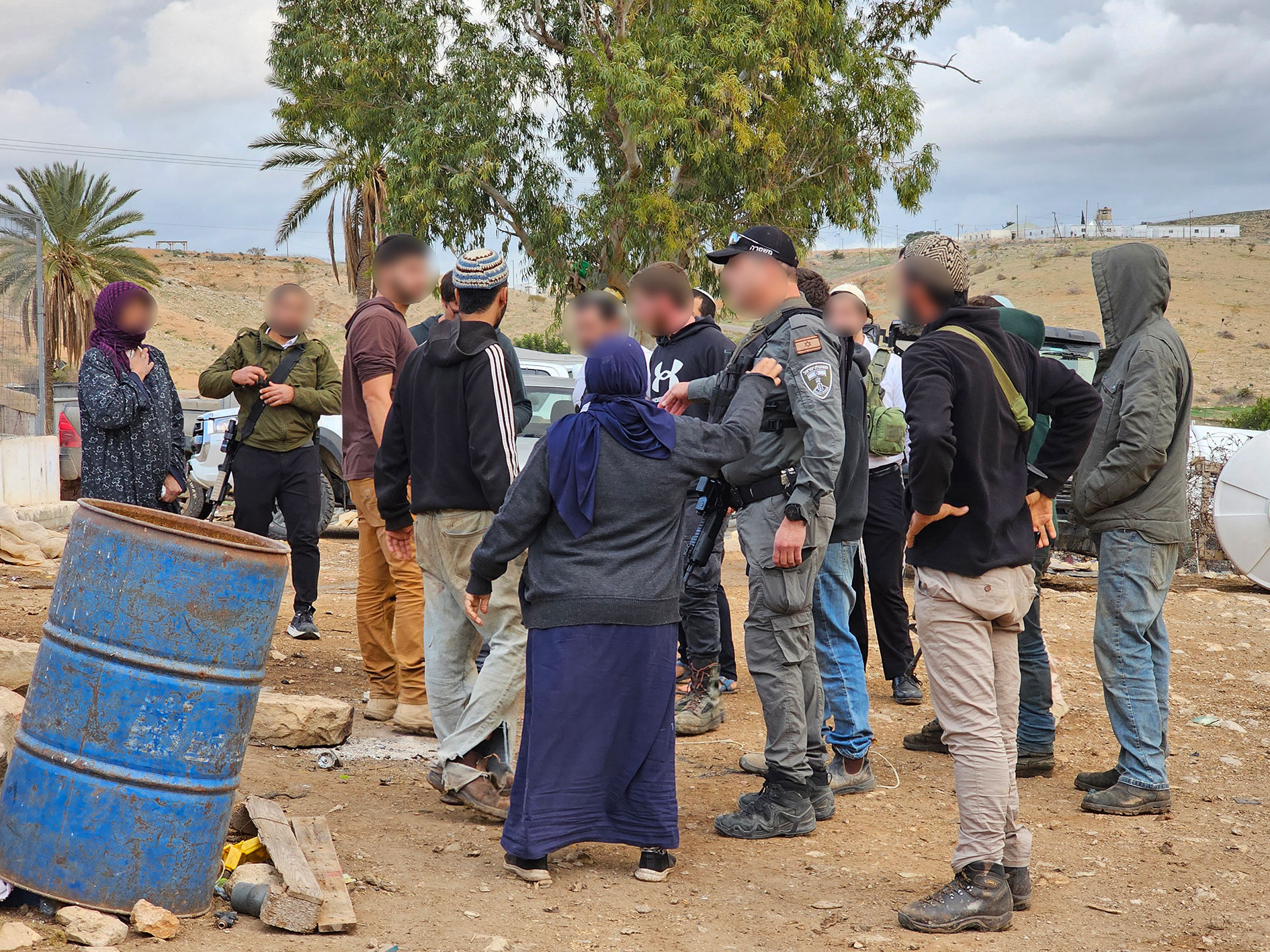 Sarah PostecDec-27-2026Hammam al-Malih: Border Guard and settlers in the compound
-