Qalandiya - Fourth Ramadan Friday
‘Take photos!’ young men shouted at me, who had been on their way to prayer at the Al Aqsa Mosque and were chased away.
‘Take photos!’ said women, crowding against each other on the other side of the compound.
I took pictures of both as well as of the women who appeared on my way to Qalandiya like a mirage on this foggy, smoggy morning.

The last Ramadan Friday seemed to assemble in it all Fridays in view of the growing essence and depth of controlling another people, and the effects of such control on Palestinian society as a whole, and its interiorization by the individual in particular.

I grasped the extent of the occupation horrors’ imprint in people’s minds when I suggested to a friend who stood in the crowded waiting lines to sneak through the alternative shortcut where she would pass in a jiffy. The woman shook her head, saying: ‘If they see me, they’ll shoot in in the head’.
The last Ramadan Friday seemed a sequel of the Ramadan Fridays prior to the pandemic, when people swarmed to the holy sites from every possible way, direction and opening.

Every encounter with the armed forces dominating the area was held in Orwellian terms.
For in a state of no freedom and no human rights, only George Orwell’s words could explain a phrase such as the one yelled at the hundreds crowding at the openings: “We are closing, for there’s crowding inside and we are concerned with your health”.

How can one explain “sterile ground” as the forces call it – an area that has nothing in common with hygiene and is simply a space where no unarmed person is entitled to enter – other than in Orwellian terms?
Or when the answer to the question why men are separated from women is that ‘We respect their tradition’?
All these serve as holiday greetings of the ruler to his subjects.

What brightened my day, again, were the ‘first aid’ youngsters who, except for helping the elderly and the disabled, stood high on the concrete blocs between the traffic lanes, and ‘fished out’ children and babies crushed in the line, held them near and fast until the mother made way and came to pick them up.
As I was the only Jewish person there not holding a weapon in the space between the refugee camp and the rifles, a youngster whose back showed the word ‘USHER’ yelled: ‘There are only Arabs here, not Jews! You are an Arab!!’ accompanying his words with a great smile of acceptance and partnership.
Qalandiya Checkpoint / Atarot Pass (Jerusalem)
See all reports for this place-
Click here to watch a video from Qalandiya checkpoint up to mid 2019 Three kilometers south of Ramallah, in the heart of Palestinian population. Integrates into "Jerusalem Envelope" as part of Wall that separates between northern suburbs that were annexed to Jerusalem in 1967: Kafr Aqab, Semiramis and Qalandiya, and the villages of Ar-Ram and Bir Nabala, also north of Jerusalem, and the city itself. Some residents of Kafr Aqab, Semiramis and Qalandiya have Jerusalem ID cards. A terminal operated by Israel Police has functioned since early 2006. As of August 2006, northbound pedestrians are not checked. Southbound Palestinians must carry Jerusalem IDs; holders of Palestinian Authority IDs cannot pass without special permits. Vehicular traffic from Ramallah to other West Bank areas runs to the north of Qalandiya. In February 2019, the new facility of the checkpoint was inaugurated aiming to make it like a "border crossing". The bars and barbed wire fences were replaced with walls of perforated metal panels. The check is now performed at multiple stations for face recognition and the transfer of an e-card. The rate of passage has improved and its density has generally decreased, but lack of manpower and malfunctions cause periods of stress. The development and paving of the roads has not yet been completed, the traffic of cars and pedestrians is dangerous, and t the entire vicinity of the checkpoint is filthy. In 2020 a huge pedestrian bridge was built over the vehicle crossing with severe mobility restrictions (steep stairs, long and winding route). The pedestrian access from public transport to the checkpoint from the north (Ramallah direction) is unclear, and there have been cases of people, especially people with disabilities, who accidentally reached the vehicle crossing and were shot by the soldiers at the checkpoint. In the summer of 2021, work began on a new, sunken entrance road from Qalandiya that will lead directly to Road 443 towards Jerusalem and Tel Aviv. At the same time, the runways of the old Atarot airport were demolished and infrastructure was prepared for a large bus terminal. (updated October 2021)
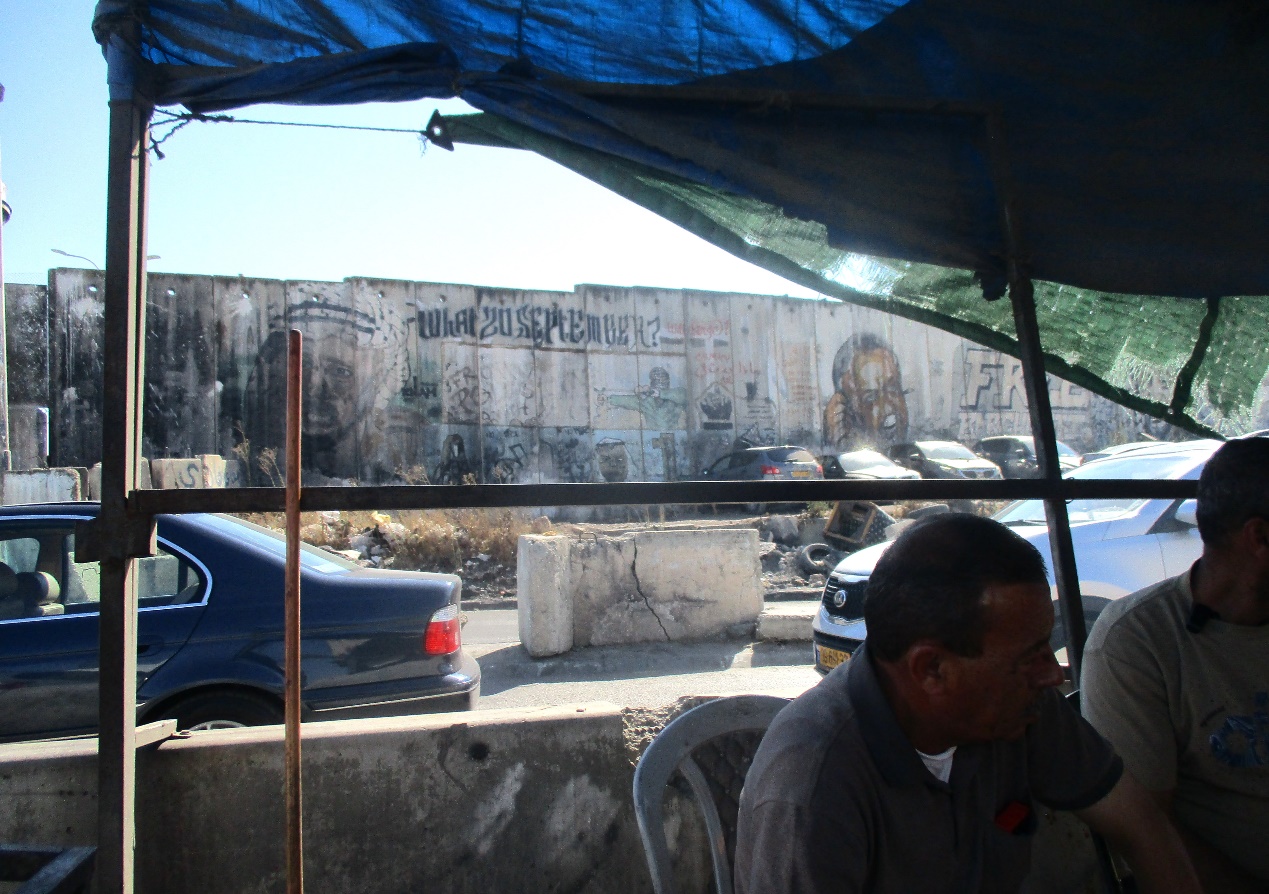 Tamar FleishmanJul-21-2026Qalandiya. Conversation in the shadow of the wall
-