
Qalandiya - the ordeal of a serious cardiac patient on his way to the hospital
While crossing the checkpoint into Palestine and back, I was verbally attacked three times by armed personnel:
You are prohibited from doing this – This is a security area – You hamper our work – Sister, go away – It’s illegal – There is an official edict forbidding it – Leave in good will or you’ll be forced to leave – Do you want to be arrested?
And more of such false, unfriendly and familiar jargon.
Furthermore, it was nearly bodily contact closer than the type usually known to people, and the attacker was only stopped by my warning that a complaint of sexual harassment would follow.
But attention should mainly be directed to the patient lying in the ambulance coming from the West Bank, waiting and waiting and then more waiting to be allowed to cross the evil line between here and there, between the West Bank and Jerusalem, and continue his journey to the East Jerusalem hospital to which he was referred by his doctors.

Even before the man in the ambulance was exposed to the human eyes, the guns and the procedures, the Red Crescent paramedic called out to the soldiers: His condition is worsening, and repeated time and again, His condition is worsening, trying to have them hurry up and approve the passage from one ambulance to the other. All in vain.
None of those in charge of the procedures at the checkpoint paid any attention to the call, nor to the patient’s fate, and continued their jobs peacefully, making sure that the patient was who he was claimed to be, as well as his accompanying wife and son, that there was nothing faulty about their permits, that the soldiers photograph everyone’s ID, and that everything was done by the book.
As the woman in charge of medical issues and coordination told me in the past about a 73-years old cardiac patient who got to the checkpoint unconscious: “What does he imagine, that he could simply come and cross over and get to the hospital?”
True, the patient back then no longer imagined anything and I am not sure that the patient whose condition was worsening could still imagine anything.
One woman-soldier noticing my concern about the man delayed in the ambulance who was clearly near death – tried to defend the soldiers’ conduct claiming that “we enable them to cross and reach the hospital”, as if they were being generous by even enabling the moribund patients to cross the checkpoint.
No, I answered, this is their right, not a virtue on your part. What you soldiers are doing is to tighten your stranglehold of millions of people.
She looked at me belligerently, unconvinced.
The good news finally arrived that everything was in order and a back-to-back procedure could begin.
The patient had to be disconnected from the equipment in the West Bank ambulance, the oxygen tank and stretcher, and connected to a Jerusalem oxygen tank in order to be placed on a Jerusalem stretcher.
Only as the doors closed on the patient and his accompaniers and the ambulance proceeded to on its way, the Red Crescent team and I finally breathed, relieved.
Qalandiya Checkpoint / Atarot Pass (Jerusalem)
See all reports for this place-
Click here to watch a video from Qalandiya checkpoint up to mid 2019 Three kilometers south of Ramallah, in the heart of Palestinian population. Integrates into "Jerusalem Envelope" as part of Wall that separates between northern suburbs that were annexed to Jerusalem in 1967: Kafr Aqab, Semiramis and Qalandiya, and the villages of Ar-Ram and Bir Nabala, also north of Jerusalem, and the city itself. Some residents of Kafr Aqab, Semiramis and Qalandiya have Jerusalem ID cards. A terminal operated by Israel Police has functioned since early 2006. As of August 2006, northbound pedestrians are not checked. Southbound Palestinians must carry Jerusalem IDs; holders of Palestinian Authority IDs cannot pass without special permits. Vehicular traffic from Ramallah to other West Bank areas runs to the north of Qalandiya. In February 2019, the new facility of the checkpoint was inaugurated aiming to make it like a "border crossing". The bars and barbed wire fences were replaced with walls of perforated metal panels. The check is now performed at multiple stations for face recognition and the transfer of an e-card. The rate of passage has improved and its density has generally decreased, but lack of manpower and malfunctions cause periods of stress. The development and paving of the roads has not yet been completed, the traffic of cars and pedestrians is dangerous, and t the entire vicinity of the checkpoint is filthy. In 2020 a huge pedestrian bridge was built over the vehicle crossing with severe mobility restrictions (steep stairs, long and winding route). The pedestrian access from public transport to the checkpoint from the north (Ramallah direction) is unclear, and there have been cases of people, especially people with disabilities, who accidentally reached the vehicle crossing and were shot by the soldiers at the checkpoint. In the summer of 2021, work began on a new, sunken entrance road from Qalandiya that will lead directly to Road 443 towards Jerusalem and Tel Aviv. At the same time, the runways of the old Atarot airport were demolished and infrastructure was prepared for a large bus terminal. (updated October 2021)
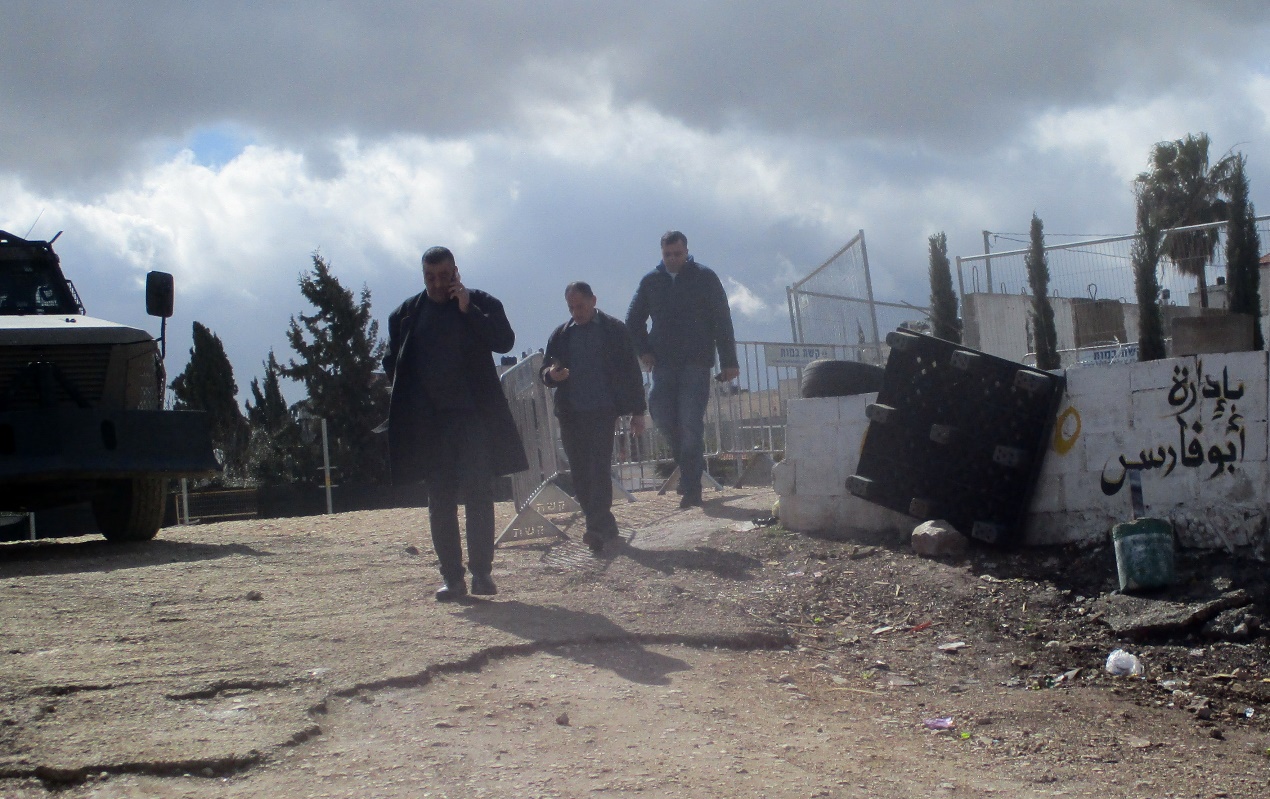 Tamar FleishmanFeb-27-2026Qalandiya: On the way to prayer
-