
Tayba Romana checkpoint: "The wall is great. It's better this way"

Barta’a Checkpoint 6 a.m.
The lower car park has been changed – it is now entered mainly from one of the huge car-parks at the foot of the checkpoint.
When we got there, a waiting line began to form rapidly at the entrance to the shed over the passage to the terminal. Workers from all over the West Bank arrive here, mostly from the northern and central regions, on their way to work inside Israel. Strangely no one came up to complain about the waiting line familiar problems such as a sudden blacklisting and so forth. People came on foot from various car-parks in the are, took their places in line quietly and waited.
7 minutes later the line began to move fast towards the turnstiles and terminal, and disappeared.
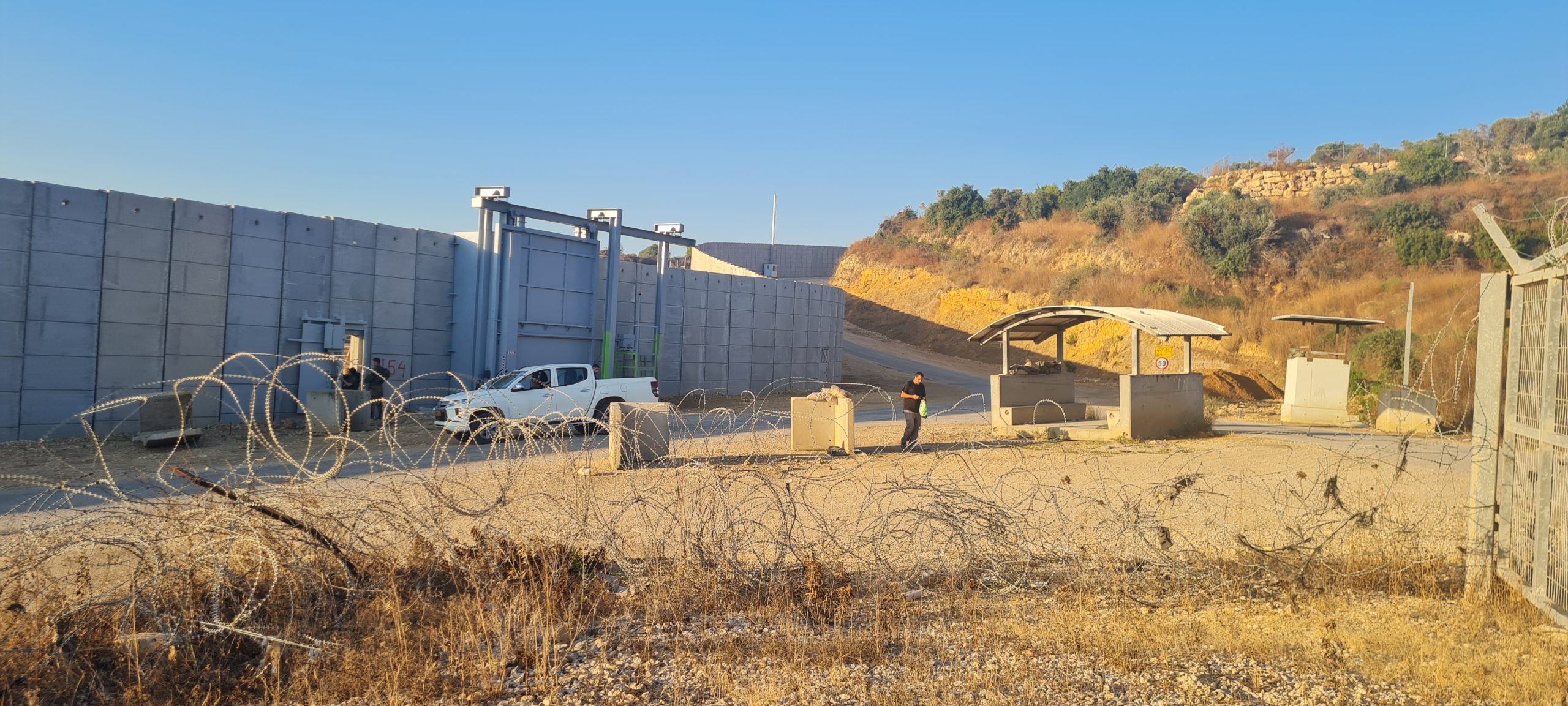
Agricultural checkpoint Tayibe-Roumana (154) below the city of Umm Al Fahm. Opens twice a week.
6:45 The huge megalomaniac wall hides the beautiful landscape of Jenin in the east as well as those waiting to cross.
Pedestrians cross in the small gate, they have been inspected there by the soldiers. A number of women with children also crossed there, followed by a tractor and its driver.
One of the women-soldiers undid by hand the chain that opens the gigantic metal gate, right of the pedestrian gate.
The violent look of the huge concrete wall always startles us anew. But one of the veteran “crossers” thinks differently. It’s good, he says. The wall closed down the problems we had during the time of the breached fence. Now it’s quiet. No more smuggling, drugs, thieves.
One of his daughters got married not long ago. Congratulations… And one of his sons has been accepted into the Palestinian Police. The man says, “He’s in the military.” He’s studying in the university because he can only be accepted as an officer if he has a degree. Now the mission is to build a home so he can marry. No one knows where he can get the 300,000 NIS for this.

Agricultural Checkpoint Anin (214) – Opens twice a week.
7 :30 a.m. The wall is nearly closed, only one section is still open. One of the workers says that rocks prevent fastening the concrete slabs to the ground. Several dozen people cross this checkpoint, from the barrow opening in the wall. Many more than before. They cross over to work in the seam-zone and on days when this checkpoint is closed, they take a taxi to the Barta’a checkpoint and pay 100 NIS for a two-way ride.
A DCO officer approaches us and, as in the past, tries to convince us to keep our distance from the checkpoint entrance. After a quiet conversation we were “convinced”. We waited until the last person to cross passed the wall, Mahmoud – an old friend – and his tractor. Ever since his policeman son was killed in a clash with drug dealers, the man no longer radiates his habitual joy of life. Two of these drug dealers were killed lately, which was heard with some relief by him and his wife.
'Anin checkpoint (214)
See all reports for this place-
'Anin checkpoint (214)
'Anin checkpoint is located on the Separation Fence east of the Israeli community Mei Ami and close to the village of Anin in the West Bank. It is opened twice a week, morning and afternoon, on days with shorter light time, for Anin farmers whose olive groves have been separated from the village by the fence it became difficult to cultivate their land. Transit permits are only issued to those who can produce ownership documents for their caged-in land, and sometimes only to the head of the family or his widow, eldest son, and children. Sometimes the inheritors lose their right to tend to the family’s land. The permits are eked out and are re-issued only with difficulty. 55-year-old persons may cross the checkpoint (into Israel) without special permits. During the olive harvest season (about one month around October) the checkpoint is open daily and more transit permits are issued. Names of persons eligible to cross are held in the soldiers’ computers. In July 2007, a sweeping instruction was issued, stating that whoever does not return to the village through this checkpoint in the afternoon will be stripped of his transit permit when he shows up there next time. Since 2019, the checkpoint has not been allways locked with the seam-line zone gate (1 of 3 gates), and the fence around it has been broken in several sites.
-
Barta’a-Reihan Checkpoint
See all reports for this place-
This checkpoint is located on the Separation Fence route, east of the Palestinian town of East Barta’a. The latter is the largest Palestinian community inside the seam-line zone (Barta’a Enclave) in the northern West Bank. Western Barta’a, inside Israel, is adjacent to it. The Checkpoint is open all week from 5 a.m. to 9 p.m. Since mid-May 2007, the checkpoint has been managed by a civilian security company subordinate to the Ministry of Defense. People permitted to cross through this checkpoint into and from the West Bank are residents of Palestinian communities inside the Barta’a Enclave as well as West Bank Palestinian residents holding transit permit. Jewish settlers from Hermesh and Mevo Dotan cross here without inspection. A large, modern terminal is active here with 8 windows for document inspection and biometric tests (eyes and fingerprints). Usually only one or two of the 8 windows are in operation. Goods, up to medium commercial size, may pass here from the West Bank into the Barta’a Enclave. A permanent registered group of drives who have been approved by the may pass with farm produce. When the administration of the checkpoint was turned over to a civilian security firm, the Ya’abad-Mevo Dotan Junction became a permanent checkpoint. . It is manned by soldiers who sit in the watchtower and come down at random to inspect vehicles and passengers (February 2020).
-
Tayba-Rummana
See all reports for this place-
Tayba-Rummana is an agricultural checkpoint. It is located in the separation fence in front of the eastern slopes of the Israeli city of Umm al-Fahm. The Palestinian villages next to the checkpoint are Khirbet Tayba and Rummana. Dozens of dunams of olive groves were removed from their owners, the residents of these villages on the western side of the separation fence. The Palestinian villages next to the checkpoint are Khirbet Tayba and Rumna. Dozens of olives dunams were removed from these villages' residents and swallowed up in a narrow strip of space, on the western side of the separation fence. The checkpoint allows the plantation owners who have permits to pass. Twice a week, the checkpoint opens for fifteen minutes in the morning and evening. During the harvest season, it opens every day for fifteen minutes in the morning (around 0630) and fifteen minutes in the afternoon (around 1530). (February 2020).
-