
Umm al-Khair - Carmel settlers have erected caravans that endanger the integrity of the settlement
We travelled to Umm al-Khair following unpleasant events that happen there every day.
On the way, we checked the status of the blockades and checkpoints:
The entrance to Samu’ is open.
Dahariya is still closed, with a military presence.
Karama is open.
Abda is closed. It seems to be a back-to-back situation.
At the Dura al-Fawwar junction, the roads to both villages are closed.
You can see that the situation is very difficult and people are finding detours to Dura.
At the Hebron-Qilqis junction, the entrances are closed and at the Rihiya junction, at the Sheep junction-Hebron junction, Hebron is closed.
The road to Yatta is open and you can travel there.
We bought groceries for Umm al-Khair at the grocery store there.
How well-kept and beautiful they maintain the “village council” despite their terrible conditions.
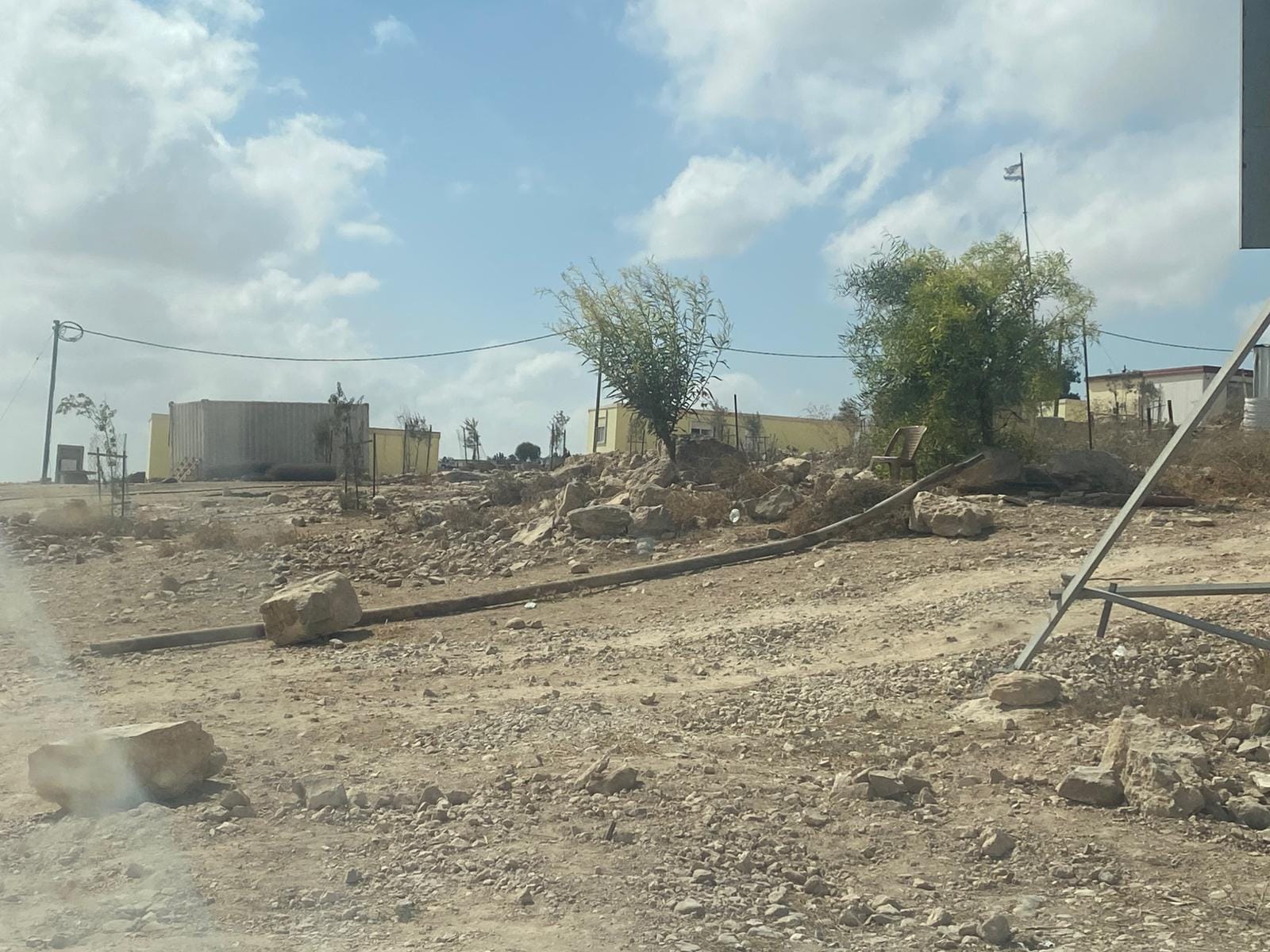
There are new trailers which are really close together, intended for the expansion of the Carmel settlement. The settlers are really surrounding them in an attempt to expel them. The work is in full swing and the security forces act accordingly.
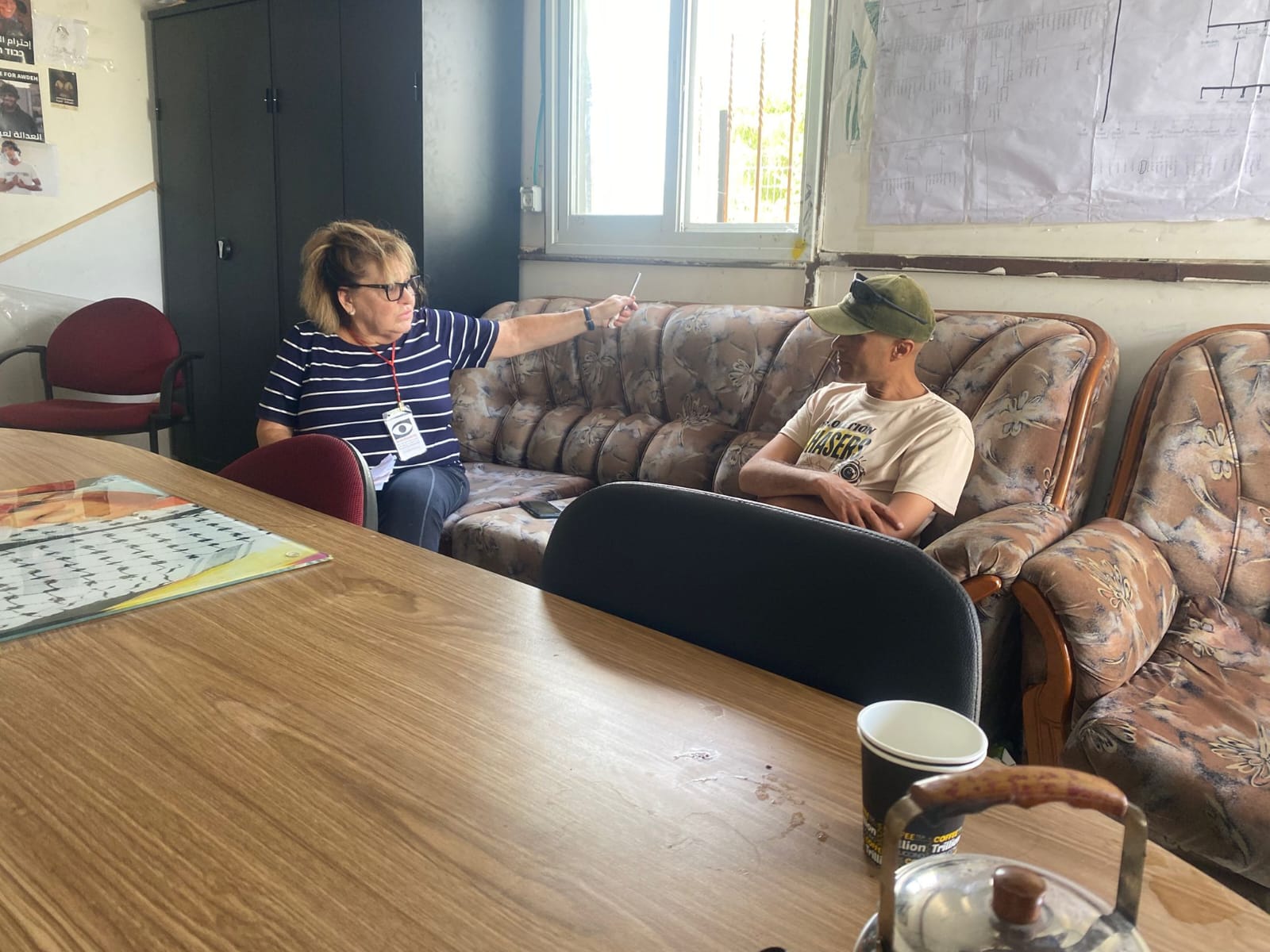
I sat down with Eid, the wise, eloquent and noble-minded man says:
“They are working on the State of Judea (we already took a picture of the flag), and will take advantage of the time that the international community is busy with Gaza and the talk of its reconstruction, and try to take over additional lands without interference.” He adds and says: “The settlers are tarnishing the good name of Judaism when they use their power in the name of Judaism and seize private lands.
Unfortunately, they are really tarnishing the name of Judaism. We all need to unite against this trend. The courts are weakand do not stand up to Smotrich.”
The head of the South Mount Hebron Council, Eliram Azoulay, is very extremist and dangerous. He calls the Palestinians terrorists, and with his support, Eid fears that when the road that is now being paved from the new trailers to Carmel is paved, the settlers will pressure the Civil Administration to demolish their homes in between in order to create continuity between the new and the old.
We went to see the plot where this road is being paved.
Eid adds and says that on October 7, the morning of the Sukkot holiday, at 5:30 the Carmel settlers arrived with their security squad and with Nevo the man in charge of security, masked in an IDF uniform, accompanied by the army.
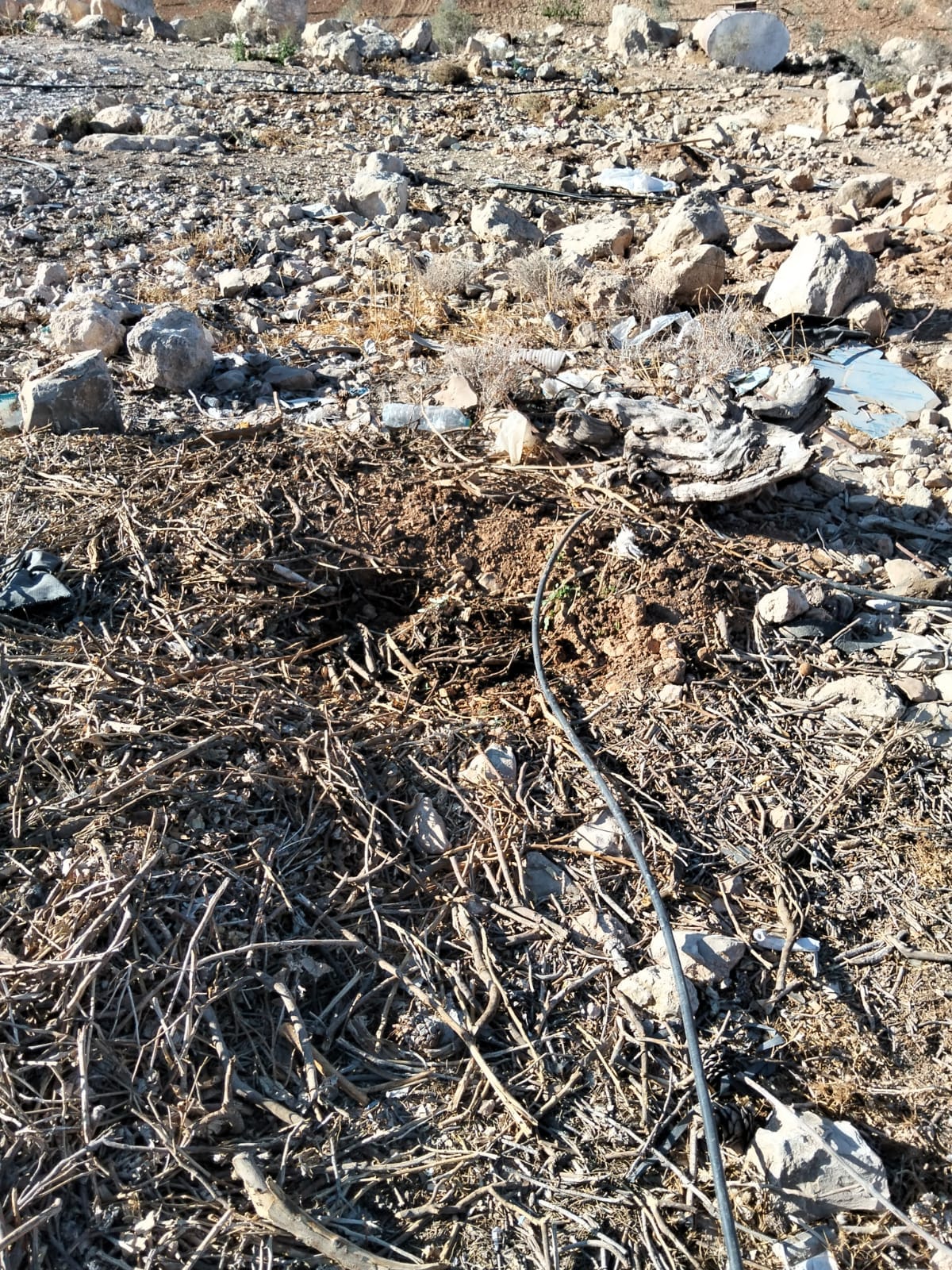
They all uprooted the new olive seedlings that the people of Umm al-Khair had planted on their private and legal plot, as it also says in the Civil Administration: private Palestinian land. After the eviction, they came and cut the fence around the plot and loaded the uprooted trees, metal pules and fences onto pickup trucks. Of course, they didn’t have a demolition order and there were no administrators there.
These were just trained settlers who knew their actions were illegal.
They did this for 40 minutes. They finished their work and left nothing behind and left, locking the residents and activists in their homes and not allowing them to go out and take pictures and testify about this crime. “But with us, everything is documented,” says Eid, “We managed to take pictures through the windows. “It cannot be denied or obscured,” says Eid in fluent Hebrew.
In addition, they detained Khalil, the head of the village, for three hours, claiming that it was a closed military area and that he was not allowed to let foreign volunteers who do not live there roam around.
Khalil answered them: “If it is a closed military area, then why were settlers who do not live here allowed to enter?” There was no answer and he was released without complaint.
I was happy to see him when we arrived.
In the same plot, the previous Saturday at 4 am, they attacked a volunteer, knocked her down and beat her with clubs and injured her until she needed treatment.
This time, it was just the people from the new “Shorashim” (roots) farm, which is adjacent to the command of Shimon Atiya, the settler.
They let their sheep destroy everything they grow and also broke seedlings with their hands. An elderly woman who lived there who came out was also beaten with clubs. Everything is filmed and documented, says Eid, so that they can file a legal claim.
At the time of writing this report the media published a ruling by the court that the settlers are forbidden to continue building there.
We will see what the next days will bring.
We will also continue to monitor.
Location Description
Dura Al-Fawwar Junction
See all reports for this place-
Junction on Route 60: west - the town of El Dura, east - the Al Fawwar refugee camp. There is a manned pillbox at the junction. From time to time the army sets up flying checkpoints at the entrance to El Fawwar and Al Dura. Al-Fawwar is a large refugee camp (7,000 inhabitants in 2007) established in 1949 to accommodate Palestinian refugees from Be'er Sheva and Beit Jubrin and environs. There are many incidents of stone-throwing. In the vicinity of the pillbox there are excellent agricultural areas, Farmers set up stalls adjacent to the plots close to the road. In recent months the civil administration has set up dirt embankments thereby blocking access to the stalls, and making it impossible for the farmers to sell their vegetables. Updated April 2021, Michal T.
-
Hakvasim (sheep) Junction
See all reports for this place-
One of the roadblocks (earthworks, rocks, concrete blocks or iron gates) that prevent transit of vehicles to Route 60 in the southern West Bank and block the southern entrance to Hebron. A manned pillbox supervises the place.
-
Hebron
See all reports for this place-
According to Wye Plantation Accords (1997), Hebron is divided in two: H1 is under Palestinian Authority control, H2 is under Israeli control. In Hebron there are 170,000 Palestinian citizens, 60,000 of them in H2. Between the two areas are permanent checkpoints, manned at all hours, preventing Palestinian movement between them and controlling passage of permit holders such as teachers and schoolchildren. Some 800 Jews live in Avraham Avinu Quarter and Tel Rumeida, on Givat HaAvot and in the wholesale market.
Checkpoints observed in H2:
- Bet Hameriva CP- manned with a pillbox
- Kapisha quarter CP (the northern side of Zion axis) - manned with a pillbox
- The 160 turn CP (the southern side of Zion axis) - manned with a pillbox
- Avraham Avinu quarter - watch station
- The pharmacy CP - checking inside a caravan with a magnometer
- Tarpat (1929) CP - checking inside a caravan with a magnometer
- Tel Rumeida CP - guarding station
- Beit Hadassah CP - guarding station
Three checkpoints around the Tomb of the Patriarchs
 Raya YeorDec-18-2025Hebron - Yusri Jaber and part of his family
-
Mesafer Yatta
See all reports for this place-
This is happening in Fire Area 918 in the South Hebron Hills
On the eve of Remembrance Day (the day before Israel Independence Day), 4th May, 2022, the Israeli High Court decided on the transfer and expulsion of residents from 8 Palestinian communities in the area of Masafar Yata in the South Hebron Hills. Residents of the villages have been living under the threat of demolition, evacuation and expropriation since the IDF issued evacuation orders in 1999 based on the 1980s proclamation of their area of residence as a firing zone for IDF drills. None of the nearby settlements were included in this zone. The Masafer Yata Palestinian villages retain a special lifestyle and ancient agricultural culture. They also posess a clear historical documentation that testifies to a Palestinian settlement in this area, generations before the establishment of Israel, long ago in the caves and at later times outside them.
Evacuating residents from the area means destroying these historic villages and leaving entire families (about 2,000 people, children, adults, and the elderly) homeless. This is contrary to international law.
In June 2022, a firing drill started, and life became harder.
-
South Hebron Hills
See all reports for this place-
South Hebron Hills
South Hebron Hills is a large area in the West Bank's southern part.
Yatta is a major city in this area: right in the border zone between the fertile region of Hebron and its surroundings and the desert of the Hebron Hills. Yatta has about 64,000 inhabitants.
The surrounding villages are called Masafer Yatta (Yatta's daughter villages). Their inhabitants subsist on livestock and agriculture. Agriculture is possible only in small plots, especially near streams. Most of the area consists of rocky terraces.Since the beginning of the 1980s, many settlements have been established on the agricultural land cultivated by the Palestinians in the South Hebron Hills region: Carmel, Maon, Susia, Masadot Yehuda, Othniel, and more. Since the settlements were established and Palestinians cultivation areas have been reduced; the residents of the South Hebron Hills have been suffering from harassment by the settlers. Attempts to evict and demolish houses have continued, along with withholding water and electricity. The military and police usually refrain from intervening in violent incidents between settlers and Palestinians do not enforce the law when it comes to the investigation of extensive violent Jewish settlers. The harassment in the South Hebron Hills includes attacking and attempting to burn residential tents, harassing dogs, harming herds, and preventing access to pastures.
There are several checkpoints in the South Hebron Hills, on Routes 317 and 60. In most of them, no military presence is apparent, but rather an array of pillboxes monitor the villages. Roadblocks are frequently set up according to the settlers and the army's needs. These are located at the Zif Junction, the Dura-al Fawwar crossing, and the Sheep Junction at the southern entrance to Hebron.
Updated April 2022
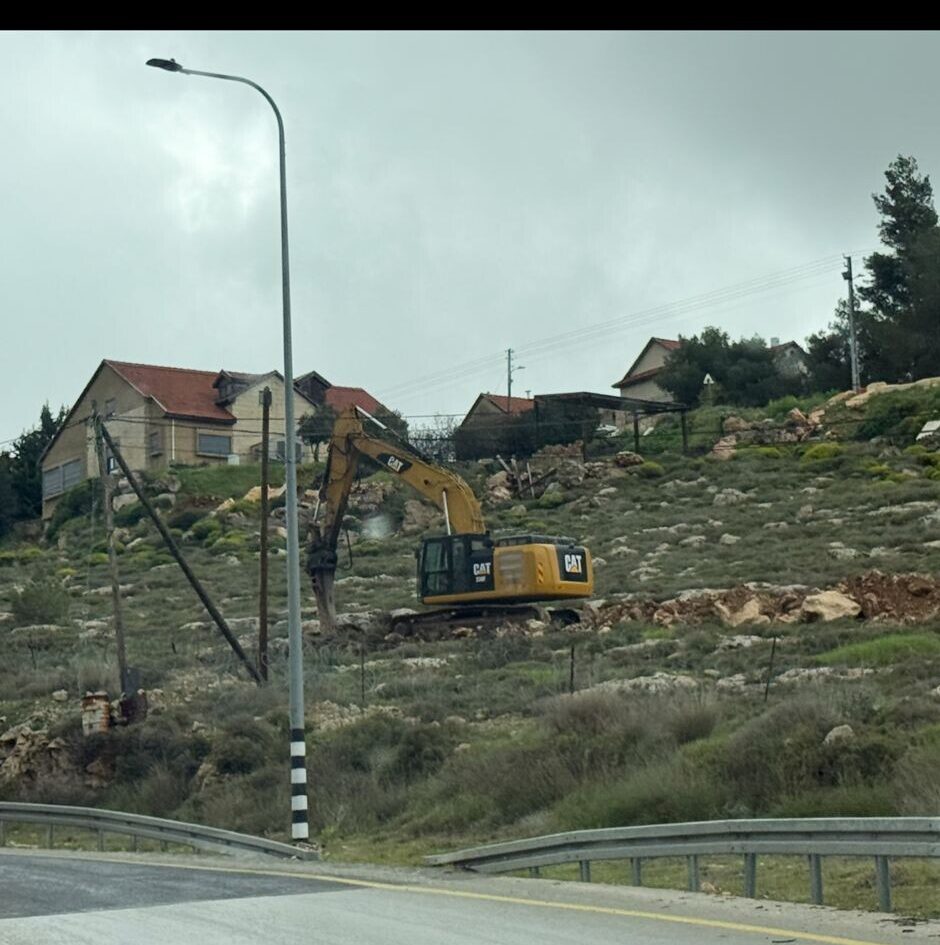 MuhammadFeb-24-2026South Hebron Hill, Beit Hagai: Paving an internal security road
-
Umm al-Khair
See all reports for this place-
Umm al-Kheir
A Palestinian village in the southern Hebron governorate, populated by five families. The Palestinian residents settled there decades ago, after Israel expelled them from the Arad desert and purchased the land from the residents of the Palestinian village of Yatta. The village suffers from the violence of nearby Carmel settlers, from water shortage and is subject to frequent demolition of buildings by the Civil Administration.
-