
חבלה, מעבר אליהו, עזון עתמה, פלאמיה
From: Judith Green [mailto:greenjudith@gmail.com]
Sent: Thursday, December 12, 2013 8:32 AM
To: Dina
Subject: trans. Azzun Atme, Hable, Eliyahu gate, Falamiye, Tuesday 9.12.13 AM
Azzun Atme, Hable, Eliyahu gate, Falamiye, Tuesday 9.12.13 AM
Observers: Rachel A., Nina S. (reporting), Translator: Judith Green
.
An ordinary occupation day; the gate closed for the people who arrived exactly at the closing hour; who cares if that means that the night guard won't be able to go home to sleep?
06:20 'Azzun 'Atma
A lot of people are already waiting outside, gathered in groups around bonfires to warm up – these are the people who got up extra early in order to make sure that they would get through the checkpoint in to get to work; now they are waiting for employers to come and take them to their workplaces. We won't enable the army to prevent us from getting to work, so we have to pay for the privilege with hours of lost sleep. The coffee boys are on the Israeli side this morning – they have now been allowed to earn a little money before they go to school. The coffee is diluted, but we want to help and support them.
Today the soldiers are pleasant and, naturally, this makes everything more efficient at the checkpoint. When we arrived, there were about 60 people but, by 06:50, the line had shortened even though more people are arriving all the time. According to the soldiers, the entrance to 'Azzun 'Atma from the other side (Beit Amin) is also manned and only those who live in 'Azzun 'Atma, or those who have a work permit for the seam area, are allowed to enter the village. So there is less sneaking through the holes in the fence. It seems as though this situation will continue as long as they have not finished the new fence, on which we have not seen any signs of work today.
The checkpoint area on the Palestinian side is full of trash, but it looks as though no one has responsibility for the area and no one cares.
Five people were arrested outside of the inspection booth; two of them were quickly released and seem to have gone through legitimately, but the soldiers who arrested them didn't believe them. The others were infiltrators who got through the fence and were caught. They will have to stand there for 2-3 hours and then be sent home.
The inspection of bags was, as usual, very annoying. There is no place to put them down and if someone comes with a lunch box, he has to take everything out, one by one, and hold them under his arms and only then is the soldier able to see everything that is in the lunch box. Why can't they find a table somewhere so that people can put their possessions on it and the whole process will be easier?
07:20 Habla
No line; most people went through and each person who arrived went right through. A childrens' bus goes through with no problem (only one arrived today, usually there are 2). Could it be that fewer people are going to work because of the rain or that the checkpoint was unusually efficient? Cars, horse carts, mules and donkeys are going through to the nurseries
A couple goes through – she is ill with leukemia and needs to get to Tel HaShomer Hospital 3 times a week. The cost of this is enormous, close to 1000 NIS/week. We made contact for them with "The Way to Healing", and hope they are able to help them about the traveling.
07:45
The checkpoint is starting to close. At the same minute, another 3 people arrive from Habla, one of them is the son of a man who went through the Eliyahu checkpoint and is waiting for him on the other side of the seam area. However, his son does not have the right to go through there and had to come to Habla. At the same time, the night guard from one of the nurseries arrives. But an hour is an hour and there are no exceptions. The soldiers continue to close the gate and the poor people go on their way and now what? not clear. Anyway, at least once a week the army is late in opening the gate – but they are permitted to be late. My father had a Latin expression for this, which could be translated as "Not everything allowed Caesar is permitted to a pig."
08:00 Eliyahu checkpoint
Six cars being inspected and 2-3 people are in the pedestrian line.
08:00 Falamya
Quiet; a small Garden of Eden if there weren't a fence and a checkpoint here. One only has to look to the east to see that this is a Garden of Eden for za'atar. Vans go through and tractors (some coming from Jayyus, since the gate is already closed there), a cart with donkey and passengers, and even an empty truck.
'Azzun 'Atma
See all reports for this place-
'Azzun 'Atma
A Palestinian village of about 1,800 residents. The settlement of Sha'arei Tikva was established on its land adjacent to it, and the settlement of Oranit was established on its agricultural lands. By 2013, the separation fence had passed through the village and a checkpoint staffed by the army allowed the residents to cross from side to side. After building a massive wall surrounding the village and some of its agricultural lands, the residents went daily for five years to their lands that remained in the Seam Zone through the Oranit agricultural checkpoint (4). Since 2018 it has only opened during the olive harvest and the farmers have to pass daily at the Beit Amin / Abu Salman checkpoint (1447), about 3 kilometers north.From a report from March 24, 2021: "The farmers from Beit Amin and Azon Atma are happy that since February 21 the Oranit checkpoint .is going to be open 3 times a day, The farmers are really developing the place."
Report from July 14, 2024: "Ornit checkpoint is closed . The Beit Amin/Abu Salman agricultural checkpoint is closed (there is no contact with the military to check if it opens rarely), the Ezbat Jaloud checkpoint was opened once a day before the war.
Updated for July 2024
 Apr-11-2019Azoun: The main entrance to village blocked now for several weeks
-
Eliyahu CP (109) / Crossing
See all reports for this place-
Eliyahu CP (109) / Crossing This checkpoint, also known as the Fruit Crossing, is one of the main checkpoints between Israel and the West Bank. It is located on Route 55 between Alfei Menashe and the turn to Qalqilya and Zufin, more than 4 km east of the Green Line, in the separation fence, which separates Qalqilya from its lands to the south, thus leaving Alfei Menashe West of the fence - the Seam Zone. This checkpoint, a few kilometers across the Green Line, is intended for "Israeli settlement in the West Bank and the population of the Seam Zone." It is managed by a civil company. Palestinians with a special permit for their lands in the seam area are also allowed to pass through it, on foot, and sometimes by car.
-
Falamiya
See all reports for this placeHabla
See all reports for this place-
Habla CP (1393)
The Habla checkpoint (1393) was established on the lands of the residents of Qalqilya, on the short road that
connected it for centuries to the nearby town of Habla. The separation barrier intersects this road twice and cut off the residents of Qalqilya from their lands in the seam zone.(between the fence and the green line).
There is a passage under Road 55 that connects Qalqilya to the sabotage This agricultural barrier is used by the farmers and nursery owners established along Road 55 from the Green Line and on both sides of the kurkar road leading to the checkpoint.
This agricultural checkpoint serves the residents of Arab a-Ramadin al-Janoubi (detached from the West Bank), who pass through it to the West Bank and back to their homes. The opening hours (3 times a day) of this agricultural checkpoint are longer than usual, about an hour (recently shortened to 45 minutes), and are coordinated with the transportation hours of a-Ramadin children studying in the occupied in the West Bank.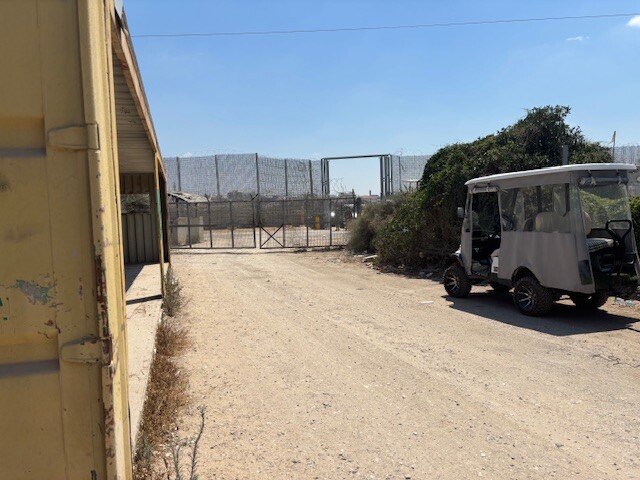 Nina SebaAug-18-2025Habla: The gate is in the process of closing
-