
Settlers from Mitzpe Yair enter the village with ATVs to scare


Route 60 from the Shoket junction to the Meitar checkpoint. Traffic is light and the reason is the checkpoint to Dahariya, which is once again closed and does not allow passage to Ramadin and Dahariya, mainly for shopping, medical treatment and trade.
We drive to the nearby Qawawis, next to Sha’ab al-Butum, which we had already visited several times following attacks by settlers from the area aimed at expelling them, as is happening in the entire area of Masafer Yatta.
We park the car and the boys and girls, who are at the beginning of their summer vacation, are happy to see us and run to tell the adults. Taleb Abu Aram, who speaks fluent Hebrew, and his son Saber invite us to sit in their house, four walls divided in two. A place to stay and a place to sleep.
I ask what the situation is since we visited, and the answer is no different from what is given in all the villages. Almost every day settlers from Mitzpe Yair and sometimes also from other settlements enter the village. Sometimes with their herds, and sometimes they go around with ATVs, to scare.
The police and the army make their presence known, even in the middle of the night.
Recently, the army required them to remove a camera that was installed at a height of 16 meters to take pictures and document, claiming that it was photographing an area far beyond the village area.
Photos and videos that the villagers take as documentation are immediately forwarded to several parties, because they are being required by the army and police to delete them.
3 days ago, settlers arrived on Jibrin’s territory, which he was evicted from at the beginning of the war, entered a cave where he stored a lot of equipment and stole all the contents, clothes, a fence, pipes, and more. It is worth mentioning that Jibrin lives in Qawawis in a house that his cousin, Taleb, allows him to live in.
And what can be better than to steal a donkey that allows accessibility and passage between the villages when everything is blocked? Here too, Jaber Awad’s donkey was stolen by the same settlers.
Cars are rare to see and shopping, if possible, is done by reaching the road and then either someone from the family or a taxi helps with the arrival. Sometimes the police stop a car, confiscate the keys and the driver’s ID card and the car owner waits in the car for hours until his belongings are returned. More torture.
During the alarms that are clearly heard from the settlements around them, they go down to two nearby caves where they lived in the 1960s and only about 20 years ago built the houses they live in today.
We went down to see the large cave that is used to prepare dairy products and, in the winter, to house the sheep.
We left clothes and games and food supplies and returned with a heavy heart as usual.
#ThisIsTheOccupation
Location Description
Masafer Yatta*
See all reports for this placeMeitar checkpoint / Sansana
See all reports for this place-
Meitar Checkpoint / Sansana The checkpoint is located on the Green Line and serves as a border crossing between Israel and the West Bank. It is managed by the Border Crossing Authority of the Defense Ministry. It is comprised of sections for the transfer of goods as well as a vehicle checkpoint (intended for holders of blue identity cards, foreign nationals or diplomats and international organizations). Passing of Palestinians is prohibited, except for those with entry permits to Israel. Palestinians are permitted to cross on foot only. The crossing has a DCO / DCL / DCL / DCL (District Coordination Office), a customs unit, supervision, and a police unit. In the last year, a breach has been opened in the fence, not far from the crossing. This breach is known to all, including the army. There does not appear to be any interest in blocking it, probably as it permits needed Palestinian workers without the bureaucratic permits to get to work in Israel. Food stalls and a parking area economy have been created, but incidents of violent abuse by border police have also been recorded. Updated April 2022
-
Sha'ab al-Butum
See all reports for this place-
This is one of the small Palestinian communities in Masafer Yatta in the southern Hebron Hills, near the settlement of Mitzpe Avigail.
Since the outbreak of the October 7, 2023 war, settler violence against residents has escalated greatly, as in the entire Palestinian community. This violent conduct receives full backing from the state and full cooperation from the IDF. The goal is to make the lives of the Palestinian residents miserable and make them abandon and leave.
The population consists of mostly shepherds who peacefully seek to cultivate the land and graze their sheep, whom the settlers treat as a dangerous enemy. They prohibit them from any movement related to herding sheep and cultivating the land and harm everything: trampling crops, breaking olive trees, smuggling herds, scaring shepherds, conducting wild searches of houses, shouting, cursing and threatening - at all hours of the day. "We are Besieged, but will not move from our land," says Lila G. New settlements are springing up around them. At first it's a bus or a truck that turns into residential buildings, on top of which every week more residential buildings and animal sheds are added. With the open encouragement of the current government, Jewish terrorism is raising its head, with authority and permission. The settlers have received army uniforms and weapons, and no one is stopping them. The police, who are supposed to protect the Palestinians from the settlers' riots, sometimes respond to calls for help, but in practice they don't do much more than provide them with a report, and they are required to go and file a complaint in Kiryat Arba Settlemnt police station . Though the settlers' identities are known, they are !never arrested.
-
South Hebron Hills
See all reports for this place-
South Hebron Hills
South Hebron Hills is a large area in the West Bank's southern part.
Yatta is a major city in this area: right in the border zone between the fertile region of Hebron and its surroundings and the desert of the Hebron Hills. Yatta has about 64,000 inhabitants.
The surrounding villages are called Masafer Yatta (Yatta's daughter villages). Their inhabitants subsist on livestock and agriculture. Agriculture is possible only in small plots, especially near streams. Most of the area consists of rocky terraces.Since the beginning of the 1980s, many settlements have been established on the agricultural land cultivated by the Palestinians in the South Hebron Hills region: Carmel, Maon, Susia, Masadot Yehuda, Othniel, and more. Since the settlements were established and Palestinians cultivation areas have been reduced; the residents of the South Hebron Hills have been suffering from harassment by the settlers. Attempts to evict and demolish houses have continued, along with withholding water and electricity. The military and police usually refrain from intervening in violent incidents between settlers and Palestinians do not enforce the law when it comes to the investigation of extensive violent Jewish settlers. The harassment in the South Hebron Hills includes attacking and attempting to burn residential tents, harassing dogs, harming herds, and preventing access to pastures.
There are several checkpoints in the South Hebron Hills, on Routes 317 and 60. In most of them, no military presence is apparent, but rather an array of pillboxes monitor the villages. Roadblocks are frequently set up according to the settlers and the army's needs. These are located at the Zif Junction, the Dura-al Fawwar crossing, and the Sheep Junction at the southern entrance to Hebron.
Updated April 2022
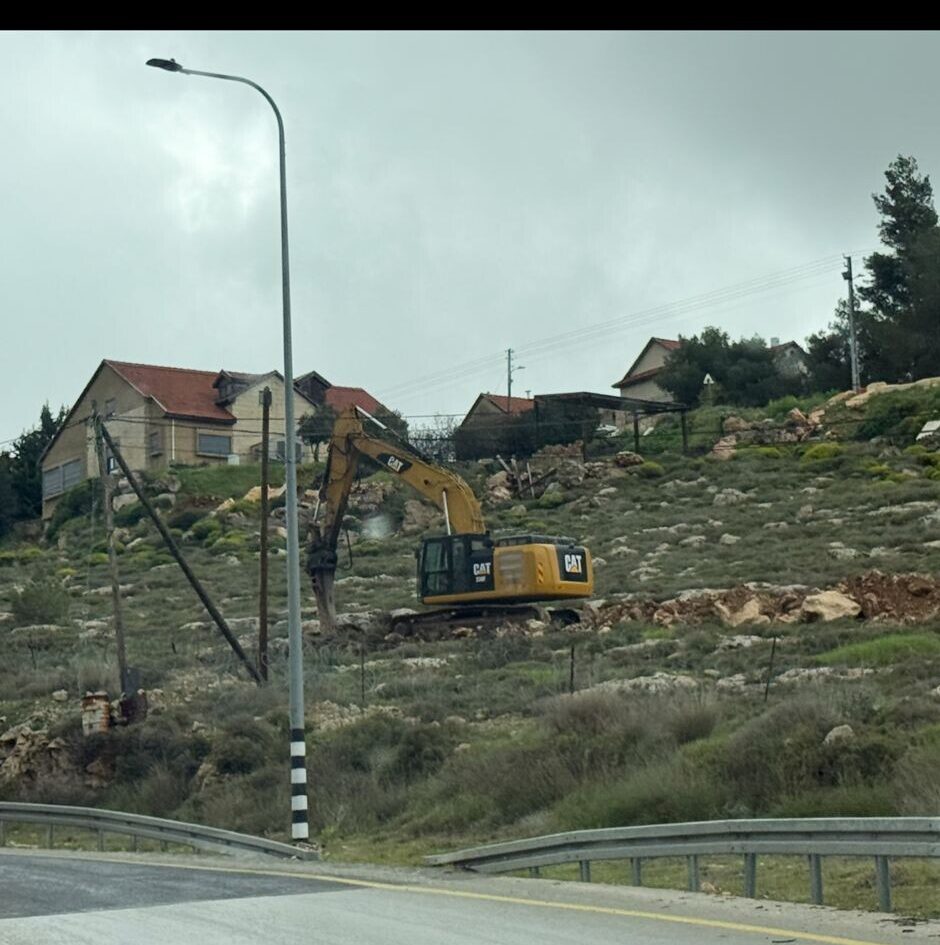 MuhammadFeb-24-2026South Hebron Hill, Beit Hagai: Paving an internal security road
-