
Qawawis - Frequent harassment by settlers
Road 60
Opposite Sham’a, “Havat Yehuda” has new caravans and sheep pens. We saw a tractor plowing Palestinian-owned land. There is also a new well-tightened dirt road leading to another colonist outpost hidden by the slope.
Along the road between Abde and Deir Razeh are newly placed huge Israel flags. They show presence without governance.
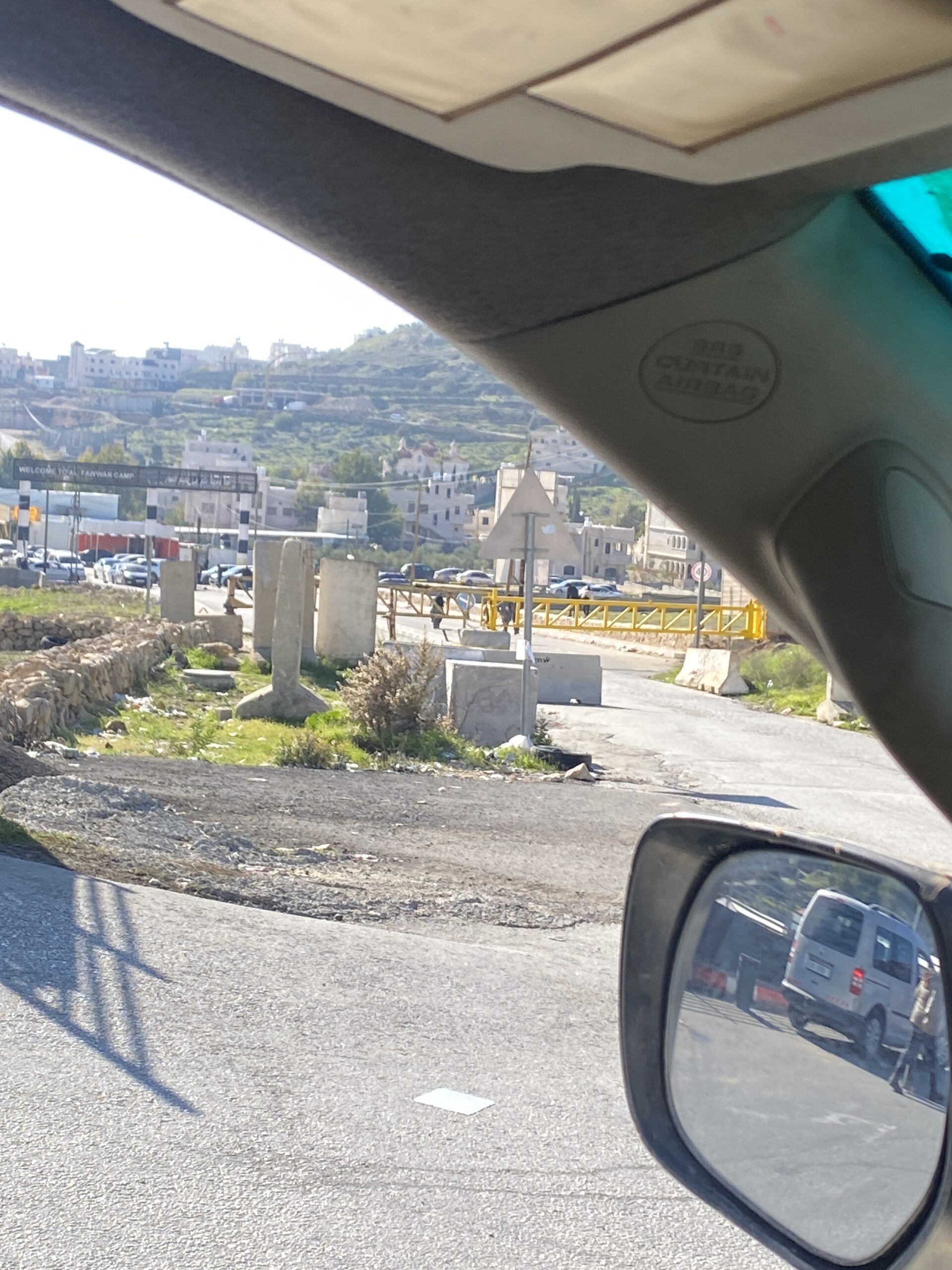
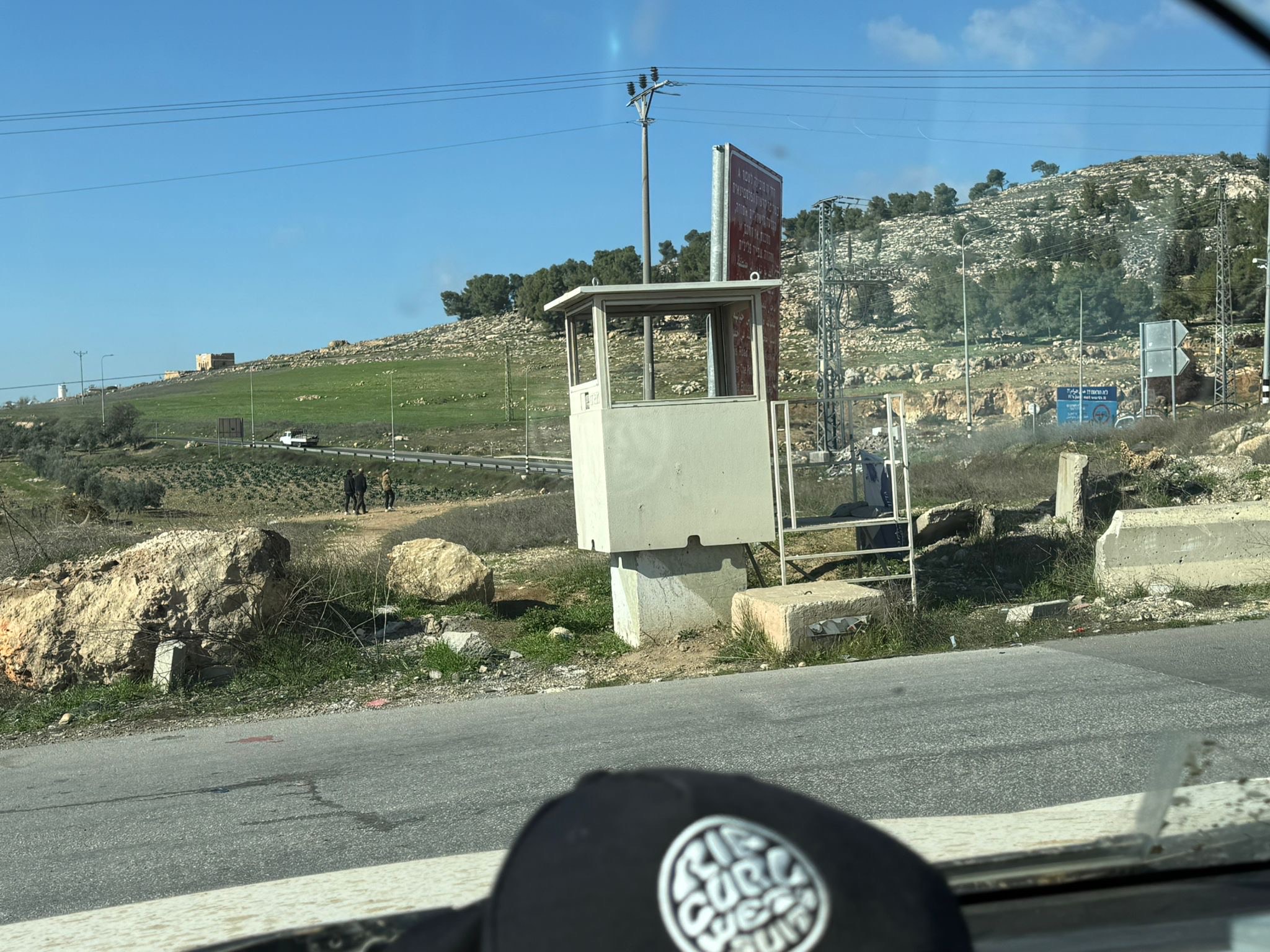
Dura, Al-Fawwar – the yellow checkpoint is open in Dura, closed in Al-Fawwar. This means people continue to walk between these villages, and the soldier sitting in the pillbox post watches from above and does not enable them to get over to the paved road, only remain on the muddy track. We could not get out.
Many large and meaningless traffic circles have been added lately for most directions there are closed off to Palestinian vehicles.
Thus, at Qilqis – closed on both sides.
Sheep Junction – open in the direction of Hebron, closed in that of Yatta.
Road 356
At the junction of Roads 60 and 356, on the traffic circle, stand two police cars apparently waiting to hand out reports to Palestinian-only traffic regulation violators.
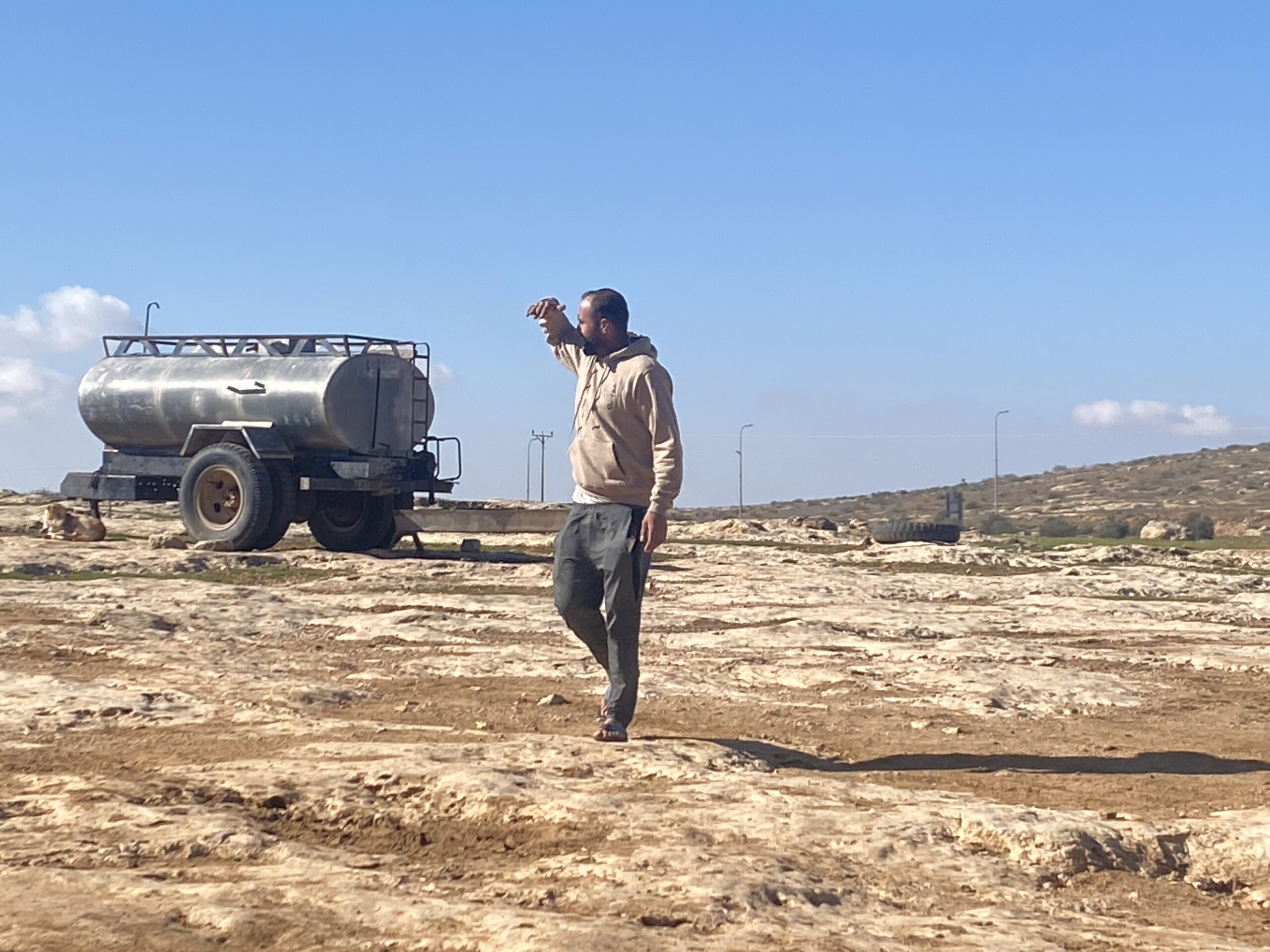
Zif Junction – we leave blankets for Ziyad at Abu Shanab’s supermarket, and fill the cart with food stuffs for Taleb’s family at Qawawis, our destination.
The promenade between Carmel and Maon has been paved and trees planted on both its sides. One day there will also be shade. Everything on Palestinian land. We hear that a petition on this has been lodged.
New yellow gates have been placed at the entrance to A-Tuwane and Dharka opposite. They are both closed.
Taleb’s compound at Qawawis
We visited it on September 5, 2025 and filmed the assault: the tractor had been broken, glass shattered, solar panels destroyed, gas thrown into the room, and sheep feed sacks cut open.
Now the glass windows have been repaired, the tractor disappeared, but attacks have not ceased. We came following their complaint that on the previous day they had colonists “visit” them twice in daylight.
They woke up in the morning and saw the colonists’ sheep flocks arrive to the actual border of residences inside the compound, hungrily chewing the new grass, and the tree leaves there.
Taleb’s sheep are closed in a pen he built, a protected concrete structure. They are not freed for then the colonists arrive with their own flock and, with the flocks mixed, the local flock would be stolen.
They have summoned police, but the police only ordered them to get indoors and shut themselves in, and announced that their role is to prevent the colonists from entering the residents’ homes. Whatever goes on outside is allowed everyone.

The children came home from school, which they attend in Sha’ab al-Butum, the neighboring village, but this is a 5 kilometer walk in each direction. The parents accompany them with looks only, for about half an hour, and on the other side the children are protected from afar as to not get hurt.
We sit outside among the houses and are served tea and coffee, feeling the locals’ tension. One of them is always on guard, looking toward neighboring Carmel and the hills behind it. He has identified a person watching him from the opposite hill and this makes for extra alertness. Taleb is close to his phone, the neighbors share a network with each reporting suspicious movement in his own area. Thus, we understood that the colonist descended the hill and may have reached the village houses that are nearer the ravine and not seen from Taleb’s compound.
Taleb says that for three days they have been planning to reach Yatta to get supplies and arrange stuff, but because of frequent attacks they cannot leave the women and children and therefore stay at home. There is no food, and their nights are sleepless for recurring colonist attacks.
“This is no life”, Taleb sums it up…
Location Description
A-Tuwani
See all reports for this place-
A-Tuwani
The locals came to a-Tuwani during the 20th century from the village of Yatta. They settled in abandoned ruins, utilizing the arable land, pastures for grazing sheep and the abundance of natural caves for habitation. The residents who settled in the caves came from families who could not purchase land for houses in the mother villages, as well as shepherds who did not have enough land to graze. They were joined by clan members who quarreled with other families in the mother locality.
Some of the residents today live in concrete buildings built above the caves. In the area of the village are several water cisterns and an ancient water well called 'Ein a-Tuwani. Local residents are forced to buy water in containers and transport them through many road blocks to the village. With the help of international organizations, an electrical system was installed in the village. In the late 90s of the 20tTh century, an elementary school was established in the serving several small villages in the area.
In 2004, MachsomWatch began visiting and reporting from the Khirbet Tuwani cave village, which suffers badly from the settlers of nearby outposts, and especially from the extremist Ma'on outpost. . The settlers contaminate cisterns, poison the flocks and uproot trees.Particularly notable is the harassment of children from the surrounding villages on their way to school in a-Tuwani, so much so that military escort of children is required to separate them from the attackers (this was arranged following an initiative of the organization's members). In the past year, the escort has been without the vital presence of overseas volunteers.
Near a-Tuwani there are several families who have returned to the caves due to the incessant demolitions of the civil administration (as there is a total construction ban in all of area C). Destroyed are not only residential and agricultural buildings, but also water pipes, machinery. Even water cisterns are clogged up. a-Tuwani residents have created an association for non-violent demolition protests, but in the past year the army’s harsh harassment and settler violence have intensified and escalated. The incident of the small generator confiscation, which left a young man paralyzed, is one of many examples - any legitimate protection of property rights leads to violence and even shootings by the army and the civil administration.
Updated April 2022
 Michal TsadikJan-29-2026Umm al-Khair - a security risk for Carmel settlers
-
Dura Al-Fawwar Junction
See all reports for this place-
Junction on Route 60: west - the town of El Dura, east - the Al Fawwar refugee camp. There is a manned pillbox at the junction. From time to time the army sets up flying checkpoints at the entrance to El Fawwar and Al Dura. Al-Fawwar is a large refugee camp (7,000 inhabitants in 2007) established in 1949 to accommodate Palestinian refugees from Be'er Sheva and Beit Jubrin and environs. There are many incidents of stone-throwing. In the vicinity of the pillbox there are excellent agricultural areas, Farmers set up stalls adjacent to the plots close to the road. In recent months the civil administration has set up dirt embankments thereby blocking access to the stalls, and making it impossible for the farmers to sell their vegetables. Updated April 2021, Michal T.
-
Hakvasim (sheep) Junction
See all reports for this place-
One of the roadblocks (earthworks, rocks, concrete blocks or iron gates) that prevent transit of vehicles to Route 60 in the southern West Bank and block the southern entrance to Hebron. A manned pillbox supervises the place.
-
Sha'ab al-Butum
See all reports for this place-
This is one of the small Palestinian communities in Masafer Yatta in the southern Hebron Hills, near the settlement of Mitzpe Avigail.
Since the outbreak of the October 7, 2023 war, settler violence against residents has escalated greatly, as in the entire Palestinian community. This violent conduct receives full backing from the state and full cooperation from the IDF. The goal is to make the lives of the Palestinian residents miserable and make them abandon and leave.
The population consists of mostly shepherds who peacefully seek to cultivate the land and graze their sheep, whom the settlers treat as a dangerous enemy. They prohibit them from any movement related to herding sheep and cultivating the land and harm everything: trampling crops, breaking olive trees, smuggling herds, scaring shepherds, conducting wild searches of houses, shouting, cursing and threatening - at all hours of the day. "We are Besieged, but will not move from our land," says Lila G. New settlements are springing up around them. At first it's a bus or a truck that turns into residential buildings, on top of which every week more residential buildings and animal sheds are added. With the open encouragement of the current government, Jewish terrorism is raising its head, with authority and permission. The settlers have received army uniforms and weapons, and no one is stopping them. The police, who are supposed to protect the Palestinians from the settlers' riots, sometimes respond to calls for help, but in practice they don't do much more than provide them with a report, and they are required to go and file a complaint in Kiryat Arba Settlemnt police station . Though the settlers' identities are known, they are !never arrested.
-
South Hebron Hills
See all reports for this place-
South Hebron Hills
South Hebron Hills is a large area in the West Bank's southern part.
Yatta is a major city in this area: right in the border zone between the fertile region of Hebron and its surroundings and the desert of the Hebron Hills. Yatta has about 64,000 inhabitants.
The surrounding villages are called Masafer Yatta (Yatta's daughter villages). Their inhabitants subsist on livestock and agriculture. Agriculture is possible only in small plots, especially near streams. Most of the area consists of rocky terraces.Since the beginning of the 1980s, many settlements have been established on the agricultural land cultivated by the Palestinians in the South Hebron Hills region: Carmel, Maon, Susia, Masadot Yehuda, Othniel, and more. Since the settlements were established and Palestinians cultivation areas have been reduced; the residents of the South Hebron Hills have been suffering from harassment by the settlers. Attempts to evict and demolish houses have continued, along with withholding water and electricity. The military and police usually refrain from intervening in violent incidents between settlers and Palestinians do not enforce the law when it comes to the investigation of extensive violent Jewish settlers. The harassment in the South Hebron Hills includes attacking and attempting to burn residential tents, harassing dogs, harming herds, and preventing access to pastures.
There are several checkpoints in the South Hebron Hills, on Routes 317 and 60. In most of them, no military presence is apparent, but rather an array of pillboxes monitor the villages. Roadblocks are frequently set up according to the settlers and the army's needs. These are located at the Zif Junction, the Dura-al Fawwar crossing, and the Sheep Junction at the southern entrance to Hebron.
Updated April 2022
Michal TsadikJan-29-2026Umm al-Khair - a security risk for Carmel settlers
-
Zif Junction
See all reports for this place-
Zif Junction located on the crossroads that directs towards Road 356 to Yata. Yata is the district city of the southern Hebron Mountains. Usually, this junction is open to traffic. The nearby pillbox is unmanned. But the army and police are present occasionally, sometimes setting up a checkpoint and sometimes detaining residents from the big city. Often, the Israeli policemen inspect vehicles and distribute driving reports to Palestinian vehicles. s
-