
Qalandiya: Back-to-back procedure is practiced where heart-to-heart procedure is needed
I know that greater injustices are perpetrated against Palestinians every single day.
I know that younger persons are beaten, starving and dying in the space between the river and the sea. But even after years of presence where incidental victims and guns meet, witnessing this procedure which years have normalized, quickens the pulse and suffocates the throat because normal sense forbids one to treat people as though they are goods.

She did not complain as she lay for a long time in the closed ambulance.
She did not shout as her tormented body was shaken between stretchers.
She only bit her lips and groaned in a choked and quiet voice as the medical team members carried her there.
Her daughter, accompanying her, tried to persuade the armed soldiers to escalate the procedure: “We’re from Shu’afat, she must reach the hospital quickly, please…”
But this place and those serving here have their own scale of preferences, unaffected by a person’s suffering or medical urgency. These armed people follow orders and instructions: “First of all one must check coordination”, said their representative.
- \t
- Coordination precedes pain, suffering, even life.
And according to procedure, coordination was checked, IDs were photographed and personal belongings were inspected.
When all procedures satisfied the armed personnel and were completed, the woman ill with cancer was passed from one ambulance to another and she made her way to the hospital on Mount Scopus.
- \t
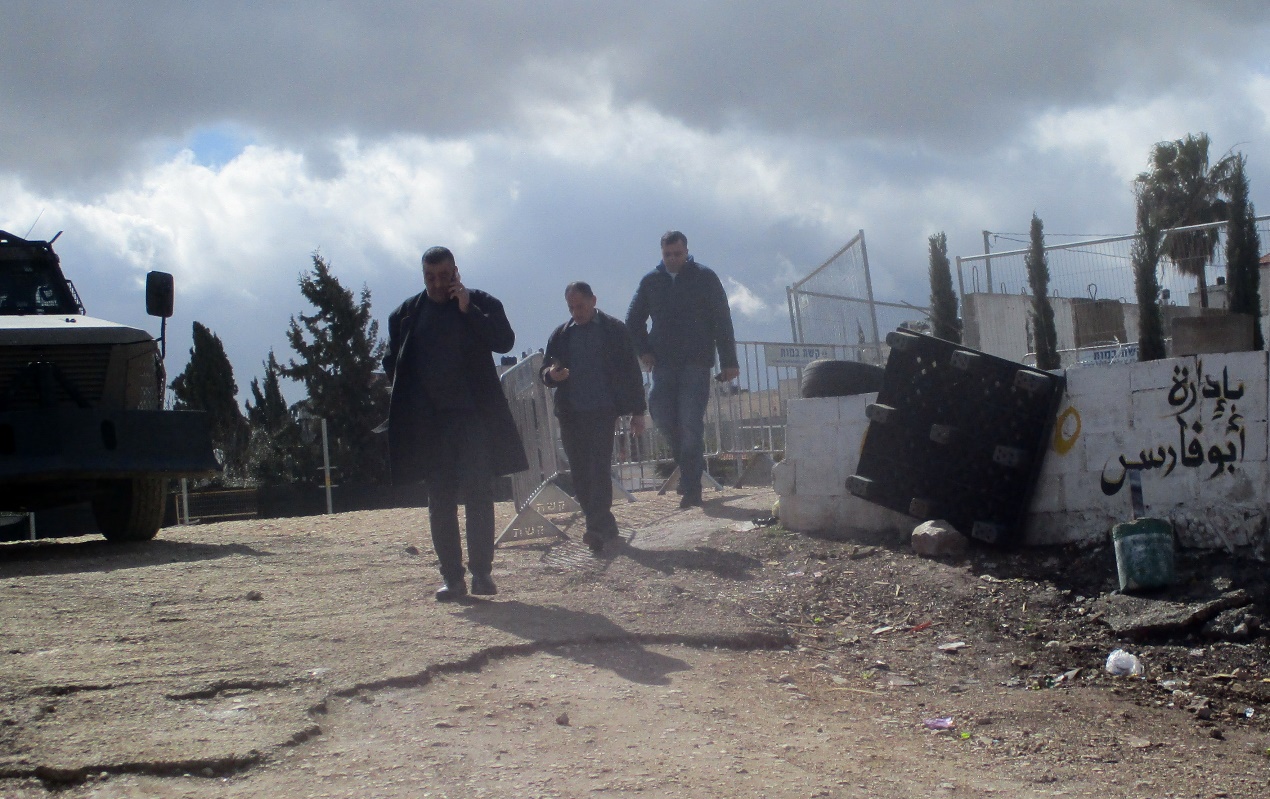
- First, they tried to remove me but I insisted on being present, for a place that holds civilians is no military zone and another civilian is not chased away. Only when the procedure took place, they claimed I couldn’t photograph it. “It is allowed,” I said. “Only if they allow it” they countered (suddenly there is ‘they’, suddenly what ‘they’ allow is most important), but the patient’s daughter not only permitted me to take pictures, she even blew me a farewell kiss.
And let us not forget that Qalandiya is not the shortest or quickest way from Shu’afat refugee camp to the Hadassa Mount Scopus Hospital. One must remember that men are distanced from the sickbed of their female family members, or as some woman said: Back-to-back procedure is practiced where heart-to-heart procedure is needed.
***
Apparently, the Separation Wall begins to wake up from its longtime slumber:


Location Description
Qalandiya Checkpoint / Atarot Pass (Jerusalem)
See all reports for this place-
Click here to watch a video from Qalandiya checkpoint up to mid 2019 Three kilometers south of Ramallah, in the heart of Palestinian population. Integrates into "Jerusalem Envelope" as part of Wall that separates between northern suburbs that were annexed to Jerusalem in 1967: Kafr Aqab, Semiramis and Qalandiya, and the villages of Ar-Ram and Bir Nabala, also north of Jerusalem, and the city itself. Some residents of Kafr Aqab, Semiramis and Qalandiya have Jerusalem ID cards. A terminal operated by Israel Police has functioned since early 2006. As of August 2006, northbound pedestrians are not checked. Southbound Palestinians must carry Jerusalem IDs; holders of Palestinian Authority IDs cannot pass without special permits. Vehicular traffic from Ramallah to other West Bank areas runs to the north of Qalandiya. In February 2019, the new facility of the checkpoint was inaugurated aiming to make it like a "border crossing". The bars and barbed wire fences were replaced with walls of perforated metal panels. The check is now performed at multiple stations for face recognition and the transfer of an e-card. The rate of passage has improved and its density has generally decreased, but lack of manpower and malfunctions cause periods of stress. The development and paving of the roads has not yet been completed, the traffic of cars and pedestrians is dangerous, and t the entire vicinity of the checkpoint is filthy. In 2020 a huge pedestrian bridge was built over the vehicle crossing with severe mobility restrictions (steep stairs, long and winding route). The pedestrian access from public transport to the checkpoint from the north (Ramallah direction) is unclear, and there have been cases of people, especially people with disabilities, who accidentally reached the vehicle crossing and were shot by the soldiers at the checkpoint. In the summer of 2021, work began on a new, sunken entrance road from Qalandiya that will lead directly to Road 443 towards Jerusalem and Tel Aviv. At the same time, the runways of the old Atarot airport were demolished and infrastructure was prepared for a large bus terminal. (updated October 2021)
 Tamar FleishmanFeb-27-2026Qalandiya: On the way to prayer
-