
Lies by a settler grazing on Palestinian land in Mufaqara lead to the arrest of Nasser from Tuwani, who came to help
We are driving to Tuwani to meet Nasser Adra, who was arrested the night before and later released.
When we passed on Route 60, near Farhan’s house in Simiya, we saw a car at the exit of a dirt road that leads off the road, abandoned, blocking the entrance and exit. It turns out that the car keys were taken by the army from its owner and he had no choice but to leave it there until they were willing to return them.
We continued on our way and drove to the entrance to Sa’ir, which was open, to hand over a sum of money that a member of MachsomWatch had asked us to give him.
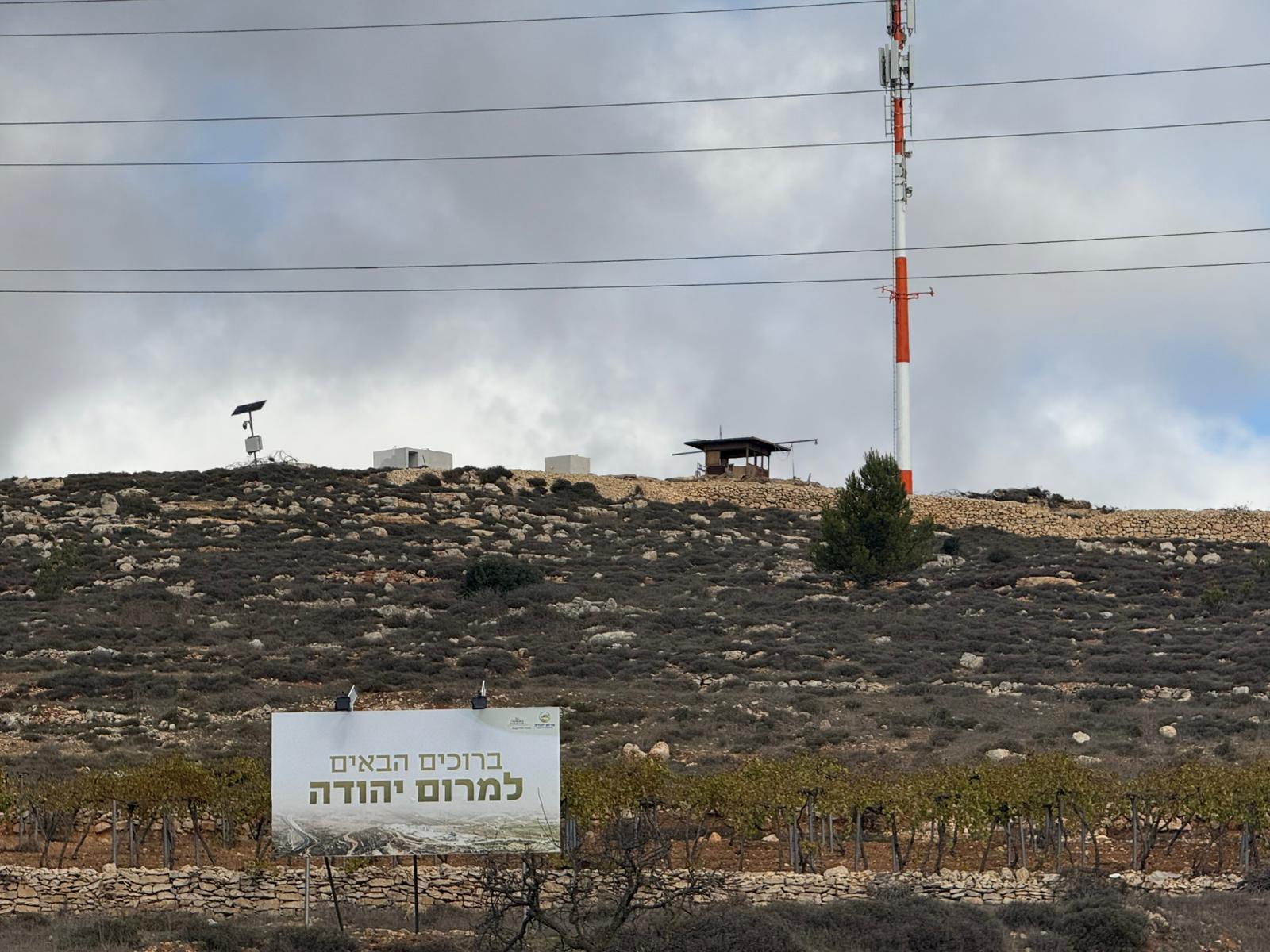
At the entrance to Sa’ir, we noticed a large sign from which we learned about an outpost called Merom Yehuda (Ma’alot Halhul). At its beginning, in 2020, the settlement was an outpost that was evacuated several times, and in May 2025, the political-security cabinet approved its transformation into a settlement. Today, the site is home to a settlement nucleus. (From Wikipedia)
The checkpoint at the entrance to Dura was open, which is quite rare.
We continued to Nabil’s shop at the Zif junction to buy some refreshments for the Adra family.
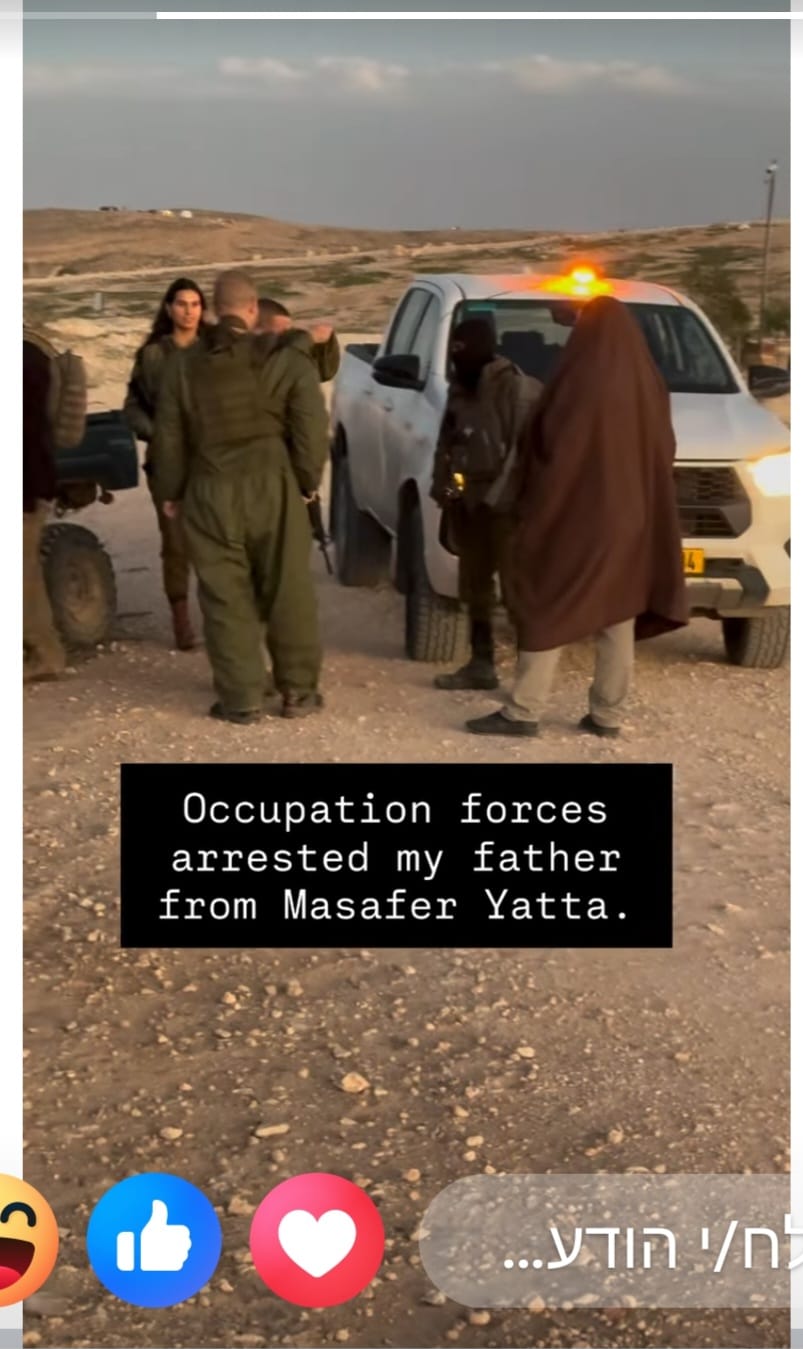
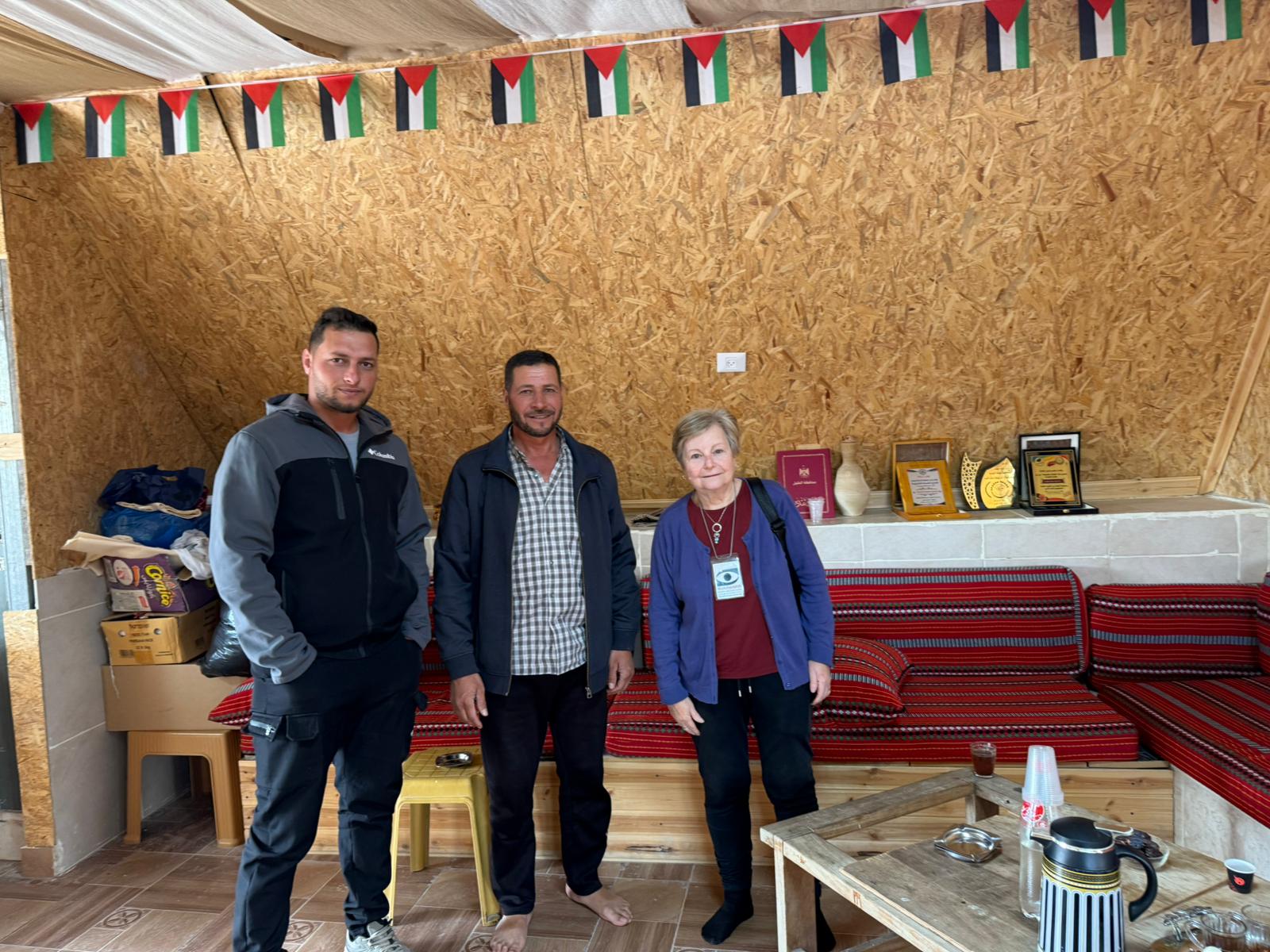
At Tuwani, we were invited to join the family’s Shig, which included Nasser, his son Salem, and several friends from Mufaqara who had come to visit him.
Nasser tells his story, starting from his arrest and then being released.
On 30.11.25, at around 14:00, a settler from Ma’on farm arrived with his flock of sheep to the orchard of Qassem Hamamda from Mufaqara. We mentioned that we have already documented recently that not much of the orchard remains, given the fact that the settlers bring their flocks of sheep to Palestinian agricultural areas (in all occupied territories).
Qassem called to report this to the police. After an hour, a policeman arrived and claimed that the settler was allowed to be in another area nearby, because it was state land. The settler left Qassem’s territory and moved to his neighbour, Naim.
When Nasser Adra and several other friends, Palestinian activists, heard this, they came to support and help. They managed to make the settler leave with his flock, but this called out other settlers who arrived with a jeep and a tractor to the place where Nasser and his friends were standing. They drew weapons, and one of them, dressed in military uniform, even loaded his weapon, threatened them, demanded documents, and informed Nasser that he was being detained. Nasser asked him where the army was, and he replied that he was a representative of the army. Nasser called the police and when they arrived, the settler (an elderly man) claimed that Nasser had thrown stones at them and attacked them.
Needless to say, but it is necessary, the settler lied with a resolute face. We have heard many times about lies from the settlers that led to false arrests of Palestinians. The police demanded that Nasser get into the vehicle, blindfolded him, and handcuffed him. First, he was taken to the military base in Susiya. After about two hours, the army transferred him to the police in Kiryat Arba for questioning. His son, Bassel, waited nearby the entire time, and at midnight, when Nasser was released, he drove him back to Tuwani.
Familiar abuse and an attempt to suppress.
#ThisIsTheOccupation
Location Description
A-Tuwani
See all reports for this place-
A-Tuwani
The locals came to a-Tuwani during the 20th century from the village of Yatta. They settled in abandoned ruins, utilizing the arable land, pastures for grazing sheep and the abundance of natural caves for habitation. The residents who settled in the caves came from families who could not purchase land for houses in the mother villages, as well as shepherds who did not have enough land to graze. They were joined by clan members who quarreled with other families in the mother locality.
Some of the residents today live in concrete buildings built above the caves. In the area of the village are several water cisterns and an ancient water well called 'Ein a-Tuwani. Local residents are forced to buy water in containers and transport them through many road blocks to the village. With the help of international organizations, an electrical system was installed in the village. In the late 90s of the 20tTh century, an elementary school was established in the serving several small villages in the area.
In 2004, MachsomWatch began visiting and reporting from the Khirbet Tuwani cave village, which suffers badly from the settlers of nearby outposts, and especially from the extremist Ma'on outpost. . The settlers contaminate cisterns, poison the flocks and uproot trees.Particularly notable is the harassment of children from the surrounding villages on their way to school in a-Tuwani, so much so that military escort of children is required to separate them from the attackers (this was arranged following an initiative of the organization's members). In the past year, the escort has been without the vital presence of overseas volunteers.
Near a-Tuwani there are several families who have returned to the caves due to the incessant demolitions of the civil administration (as there is a total construction ban in all of area C). Destroyed are not only residential and agricultural buildings, but also water pipes, machinery. Even water cisterns are clogged up. a-Tuwani residents have created an association for non-violent demolition protests, but in the past year the army’s harsh harassment and settler violence have intensified and escalated. The incident of the small generator confiscation, which left a young man paralyzed, is one of many examples - any legitimate protection of property rights leads to violence and even shootings by the army and the civil administration.
Updated April 2022
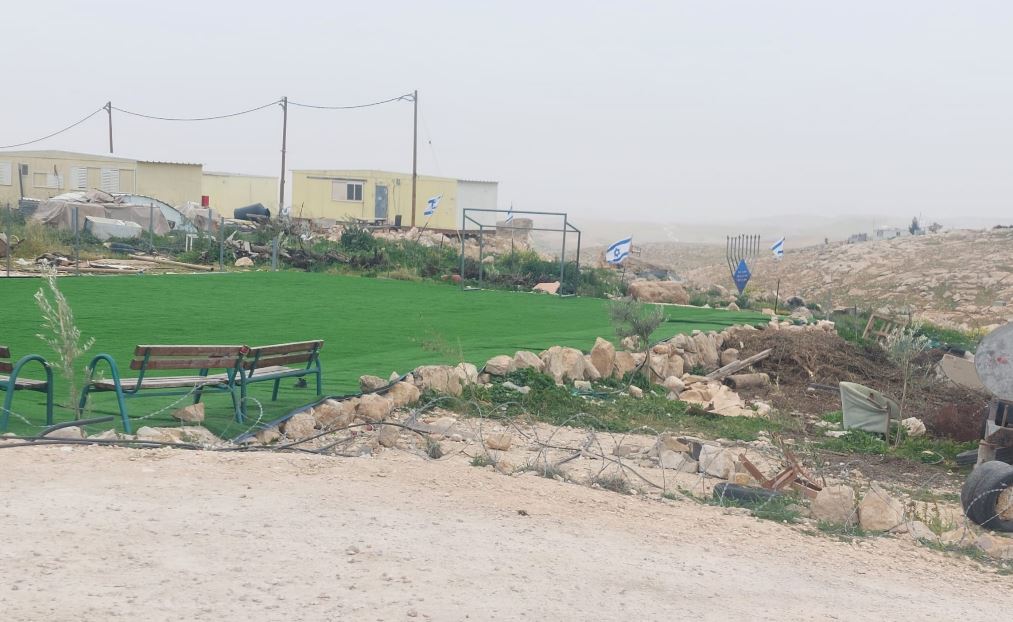 Michal TsadikFeb-17-2026Umm al-Khair: The soccer field for Palestinian children is surrounded by new trailers and lots of Israeli flags
-
Dura Al-Fawwar Junction
See all reports for this place-
Junction on Route 60: west - the town of El Dura, east - the Al Fawwar refugee camp. There is a manned pillbox at the junction. From time to time the army sets up flying checkpoints at the entrance to El Fawwar and Al Dura. Al-Fawwar is a large refugee camp (7,000 inhabitants in 2007) established in 1949 to accommodate Palestinian refugees from Be'er Sheva and Beit Jubrin and environs. There are many incidents of stone-throwing. In the vicinity of the pillbox there are excellent agricultural areas, Farmers set up stalls adjacent to the plots close to the road. In recent months the civil administration has set up dirt embankments thereby blocking access to the stalls, and making it impossible for the farmers to sell their vegetables. Updated April 2021, Michal T.
-
Mesafer Yatta
See all reports for this place-
This is happening in Fire Area 918 in the South Hebron Hills
On the eve of Remembrance Day (the day before Israel Independence Day), 4th May, 2022, the Israeli High Court decided on the transfer and expulsion of residents from 8 Palestinian communities in the area of Masafar Yata in the South Hebron Hills. Residents of the villages have been living under the threat of demolition, evacuation and expropriation since the IDF issued evacuation orders in 1999 based on the 1980s proclamation of their area of residence as a firing zone for IDF drills. None of the nearby settlements were included in this zone. The Masafer Yata Palestinian villages retain a special lifestyle and ancient agricultural culture. They also posess a clear historical documentation that testifies to a Palestinian settlement in this area, generations before the establishment of Israel, long ago in the caves and at later times outside them.
Evacuating residents from the area means destroying these historic villages and leaving entire families (about 2,000 people, children, adults, and the elderly) homeless. This is contrary to international law.
In June 2022, a firing drill started, and life became harder.
-
South Hebron Hills
See all reports for this place-
South Hebron Hills
South Hebron Hills is a large area in the West Bank's southern part.
Yatta is a major city in this area: right in the border zone between the fertile region of Hebron and its surroundings and the desert of the Hebron Hills. Yatta has about 64,000 inhabitants.
The surrounding villages are called Masafer Yatta (Yatta's daughter villages). Their inhabitants subsist on livestock and agriculture. Agriculture is possible only in small plots, especially near streams. Most of the area consists of rocky terraces.Since the beginning of the 1980s, many settlements have been established on the agricultural land cultivated by the Palestinians in the South Hebron Hills region: Carmel, Maon, Susia, Masadot Yehuda, Othniel, and more. Since the settlements were established and Palestinians cultivation areas have been reduced; the residents of the South Hebron Hills have been suffering from harassment by the settlers. Attempts to evict and demolish houses have continued, along with withholding water and electricity. The military and police usually refrain from intervening in violent incidents between settlers and Palestinians do not enforce the law when it comes to the investigation of extensive violent Jewish settlers. The harassment in the South Hebron Hills includes attacking and attempting to burn residential tents, harassing dogs, harming herds, and preventing access to pastures.
There are several checkpoints in the South Hebron Hills, on Routes 317 and 60. In most of them, no military presence is apparent, but rather an array of pillboxes monitor the villages. Roadblocks are frequently set up according to the settlers and the army's needs. These are located at the Zif Junction, the Dura-al Fawwar crossing, and the Sheep Junction at the southern entrance to Hebron.
Updated April 2022
Michal TsadikFeb-17-2026Umm al-Khair: The soccer field for Palestinian children is surrounded by new trailers and lots of Israeli flags
-
Zif Junction
See all reports for this place-
Zif Junction located on the crossroads that directs towards Road 356 to Yata. Yata is the district city of the southern Hebron Mountains. Usually, this junction is open to traffic. The nearby pillbox is unmanned. But the army and police are present occasionally, sometimes setting up a checkpoint and sometimes detaining residents from the big city. Often, the Israeli policemen inspect vehicles and distribute driving reports to Palestinian vehicles. s
-