
Qawawis - Kh. says: "I will not move from here, I will stay on my land."

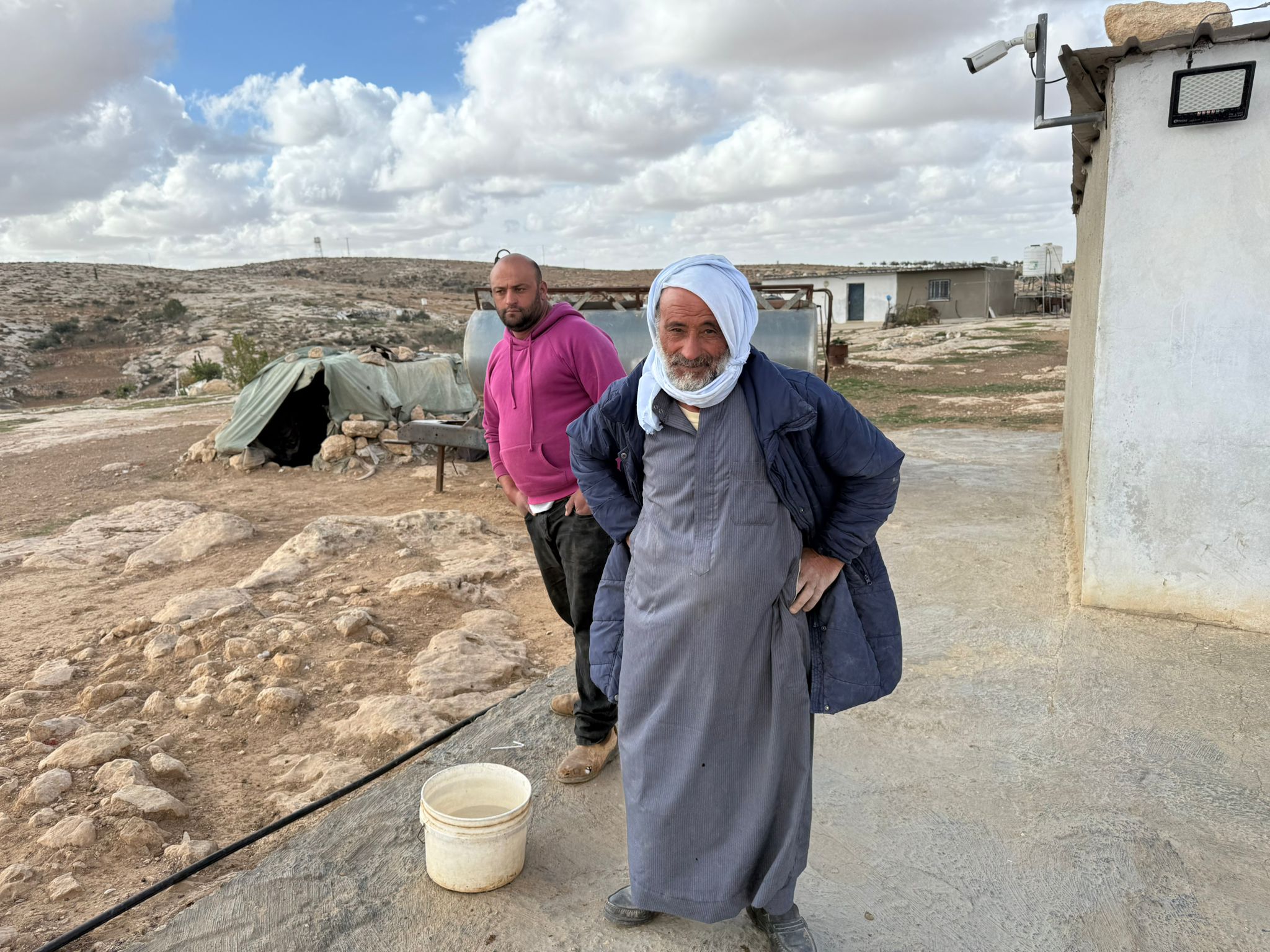


This time we went to Qawawis, which is a small hamlet on a hill at the foot of Mitzpe Yair. On the way to Sha’ab al-Butum. We hadn’t been there for a long time.
The Najjar family lives there in heartbreaking misery. On our way there, we surveyed the state of the entrances to the settlements along Route 60:
At the entrance to Dahariya, which has been closed since 7.10.23, located at the foot of the Otniel settlement, we met Ali, who for several months has been given money to buy more groceries in his village than we can buy, as well as a bag of clothes for his children.
An abandoned car is parked next to the closed checkpoint. According to M., it was confiscated by the IDF.
All the way to Abda, about 5 km, Israeli flags were densely planted. We see them everywhere, but this “boulevard” is new.
The entrance to Abda is closed.
At the Dura al-Fawwar junction, it is open on both sides.
At the Qilqis junction, the road is closed on both sides.
At the Sheep junction, the entrance to Hebron is open, to Yatta it is closed.
At the Zif junction, the entrance to Yatta is open. At the grocery store there, we bought groceries for the Najjar family. On the way there, Jaber plows with a donkey (that’s the only way there, as I recall)
He was also expelled from his “home” in Qawawis a year ago. “They took everything from me,” he says. “They demolished the house, I had no sheep left because I had to sell them. They uprooted the olives.” Now he lives in a shack not far away.

We arrived at Najjar family. The old man in the group opens up and talks about his health today, after being seriously injured in an attack by settlers from Mitzpe Yair who shot him in the stomach 24 years ago. I didn’t want him to show me his scarred stomach. He says they took him on a donkey to Yatta. For some reason, the army came and took him to Soroka Hospital, where he underwent surgery and was there for 45 days. From there he was transferred to Jordan for a month, and from there, in an agreement with Saddam Hussein, he was transferred to Iraq and was there for 7 months and underwent many surgeries. In Baghdad, the medical treatment was almost as good as in Israel, says Khaled al-Najjar, who now lives with a severe disability.
Again, in January of this year, they arrived from Mitzpe Yair at 3 a.m. to the cave where the sheep and donkey were, intending to steal. He was sleeping outside. The dog barked and he went out to see what was happening. The settlers hid in a fold of ground, where they lay dressed in IDF uniforms. When he approached, they attacked him with sticks and wounded him in the head and eye. He was taken to the hospital in Hebron for intensive care and had 14 stitches in his head. But his eye was badly damaged. He can’t see out of that eye now. At the time of the incident, B’Tselem and neighbors arrived immediately.
The settlers fled without being able to steal anything.
Yesterday, Monday, they came again and tried to steal again. They are now coming with the sheep to eat all the tender olive seedlings and everything that sprouts. Every day the settlers come and shout: “Get out of here, go to Egypt, go to Iran, Saudi Arabia, this is our country!”
When the policemen arrive, they do nothing. They say that when the police arrive, they say that a settler is allowed to come up to 3 meters from their house. And also, when he enters their house, they are not allowed to touch him, just call the police. They say the police call the security coordinator and he informs the settlers that the police are coming soon, and then they run away before they arrive. Then they arrive two hours later, they don’t want to see the photographs that the Palestinians want to show them. And they say: There are no settlers, so there’s no problem.
Another answer they hear from the police is that they can’t come because it costs a lot of fuel to get there. The reality is that the settlers come every day, day or night, frightening and threatening.
Kh. says: “I won’t move from here, I’ll stay on my land.”
Location Description
Dura Al-Fawwar Junction
See all reports for this place-
Junction on Route 60: west - the town of El Dura, east - the Al Fawwar refugee camp. There is a manned pillbox at the junction. From time to time the army sets up flying checkpoints at the entrance to El Fawwar and Al Dura. Al-Fawwar is a large refugee camp (7,000 inhabitants in 2007) established in 1949 to accommodate Palestinian refugees from Be'er Sheva and Beit Jubrin and environs. There are many incidents of stone-throwing. In the vicinity of the pillbox there are excellent agricultural areas, Farmers set up stalls adjacent to the plots close to the road. In recent months the civil administration has set up dirt embankments thereby blocking access to the stalls, and making it impossible for the farmers to sell their vegetables. Updated April 2021, Michal T.
-
Hakvasim (sheep) Junction
See all reports for this place-
One of the roadblocks (earthworks, rocks, concrete blocks or iron gates) that prevent transit of vehicles to Route 60 in the southern West Bank and block the southern entrance to Hebron. A manned pillbox supervises the place.
-
Sha'ab al-Butum
See all reports for this place-
This is one of the small Palestinian communities in Masafer Yatta in the southern Hebron Hills, near the settlement of Mitzpe Avigail.
Since the outbreak of the October 7, 2023 war, settler violence against residents has escalated greatly, as in the entire Palestinian community. This violent conduct receives full backing from the state and full cooperation from the IDF. The goal is to make the lives of the Palestinian residents miserable and make them abandon and leave.
The population consists of mostly shepherds who peacefully seek to cultivate the land and graze their sheep, whom the settlers treat as a dangerous enemy. They prohibit them from any movement related to herding sheep and cultivating the land and harm everything: trampling crops, breaking olive trees, smuggling herds, scaring shepherds, conducting wild searches of houses, shouting, cursing and threatening - at all hours of the day. "We are Besieged, but will not move from our land," says Lila G. New settlements are springing up around them. At first it's a bus or a truck that turns into residential buildings, on top of which every week more residential buildings and animal sheds are added. With the open encouragement of the current government, Jewish terrorism is raising its head, with authority and permission. The settlers have received army uniforms and weapons, and no one is stopping them. The police, who are supposed to protect the Palestinians from the settlers' riots, sometimes respond to calls for help, but in practice they don't do much more than provide them with a report, and they are required to go and file a complaint in Kiryat Arba Settlemnt police station . Though the settlers' identities are known, they are !never arrested.
-
South Hebron Hills
See all reports for this place-
South Hebron Hills
South Hebron Hills is a large area in the West Bank's southern part.
Yatta is a major city in this area: right in the border zone between the fertile region of Hebron and its surroundings and the desert of the Hebron Hills. Yatta has about 64,000 inhabitants.
The surrounding villages are called Masafer Yatta (Yatta's daughter villages). Their inhabitants subsist on livestock and agriculture. Agriculture is possible only in small plots, especially near streams. Most of the area consists of rocky terraces.Since the beginning of the 1980s, many settlements have been established on the agricultural land cultivated by the Palestinians in the South Hebron Hills region: Carmel, Maon, Susia, Masadot Yehuda, Othniel, and more. Since the settlements were established and Palestinians cultivation areas have been reduced; the residents of the South Hebron Hills have been suffering from harassment by the settlers. Attempts to evict and demolish houses have continued, along with withholding water and electricity. The military and police usually refrain from intervening in violent incidents between settlers and Palestinians do not enforce the law when it comes to the investigation of extensive violent Jewish settlers. The harassment in the South Hebron Hills includes attacking and attempting to burn residential tents, harassing dogs, harming herds, and preventing access to pastures.
There are several checkpoints in the South Hebron Hills, on Routes 317 and 60. In most of them, no military presence is apparent, but rather an array of pillboxes monitor the villages. Roadblocks are frequently set up according to the settlers and the army's needs. These are located at the Zif Junction, the Dura-al Fawwar crossing, and the Sheep Junction at the southern entrance to Hebron.
Updated April 2022
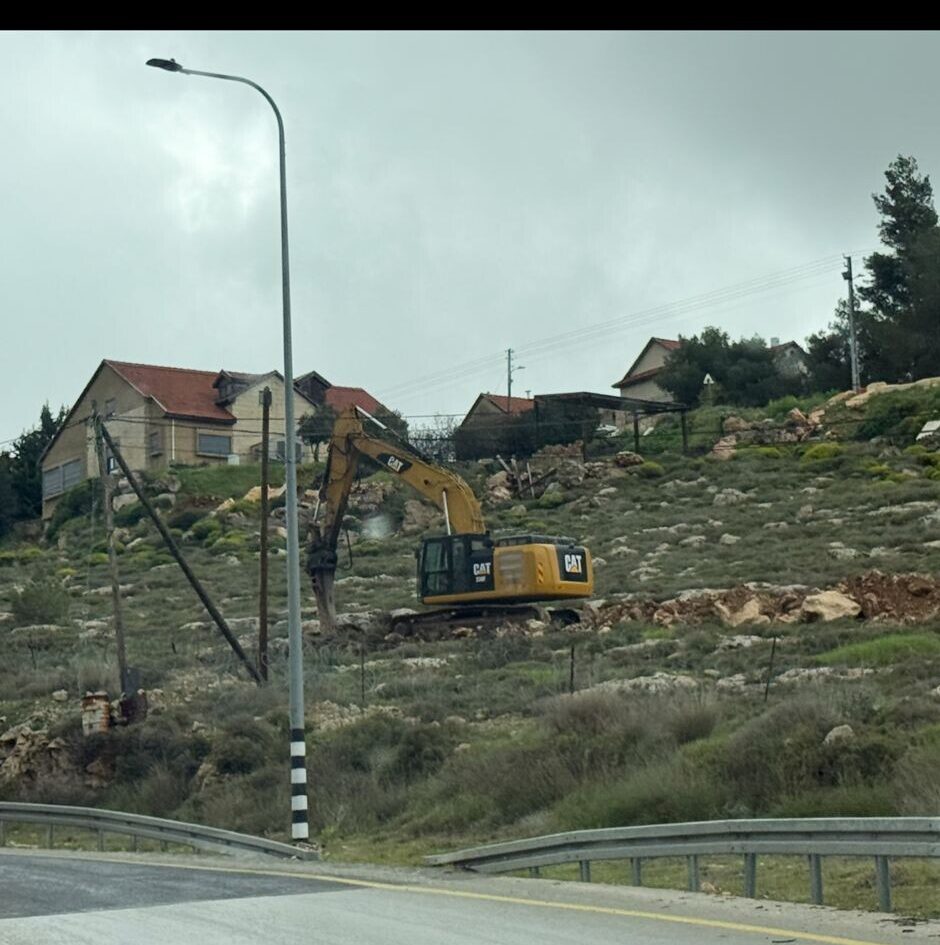 MuhammadFeb-24-2026South Hebron Hill, Beit Hagai: Paving an internal security road
-
Zif Junction
See all reports for this place-
Zif Junction located on the crossroads that directs towards Road 356 to Yata. Yata is the district city of the southern Hebron Mountains. Usually, this junction is open to traffic. The nearby pillbox is unmanned. But the army and police are present occasionally, sometimes setting up a checkpoint and sometimes detaining residents from the big city. Often, the Israeli policemen inspect vehicles and distribute driving reports to Palestinian vehicles. s
-