
A., a shepherd from the Jordan Valley who was severely beaten by soldiers and had his car impounded, asks “Why? What did we do to them?
Saturdays have become almost routine for our escorting shifts. The morning hours normally pass quietly, without disturbance and that’s how it was this time. But there’s always tension in the air, that maybe this time the settlers will deviate from their rest and will disturb the Palestinians during the daytime as well. And in the afternoons, there’s always harassment in one of the Palestinian localities.
On this weekend, the teams of volunteer escorts who arrived in the Valley at daybreak split up among the communities: At 6:30, three of them joined three flocks and shepherds from Al-Farisiya, who were returning home after a long summer grazing at Ein a-Sakut, to the east of Route 90. This Saturday, they returned with their flocks via a wadi that winds its way through the mountainous hills for some 10 km to Al-Farisiya, which is on the west of the Allon Road, opposite the settlement Rotem.
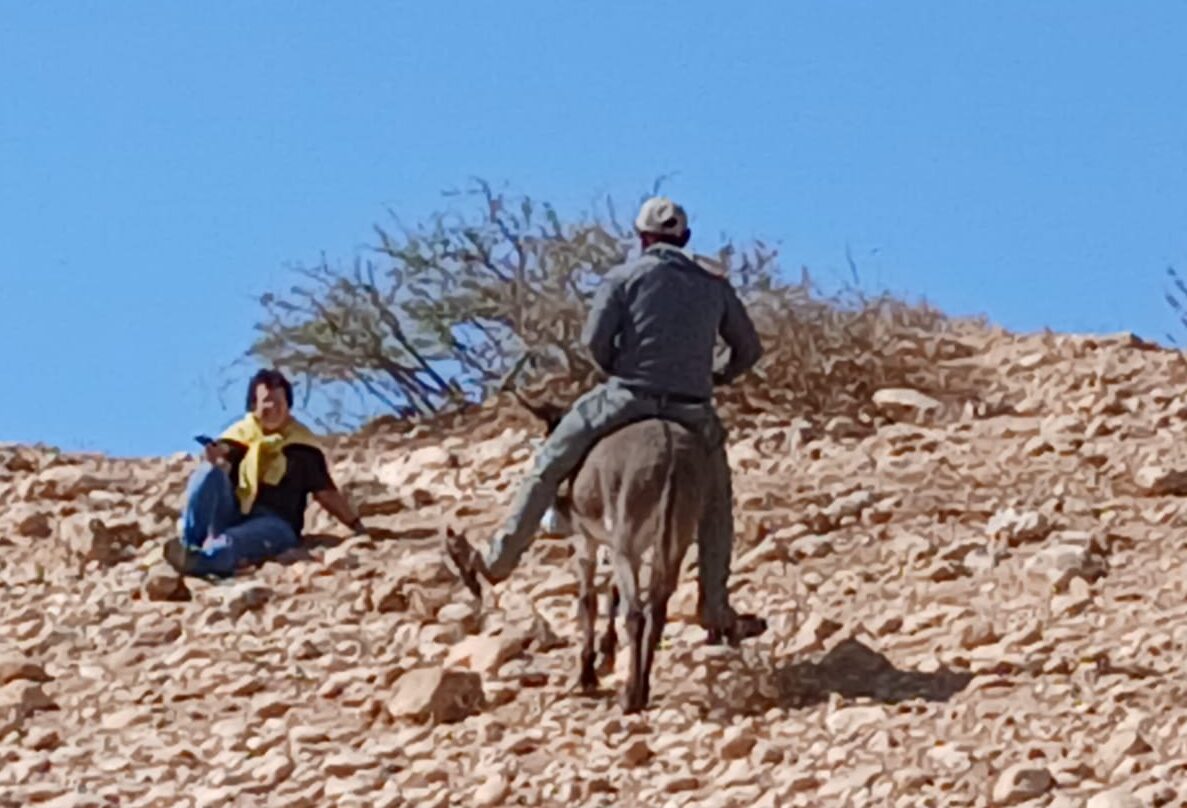
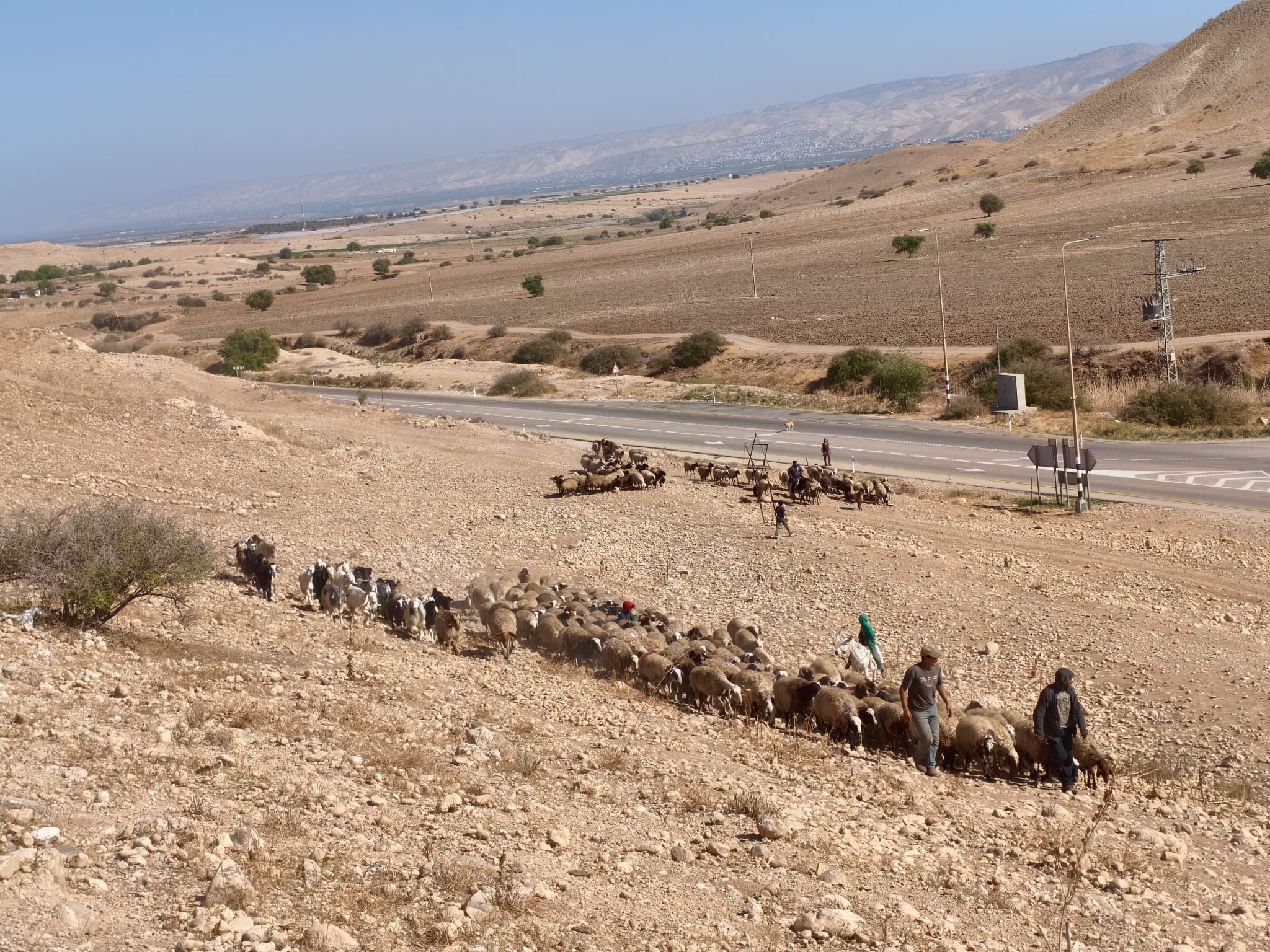
The shepherds’ walk with their sheep began at 7:00 a.m. Two of the three escorts joined them on foot and the third drove ahead them slowly in his car from the summer pasture at Ein a-Sakut. This was to warn the settlers if they appeared and tried to disturb and harass the shepherds and their flocks.
At the same time, two more cars remained at Al-Farisiya as a protective presence (24/7 presence with the shepherds’ families in their homes) and had time to enjoy several cups of tea and coffee and conversations with the village women while waiting for the shepherds and flocks to arrive. At 10:30, two escorts went up to the hill overlooking the village of Al-Farisiya and the path leading to the village, to watch and warn of any malicious intentions by the settlers. This was necessary, so that the sheep’s permanent pens could be prepared and filled with sacks of hay and water before they reached the end of their long journey.
The sheep’s return home went peacefully with no interference that morning. At 11:30, the shepherds were reunited with their families and the sheep were settled in the pens.
At the same time, two other escorts at Ein al-Hilwe were accompanying two herdsmen with their two herds of cattle to drink at En Al Hilwe spring – Z at 8:30 and F at 9:00. Here too, this passed without disturbance and when the cows had finished drinking, they returned to their enclosures to eat the hay that had been bought at great cost. It’s no longer possible to take them out to graze since the settlers, with the army’s cooperation, forbid them to graze on open land.
The rest of the day passed peacefully, even calmly. Some of the escorts stayed at Ein al-Hilwe for the afternoon watering and the others dozed under the tree at the center of Al Farisiya or talked amongst themselves with the locals. The afternoon grazing passed quietly as well.
But there’s always at least one disturbance towards the end of the day.
At 4:00 p.m., a call was received from Khalet Makhul. Y. reported that the army had come to his home and were about the arrest him. Three of us went there and indeed we found a military jeep with four male and female soldiers, who said they’d been given an order to arrest Y. because settlers had seen him wandering around the army base gathering ammunition.
Y. denied it and said he was just picking vegetation for his sheep. But it didn’t help. Nor did our request to have the matter checked again. They ordered him to get into the jeep and immediately all the family gathered and began shouting at the soldiers, asking why were they taking him for no reason. That he’d done nothing. A heated argument between Y’s wife and one of the female soldiers ensued, and then suddenly, without warning, one of the soldiers, whose face was masked like all the others, took a machine gun from the car and aimed it at the family, including Y’s wife and his ten children aged between three and 20. We couldn’t just stand and watch. We stood between them and yelled at them to put down their weapons. The soldier apparently gave himself a fright and said that he wasn’t intending to shoot. One of the escorts, who couldn’t bear to see this began reprimanding them – how could they not be ashamed of themselves for threatening women and children.
That didn’t help either. Y. was taken to one of the bases “for investigation.”
We informed the army contact person to find out where they had taken Y. and make sure, he was released. We left our phone numbers with the family for updates and in the meantime drove to the birthday party of one of the shepherds at Ein al-Hilwe. We had to leave at 5:30 p.m. Y. was only released around 7:00 p.m., after a delay of three-and-a-half hours. Members of the evening shift picked him up and brought him home. He said that the soldiers bound his arms and legs and beat and kicked him all over his body for hours. His entire body was full of bruises and pains and it will take days for him to recover.
The following day we heard that there was a problem bringing the sheep back from Ein a-Sakut. A., who was bringing back tarpaulin that had been used to make the temporary pen at the summer camp was arrested and taken by the army, based on information from one of the Jordan Valley council workers. The claim was that he wanted to use the tarpaulin to build a new structure. He, too, was severely beaten, and when he returned, he couldn’t stand on his legs. On top of that, his car was confiscated. He said about it: Physical injuries will pass, but mental injuries won’t go away. And he asked all of us: “Why? What did we do to them?”
Yup! The occupation is no party for the Palestinians. It’s hell everywhere.
Location Description
'Ein al-Hilwe
See all reports for this place-
Ein al-Hilwe is a natural spring and a Palestinian grazing area in the Jordan Valley that was used by the Palestinian shepherd communities for watering their flocks and for daily use. As of 2021, settlers from the Maskyot settlement took control of the spring: they fenced it off, built a wading pool and a mikveh, and installed flags and recreational facilities.
Palestinians are effectively denied access to the spring, and are forced to make do with running water in a remote wadi or, when the road is blocked, buy water from vendors at high prices.
The spring is located in the heart of an area where illegal outposts are being established, as part of a broader trend of pushing Palestinian communities away by denying them access to essential resources. Neighboring communities such as Umm Jamal and Khirbet Samra have already left due to the pressure.
Over the years, MachsomWatch members have reported arrests on false claims by settlers, harassment and violence, including damage to herds, intrusion into homes, and the intimidation of children. MachsomWatch volunteers participate in a protective presence in areas around the spring to prevent harassment of shepherds due to the presence of settlers.
-
Al-Farisiya / 'Ein a-sakut
See all reports for this place-
Al-Farisiya / 'Ein a-sakutA community of shepherds in the Jordan Valley opposite the settlement of "Rotem". Making a living from grazing sheep, the residents are exposed to harassment, abuse and theft from settlers who come to them from outposts and settlements in the area, and their grazing area is shrinking due to settler takeovers, fire zones and declared nature reserves.Machsom Watch companies participate in shepherd escort activities and provide a 24/7 protective presence, and there is continuous and warm contact with the community.
-
Khalet Makhul
See all reports for this place-
Khalet Makhul
A small settlement of a shepherd community located on the way to the settlement of Hemdat. Two nearby outposts make life miserable for the Palestinians, who make a living from grazing, and the army backs the settlers. As a result, the possible grazing areas are getting smaller.
The local children attend school in the settlement of Ein Al-Beida. Long lines of 3 hours sometimes stretch out at the Hamra and Tayasir checkpoints leading to the town of Tubas, making it difficult to get water, supplies, and sell the cheese, milk, and meat that the residents produce for their living.
Following a deadly attack at the Tayasir checkpoint in February 2025, the checkpoint was closed completely for the time being.
(Updated March 2025)
-