
A shift and a tour of the Oranit area
The tour was conducted in connection with an interview conducted by a Swiss student researching the conflict and human rights organizations in Israel. His grandmother, who lives in central Israel, accompanied us.
We drove to Ariel. I explained how the settlements are taking over lands belonging to the area’s villages. We continued to the Elkana salient, to Hani gate and Oranit, with explanations about the occupation, checkpoints, and the separation fence – which here is the form of a wall, unusual in an uninhabited location. We recounted the story of Hani’s house and the wall dividing him from his village. At the Oranit gate we found a male and a female soldier seated in a shed that I’d thought had been erected for Palestinians waiting for the gate to open. They didn’t know when it opened in the afternoon – “The hours have changed – maybe at 2 PM” – nor during what hours it was open in the morning or afternoon. Their function is to prevent Palestinians from climbing over the huge gate surmounted by two metal, barbed wire fences. They promised us to permit arriving Palestinians to wait across the way, pointing to a pile of barbed wire coils.
Our guests realized the arbitrariness of the situation and the Palestinians’ helplessness.
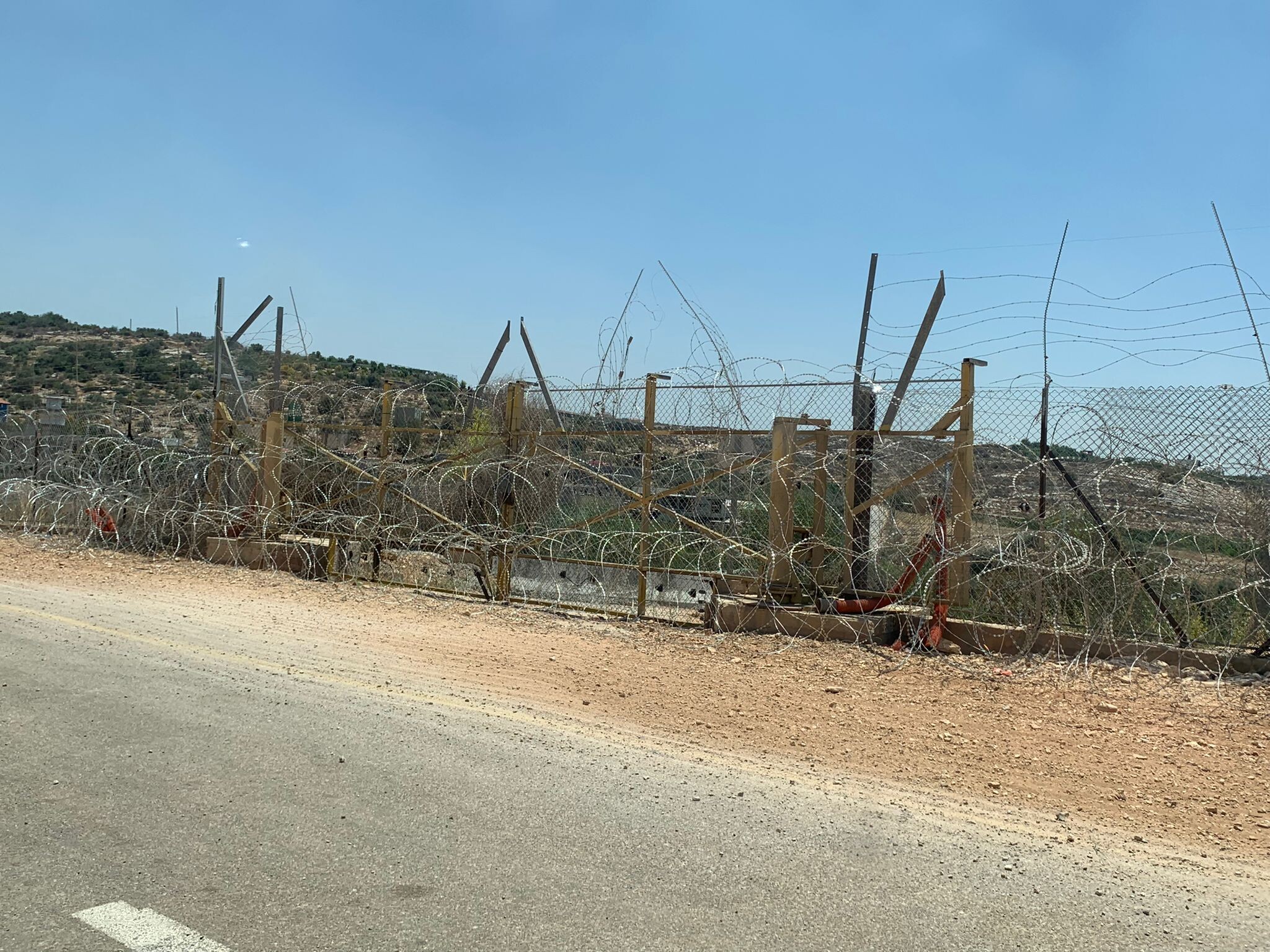
Back to Highway 444, to Alfei Menashe and the separation fence that had been relocated following a court decision, with an explanation of the entire procedure. The large yellow gate in this fence, which has never opened, is wrapped with coils of barbed wire – apparently part of the effort to prevent people without permits from entering Israel.
We drove through ‘Arab a Ramadin and reached the Habla checkpoint a few minutes before it opened. This time the pump room was open, and I saw for the first time some plant nurseries that had been established near the gate.
We approached the checkpoint. The large left-hand wing of the gate on our side was already wide open. Three soldiers who proudly declared they were paratroopers sit in a shaded emplacement guarding the side entrance adjoining the main gate, for people on foot. For some reason unknown to us (maybe budget) a barred metal gate still hadn’t been installed there. The military policemen arrived at 13:30 and opened the gate on the Habla side as well, where they checked the permits of those going through. The first was a motorcyclist, then people on foot, and then vehicles. Two trucks went through, one of them loaded with saplings and a few cars. Traffic toward Habla was also light.
We ran into A. at the plant nursery who was very busy watering the lovely plants in the very hot weather. We didn’t want to interrupt, and instead of joining him for coffee conducted the interview in the air-conditioned car. When we finished it was almost three and we weren’t able to talk to him ourselves, so we left.
Habla CP (1393)
See all reports for this place-
Habla CP (1393)
The Habla checkpoint (1393) was established on the lands of the residents of Qalqilya, on the short road that
connected it for centuries to the nearby town of Habla. The separation barrier intersects this road twice and cut off the residents of Qalqilya from their lands in the seam zone.(between the fence and the green line).
There is a passage under Road 55 that connects Qalqilya to the sabotage This agricultural barrier is used by the farmers and nursery owners established along Road 55 from the Green Line and on both sides of the kurkar road leading to the checkpoint.
This agricultural checkpoint serves the residents of Arab a-Ramadin al-Janoubi (detached from the West Bank), who pass through it to the West Bank and back to their homes. The opening hours (3 times a day) of this agricultural checkpoint are longer than usual, about an hour (recently shortened to 45 minutes), and are coordinated with the transportation hours of a-Ramadin children studying in the occupied in the West Bank.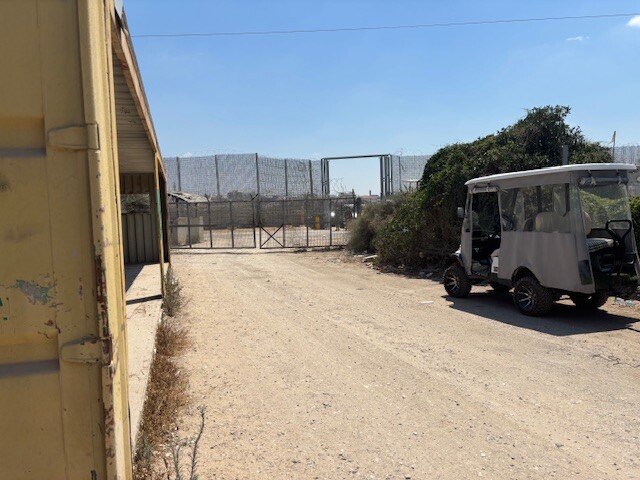 Nina SebaAug-18-2025Habla: The gate is in the process of closing
-
Oranit CP (1474)
See all reports for this place-
Oranit CP (1474) Oranit Checkpoint (4) (formerly 1474) An agricultural checkpoint in the separation wall serves the farmers of 'Azzun' Atma, whose land is in the seam zone near Oranit. Since the construction of the new wall in 2013. Was opened 3 times a day. Since 2018, the army has refused to open it except during the olive harvest. Since 2018, it has been opened only during the olive harvest and the farmers have to pass daily at the Beit Amin / Abu Salman checkpoint (1447). Fein Report from March 24, 2021: "The farmers from Beit Amin and Azzun Atma are happy that since last month the checkpoint has been open 3 times a day, at 6 in the morning, at 1 in the afternoon and at 4 in the afternoon. The farmers are really developing the place. "
-