
A – Tuwani,South Hebron Hills
A-Tuwani, Saturday August 6, 2005 AMWatchers: Tal H, Ivonne M, Rachel H, Angela G, Hagit S, Ronnie H, 5 guests from abroad and Nina M (reporting) A-Tuwani is a small village of Palestinian shepherds south of Hebron. 350 people live here. The village is in the area C. Old stone-made houses are from the Ottoman period. New buildings (a school, a clinic and few living houses) made from cement bricks are build without permits and can be destroyed by the Israeli forces, at any “suitable” moment. The address of citizens of A-Tuwani, as stated in their IDs, is Yata or Hebron. From time to time , when the Israeli army has an urge to harass A-Tuwani people, soldiers at the flying checkpoint in an entrance to the village do not let people to go to their homes, because in their IDs A-Tuwani as their home address is not stated.Below is the story of J. about his struggle against Maon settlers and the Israeli authority, who try to disposes him from his land.J. told his story during the visit of Machsom Watch women in A-Tuwani on Saturday August 6, 2005J. is an owner of an agricultural land and he has an ownership documents from the Turkish times. Three years ago Maon settlers decided to prevent J. from plotting his land. After he plotted and seeded settlers entered and destroyed his work. DCO interfered in this “conflict” and decided that J.’s land is a closed military zone, but J. was allowed to attend his land on Saturdays and Jewish holidays, however he was requested to apply for a special permit each time he wanted to work on his field.At the beginning of the last winter (around December 2004) , J. asked his brothers to get a permit for cultivating the land on one of Saturdays. His brothers spend the whole day trying to enter the DCO office, but did not manage to enter the office, not to speak about getting a permit.In the next few days J.’s family noticed that settlers from Havat Maon plow J.’s land during weekdays (days of the closed military zone) and soldiers guard them.J. decided that he will use his land for sheep gazing, because he understood that he will not be able to cultivate anything.At one of the winter days settlers (among them one named Gadi) decided to challenge shepherds. Gadi throw a stone towards J., another settler with a gun threaten to shoot J. and his sheep. A-Tuwani people moved their sheep out of the land and than returned. Settlers attacked shepherds and the Operation Dove people, who tried to record the whole event with their video camera. They severely injured two people from the Operation Dove group, Georgio and Yohanes, who needed to be hospitalized.J. went to Kiryat Arba police station to complain about settlers attack. He met there Avi Kotenberg, an officer, who shouted at J. and accused Ezra (a Taayosh person, very much committed to A-Tuwani cause) of pushing J. into unnecessary confrontations with settlers. When J. told Avi that he will report to media about his behavior, Avi calmed down and asked to be excused.At the same time, when J. was at the police station, settlers again launched an attack, this time against sheep, while blue police observed the event without interfering.In order to end this “conflict” the army decided to convert the area into “a firing zone no 918”, meaning nobody is allowed to enter there, however another land belonging to J.’s family was permitted to be used for grazing.On March 25, 2005 A-Tuwani people found a poison grains spread on their grazing fields. Gidalia, a security officer from Maon settlement claimed that J. was the one who spread the poison. J. informed media and took care about a proper film documentation. A-Tuwani people, together with Taayosh and international activists, started to collect poison grains. The Israeli organization for Nature Protection (Hevra Lehaganat Hateva) became very worried , when wilde goats and eagles started to die. Abu Bahar, Druze worker of this organization insisted that teenagers from Maon settlement will participate in cleaning activity, in spite of J.’s objections. While cleaning fields, J. heard young settlers saying, that they want to transfer collected poison grains in order to poison a nearby Susia village sheep. As a result of spreading the poison by settlers 60 sheep died. The biggest waste was in sheep milk, which could not be used for 3 months. The attacks of settlers continue all the time. J. says that, when settlers appear, he asks CPT people or friendly Israelis to call the police. He says, that if he calls the police never comes.Few weeks ago a lawyer from Center for the Defence of the Individual (Moked le Haganat Haprat) sent a map proving that the fire zone no 918 is not, where J.’s land is.At the end of July J. decided to use his non-“fire zone land” for gazing his herd of sheep. On August 1 st , 2005 settlers spotted A-Tuwani people on the “conflict” land and called the army. J. showed the DCO officer, who arrived quickly, the map, which he get from the Defence Center, but the officer just tear the map into pieces. While J. left the area, another jeep with soldiers appeared. Soldiers started to beat a shepherd named N. and J.’s 60 years old mother in law, both were with their sheep in the “conflict” area. N. was severely beaten by 7 soldiers. Beatings were recorded by D. from Christian Peacemaker Team (CPT). The copy of this film can be obtained.Blue police detained N. He was accused of grabbing a gun from one of the soldiers (this is a standard accusation). N. was released on a bail of 2000 IS by Taayosh people.The struggle of J. and other A-Tuwani people continues.It is worthwhile to add that objectives of settlers and the Israeli authorities are very clear. Both want to disposes villagers of the South Hebron Mountain and to force them to live in Yata, a kind of Bantustan of the South part of the occupied West Bank.
A-Tuwani
See all reports for this place-
A-Tuwani
The locals came to a-Tuwani during the 20th century from the village of Yatta. They settled in abandoned ruins, utilizing the arable land, pastures for grazing sheep and the abundance of natural caves for habitation. The residents who settled in the caves came from families who could not purchase land for houses in the mother villages, as well as shepherds who did not have enough land to graze. They were joined by clan members who quarreled with other families in the mother locality.
Some of the residents today live in concrete buildings built above the caves. In the area of the village are several water cisterns and an ancient water well called 'Ein a-Tuwani. Local residents are forced to buy water in containers and transport them through many road blocks to the village. With the help of international organizations, an electrical system was installed in the village. In the late 90s of the 20tTh century, an elementary school was established in the serving several small villages in the area.
In 2004, MachsomWatch began visiting and reporting from the Khirbet Tuwani cave village, which suffers badly from the settlers of nearby outposts, and especially from the extremist Ma'on outpost. . The settlers contaminate cisterns, poison the flocks and uproot trees.Particularly notable is the harassment of children from the surrounding villages on their way to school in a-Tuwani, so much so that military escort of children is required to separate them from the attackers (this was arranged following an initiative of the organization's members). In the past year, the escort has been without the vital presence of overseas volunteers.
Near a-Tuwani there are several families who have returned to the caves due to the incessant demolitions of the civil administration (as there is a total construction ban in all of area C). Destroyed are not only residential and agricultural buildings, but also water pipes, machinery. Even water cisterns are clogged up. a-Tuwani residents have created an association for non-violent demolition protests, but in the past year the army’s harsh harassment and settler violence have intensified and escalated. The incident of the small generator confiscation, which left a young man paralyzed, is one of many examples - any legitimate protection of property rights leads to violence and even shootings by the army and the civil administration.
Updated April 2022
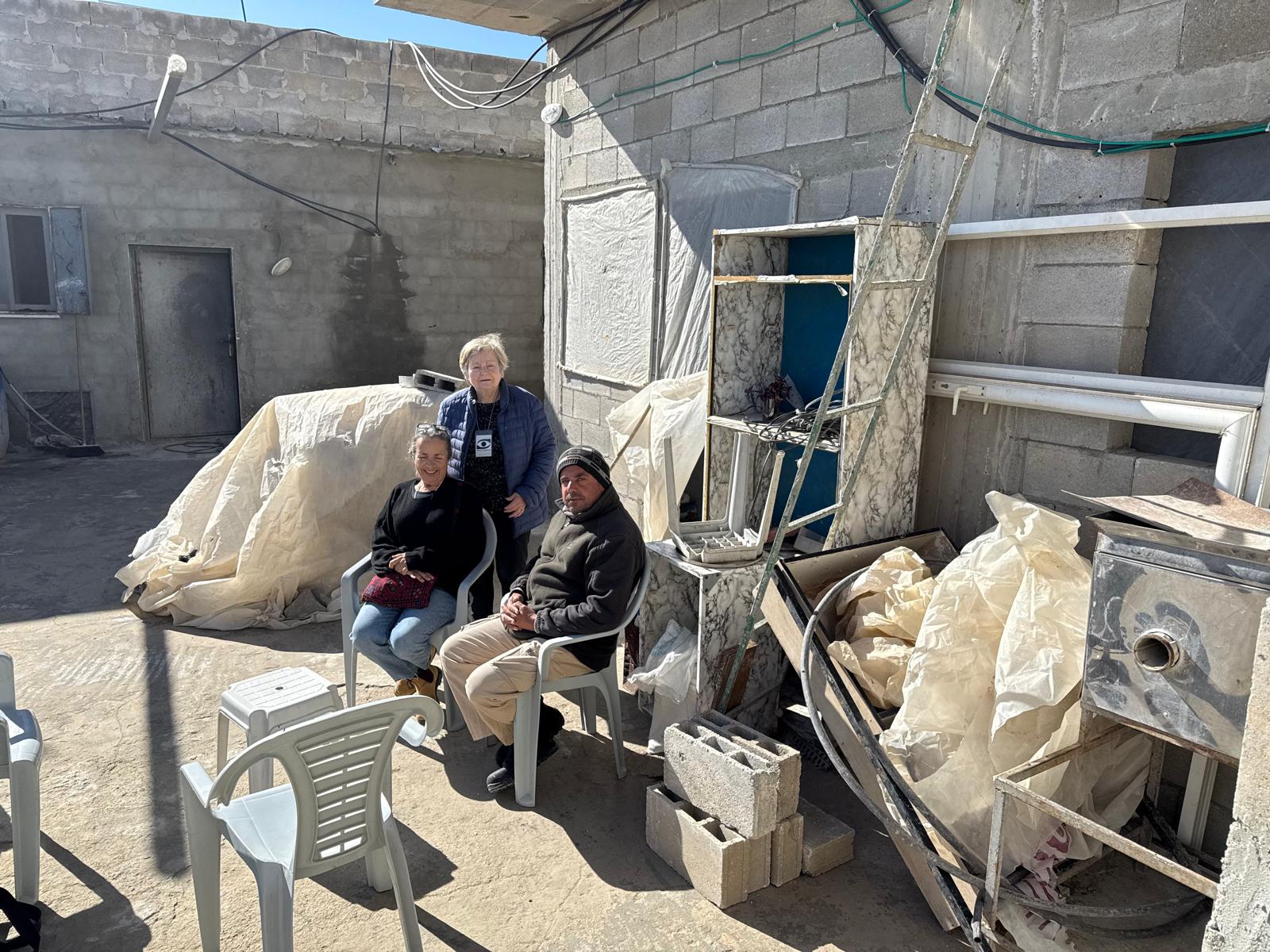 Muhammad D.Jan-4-2026At the Nassar family in Wadi Ras al-Jerfan
-
Hebron
See all reports for this place-
According to Wye Plantation Accords (1997), Hebron is divided in two: H1 is under Palestinian Authority control, H2 is under Israeli control. In Hebron there are 170,000 Palestinian citizens, 60,000 of them in H2. Between the two areas are permanent checkpoints, manned at all hours, preventing Palestinian movement between them and controlling passage of permit holders such as teachers and schoolchildren. Some 800 Jews live in Avraham Avinu Quarter and Tel Rumeida, on Givat HaAvot and in the wholesale market.
Checkpoints observed in H2:
- Bet Hameriva CP- manned with a pillbox
- Kapisha quarter CP (the northern side of Zion axis) - manned with a pillbox
- The 160 turn CP (the southern side of Zion axis) - manned with a pillbox
- Avraham Avinu quarter - watch station
- The pharmacy CP - checking inside a caravan with a magnometer
- Tarpat (1929) CP - checking inside a caravan with a magnometer
- Tel Rumeida CP - guarding station
- Beit Hadassah CP - guarding station
Three checkpoints around the Tomb of the Patriarchs
 Raya YeorDec-18-2025Hebron - Yusri Jaber and part of his family
-