Back to reports search page

Abu Dis, Container (Wadi Nar), Ras Abu Sbitan (Olive Terminal), Sheikh Saed, Thu 21.8.08, Morning
Observers: Yehudith S., Michaela R. (reporting)
Aug-21-2008
| Morning
6:45 Sheikh Saed

Few crossing, all labourers.  They hold their ID's  and permits up to the glass partition, show the contents of their bags of provisions and move on.

 
This is the second time we have seen rats roaming the mountain of garbage spilling from the checkpoint to the road — three the previous time, one this time.  Some of the garbage has been burnt, but since the Palestinians have no other place to dispose of it, they continue to dump garbage here.  Already a significant number of plastic bags filled with garbage can be seen, and the rat.

7:20 Sawaharah

Very sparse traffic.

 
Before the roundabout to the entrance to Ma'aleh Adomim, on the lane to Ezariya, there is a police checkpoint.  We didn't linger.

8:52 Wadi Nar

We encountered a heavy stream of traffic.  The checkpoint emptied within a few minutes.  There were almost no detentions.

 
Earthworks proceeding apace.

 
9:00 Zeitim Crossing from Ezariya direction

At this hour, families with their children cross, many women. One lane only is open, with a line in front of it.  Passage is slow.  Later we learn that the magnometer goes off too often, along with other glitches in the technological wonders at the checkpoint.

A young woman from Sheikh Sa'ad has a magnetic card valid till 2009; nevertheless she's told she must renew it.  At the DCO she's told they don't renew magnetic cards today.

 
A couple comes out of the DCO.  The woman is feeling unwell and wishes to get to the Augusta Victoria Hospital. But they are told that one of the documents lacks the doctor's signature next to the stamp.  She has no choice but to return home, swallow some acamol and go to bed.  21st century medicine at its finest!

 
Just as we were about to leave Y. noticed a silent woman leaning against the wall of the waiting shelter.  With the assistance of a driver who translated we learned that the foetus inside her is dead and she must reach the Mukassad Hospital.  The date on the medical document is 19.8.08, namely the day before yesterday.
Yesterday she had come to the checkpoint and was not allowed to cross — we have no idea why.  She stood there, leaning, wrapped in her grief and bereavement, unable to act.

 
We began phoning.  Tali from the DCO does not answer her cellphone, the office phone doesn't answer either.  The emergency telephone in front of the turnstile takes us to a health depot which sends us to Dalia Bassa.  She asks for a fax from Mukassad.  We call Mukassad, but they are on strike and refuse to send a fax.  (A central hospital is on strike, but there has been no mention of this in the press.) They suggest the woman arrive in an ambulance or send her documents by herself to the health depot.

 
We try to find Dalia B.'s fax, but her line is engaged and the assistant refuses to give the number.  We try via machsom-watch friends and reach Hanna BR"G.  She begins a series of phone calls, and an arrangement begins to take shape whereby the woman's doctor will call Mokassad and they will get back to Dalia.  The woman has difficulty finding her doctor — not surprising.  I too would have had difficulty, faced by a hostile system and with a dead foetus inside me.  All this while we must rely on the translation services of passing drivers of good will.  The woman is compelled to reveal her private medical problems to all the strangers trying to assist her.  Our ignorance of Arabic is frustrating.

 
We decide to take her to her clinic in Abu Dis to speed up the process.  On the way, a phone call from Hanna  informs us that the necessary permit is at the checkpoint.

 
We return to the checkpoint and decide to enter with the woman.  The turnstile is blocked.  We buzz, trying to draw the attention of the soldier behind the distant glass partition.  The turnstile remains blocked.  For a brief moment the green light comes on and the woman manages to squeeze through, but when I try to follow the turnstile is locked in my face.  We call out that this is an emergency and the woman must reach hospital immediately.  A large finger is raised behind the glass, and waved back and forth to signal an unequivocal "no."  In halting Arabic mixed with sundry languages, and mainly gestures, I persuade the woman to proceed alone, that all will be well.  She walks, her gaze fixed on us, waits in the slow line, then returns.  We exchange telephone numbers, and this enrages the soldier behind the glass who yells at us.  The woman is persuaded to try again, the permit after all is there.  Hanna  calls to inquire why we have not picked up the permit and is told that we are not at the checkpoint — indeed true, since we are outside it!

 
G., one of the senior policemen at the checkpoint, arrives.  He approaches us at his leisure to inquire about the hassle.  Yes, he knows there's some pregnanat woman here, he's been told.  At his behest, the turnstile is opened for us.  We take him to the woman and he lets her through a side entrance circumventing the turnstile, talks to the soldiers and finally the woman crosses.
Now we are stuck in front of the inner turnstile.  The magnometer whistles almost constantly.  Most of the time the turnstile is locked.  A woman with a baby is her arms is made to pass again and agin through the magnometer, and all this time the line is stuck.  Afterwards, she's taken to a side room and only then does the turnstile open.

Y. has a pace-maker.  I cross first and tell the soldier she cannot go through the magnometer.  (What happens to a Palestinian who arrives at the checkpoint alone, with no one to precede him and convey this information?)  Soldier A is talking to female soldier B who is talking to the guards.  They await the arrival of the guard  and all this time the line is stuck.  The guard arrives and disconnects the magnometer's electric cable.  Three men are required to unplug the cable from the socket.  We cross, only to return to the eastern side of the checkpoint.
  • Abu Dis / Lazarus gate (formerly The Wicket)

    See all reports for this place
    •  

      Abu Dis / Lazarus Checkpoint/Gate (east of the former “wicket”)

      Construction of the wall in the Abu Dis area blocked all the gaps that allowed people to cross from al-Ezariya to the neighbourhoods of Abu Dis and Ras al 'Amud that are located within Jerusalem’s municipal boundary. The Lazarus checkpoint is a gate in the wall adjacent to the Lazarus Monastery. Until 2011 it had a door for pilgrims to al-Ezariya and for the monastery’s kindergarten pupils from al-Ezariya. The crossing is currently closed, but the site has infrastructure for conducting inspections.

  • Container (Wadi Nar)

    See all reports for this place
    •  Wadi Nar Checkpoint ("Container", "The Kiosk") - a barrier for vehicles in Area B that is regularly manned - east of Abu Dis between Sawahra A Sharqiya and Bethlehem and its daughters. Controls Palestinian movement between the north and south West-Bank. Includes driving routes, access roads, spikes, traffic lights and signs. There is no pedestrian crossing. Open 24 hours a day with random checks enhanced on security alerts. The checkpoint is in Palestinian territory, allowing for separation between the north and the south Palestinian areas when necessary.

      In 2015, the leading road from Azaria to Bethlehem was renovated, as well as the steep and narrow ascent to the Wadi Nar checkpoint, which was dangerously travelled in both directions! The temporary checkpoint was renovated and expanded, and pedestrian traffic was banned. From 2016, traffic travelling from the south bank to Azaria was directed to a one-way road near the Southern Keydar Jewish settlement.

      Machsomwatch shifts visit this far-fetched checkpoint only occasionally.

      (updated to July 2019)


  • Ras Abu Sbitan (Olive Terminal)

    See all reports for this place
    • A large checkpoint/crossing to the area of a-Tur, Abu Dis and the Old City; only for pedestrians. Located on Jerusalem’s municipal boundary.

      One of the major crossings in Jerusalem’s central sector. It is located on the separation fence between the northern portion of the al-Ezariya neighborhood and the neighborhood of a-Tur and the rest of East Jerusalem. It is manned by Border Police soldiers and private security companies and operates 24 hours a day. Palestinians are forbidden to go through, other than permanent residents of East Jerusalem (holders of blue ID cards) and holders of work and commercial permits who are allowed through only on foot.

  • Sheikh Sa'ed

    See all reports for this place
    • A checkpoint limited to pedestrians, located on Jerusalem’s municipal boundary.

      The checkpoint sits on the separation fence at the entrance to Sheikh Sa’ad, dividing it from its neighbourhood of Jabel Mukkabar. It’s manned by Border Police soldiers and private security companies and operates 24 hours a day. Palestinians are forbidden to go through, other than residents of Jabel Mukkabar or Sheikh Sa'ad who have permits. Both groups are permitted through only on foot. Residents of East Jerusalem who don’t live in Jabel Mukkabar are also allowed to cross to Sheikh Sa’ad, but not in the opposite direction; they must return through the Sawahira ash Sharqiya checkpoint.
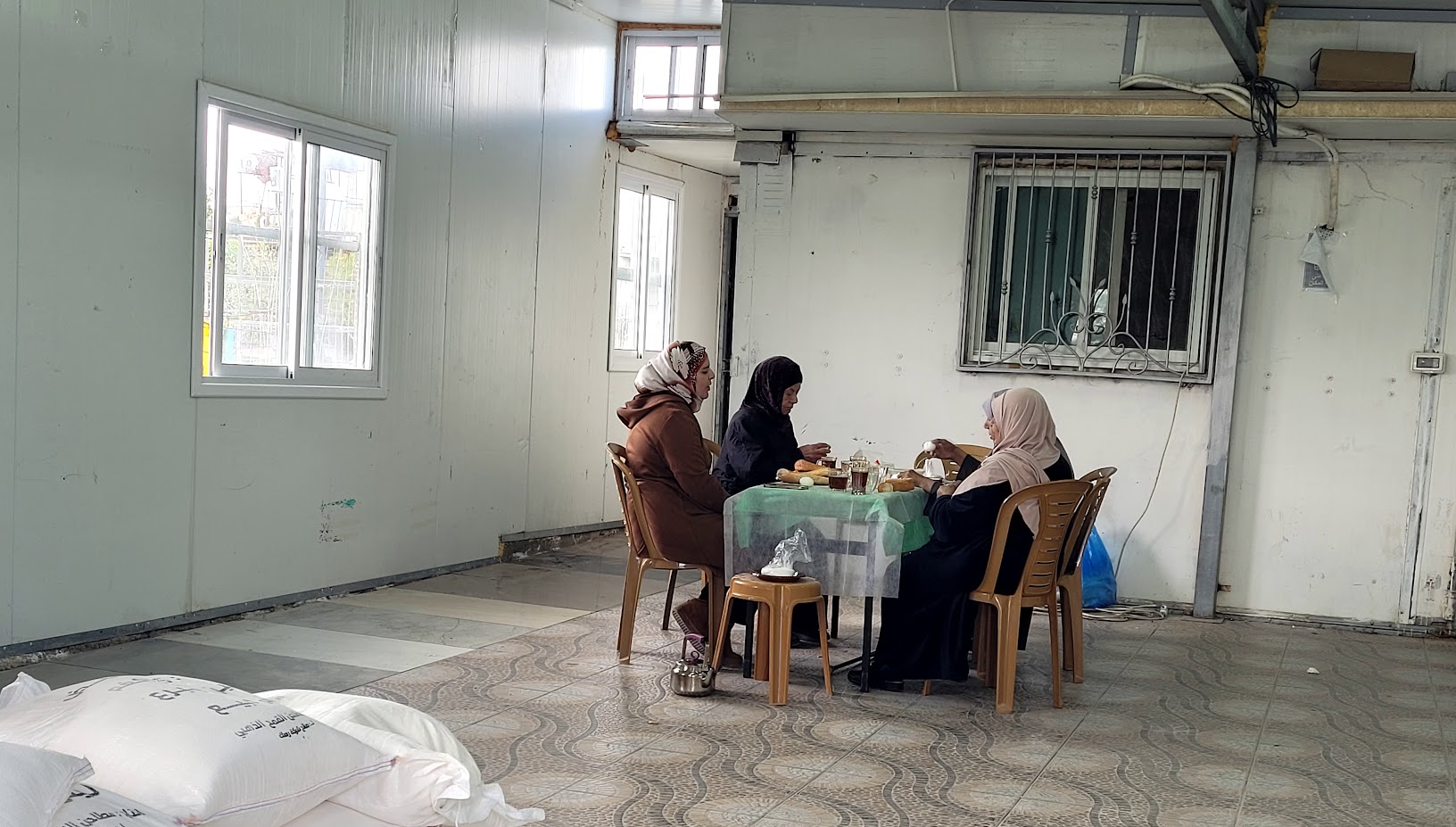
      נבי סמואל: פציינטיות והרופאה בארוחת בוקר
      Anat Tueg
      Feb-11-2026
      Nabi Samwil: Female patients and the doctor at breakfast
Donate