Back to reports search page

Abu Dis, Ras Abu Sbitan (Olive Terminal), Sheikh Saed, Silwan, Tue 20.3.12, Morning

Tags: Detainees
Observers: Idit s., Anat T., (reporting)
Mar-20-2012
| Morning

  )


6:40 Sheikh Saed checkpoint
 
Lively traffic; no unnecessary recording, and no line.  The commander let through a teacher with a Palestinian ID and an address in Abu Dis.  He is familiar with the man and knows he has moved to live in Sheikh Saed.  The commander explains to the young man that actually he ought to be sent to the Olive Terminal, and asks him to change his address to Jabel Mukhaber or Sheikh Saed at the Palestinian DCO, or the Israeli DCO, so that he will be able to continue to cross at the local checkpoint.  Should he change his address? We don't think so; even though he doesn't have a blue ID, at least he has an address in Jerusalem and the hope of not losing his Jerusalem identity.  The commander explains that he is compelled to turn back persons coming from Sawahara to cross at Sheikh Saed, because according to regulations he is forbidden to let residents from other places cross.  When he lets through a humanitarian case or an older person, many more immediately turn up as the message travels on the cell phones.
 
7:15 Drive through Silwan
 
Metal trash bins (which don't burn?) and graffiti all along the wadi route in the Bustan neighbourhood, and the stench is awful. It seems that people use the outdoors for defecating before entering the checkpoint.  The commander, D., claims that the drivers foul up and block the toilets which have on that account been locked, and that the Civil Administration is responsible for the entire matter.  He agrees to try opening the toilets during rush hours (morning, and afternoon return from work and school), and to lock for the rest of the day when traffic is sparse.  He thinks it would be impossible to clean them every day… on the other hand, he says thousands cross daily, so perhaps once a day is not enough!
 
Olive Terminal
On our way back through the checking area we hear a noisy to-do on the Al-Ezarya side.  Idit finds a fellow without an ID (only Palestinian) in hysterics.  He says the checkpoint guard and policemen have taken his new magnetic card.  He's scared, and blames them also for taking his belt and dealing with him brutally, including beating.  He goes back into the area and we follow him.  The policemen and guard  ask us to leave.  We produce our IDF permits which usually silence such requests, but the guard does not yield.  Now he tells us we may cross but not speak to any of the residents.  Meanwhile two more policemen arrive, and the Palestinian shows his wife's blue ID; they live in the Shuafat refugee camp together with their two children.  He also shows a request signed by a lawyer in which the wife asks for her husband to be allowed to cross in order so support their five children in the absence of some other document for family reunion.   The guard and policemen are not pleased with our presence and our arguments that they have no right to confiscate magnetic cards.  They explain that the man had been asked to wait until the DCO opens in 30 minutes in order to get his confiscated card.  We are asked to leave the checkpoint and then, if we wish, return, which is what we do.  Again we are told that we disrupt the work of the checkpoint (which is now fairly empty) by talking to the Palestinians and provoking bitter feelings.  We stay until the DCO opens (that too requires a few phone calls to headquarters) and the fellow, Muhamad,  enters to meet T., the DCO commander.  In a phone call, the checkpoint commander complains about our interference, and claims that the Palestinian tried to cross a few times without a permit, and it was only after these repeated efforts that his magnetic card had been confiscated in order to delay him at the DCO which has not yet opened… 
 
Once again this impossible stalemate situation: no family reunions, no livelihood, no work in the occupied territories, and children to feed in Jerusalem.


  • Abu Dis / Lazarus gate (formerly The Wicket)

    See all reports for this place
    •  

      Abu Dis / Lazarus Checkpoint/Gate (east of the former “wicket”)

      Construction of the wall in the Abu Dis area blocked all the gaps that allowed people to cross from al-Ezariya to the neighbourhoods of Abu Dis and Ras al 'Amud that are located within Jerusalem’s municipal boundary. The Lazarus checkpoint is a gate in the wall adjacent to the Lazarus Monastery. Until 2011 it had a door for pilgrims to al-Ezariya and for the monastery’s kindergarten pupils from al-Ezariya. The crossing is currently closed, but the site has infrastructure for conducting inspections.

  • Ras Abu Sbitan (Olive Terminal)

    See all reports for this place
    • A large checkpoint/crossing to the area of a-Tur, Abu Dis and the Old City; only for pedestrians. Located on Jerusalem’s municipal boundary.

      One of the major crossings in Jerusalem’s central sector. It is located on the separation fence between the northern portion of the al-Ezariya neighborhood and the neighborhood of a-Tur and the rest of East Jerusalem. It is manned by Border Police soldiers and private security companies and operates 24 hours a day. Palestinians are forbidden to go through, other than permanent residents of East Jerusalem (holders of blue ID cards) and holders of work and commercial permits who are allowed through only on foot.

  • Sheikh Sa'ed

    See all reports for this place
    • A checkpoint limited to pedestrians, located on Jerusalem’s municipal boundary.

      The checkpoint sits on the separation fence at the entrance to Sheikh Sa’ad, dividing it from its neighbourhood of Jabel Mukkabar. It’s manned by Border Police soldiers and private security companies and operates 24 hours a day. Palestinians are forbidden to go through, other than residents of Jabel Mukkabar or Sheikh Sa'ad who have permits. Both groups are permitted through only on foot. Residents of East Jerusalem who don’t live in Jabel Mukkabar are also allowed to cross to Sheikh Sa’ad, but not in the opposite direction; they must return through the Sawahira ash Sharqiya checkpoint.
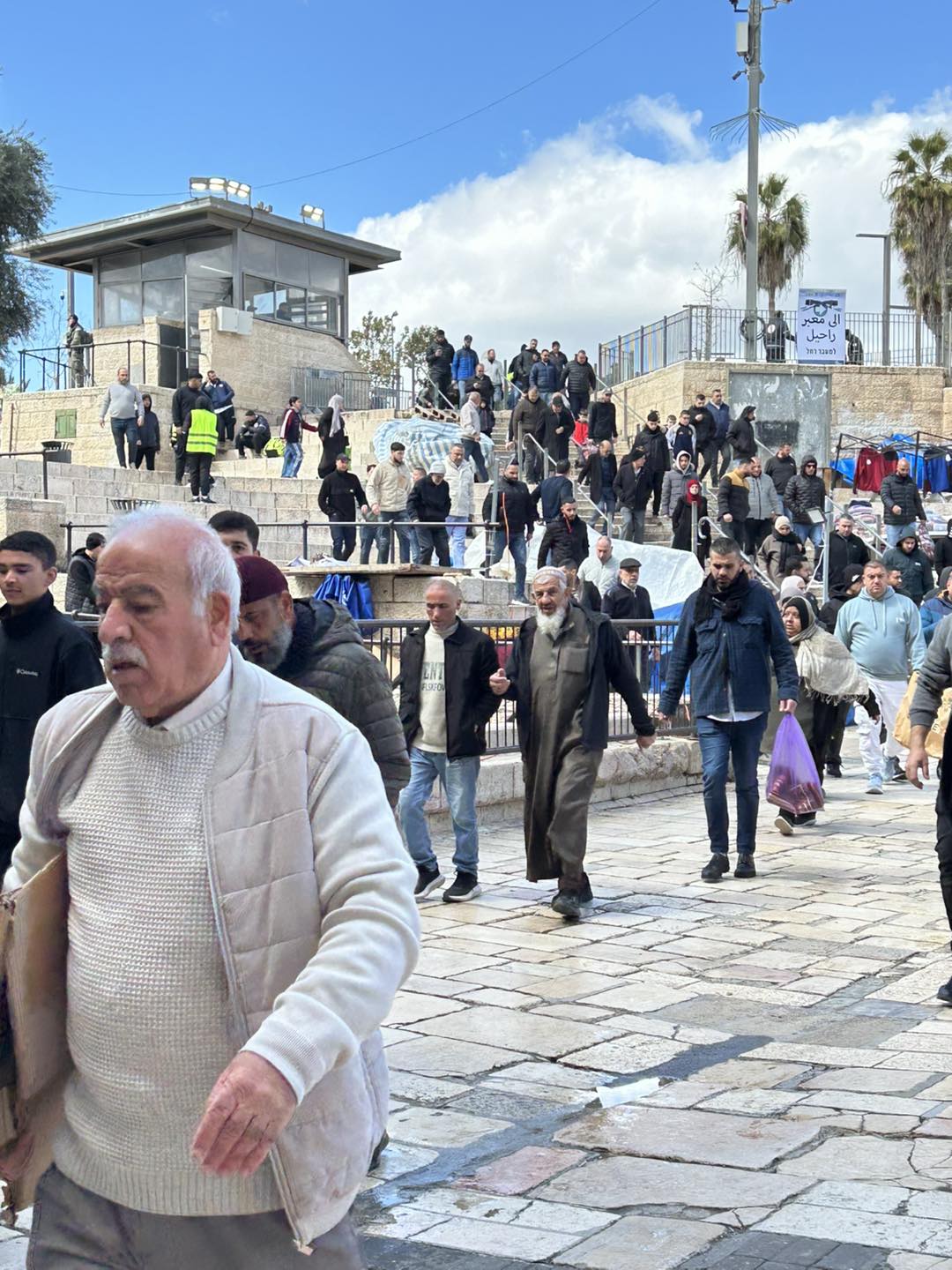
      ירושלים, שער שכם: קהל ממהר לתפילה
      Avital C
      Feb-27-2026
      Jerusalem, Damascus Gate: Crowd rushing to prayer
  • Silwan

    See all reports for this place
    • Silwan is south of the Old City of Jerusalem and has become one of the main confrontation areas with settlers.


Donate