
Activities of the kindergarten of Huda Bechashem al Darag And a review (not planned) of the destruction of Sarura
We had not been at Huda’s kindergarten for a long time. We came two days before Ramadan. Today the kindergarten is closing down for this year. There are only a few children there. This is now examination time, the classes end early and the small children go with their older siblings. Huda and Hula are at the kindergarten with her daughter of about a year old, retag. When we arrived the children ran to us and there was much rivalry to hold our hands. We organized a short activity with music, percussion intruments, bells, ? , etc. The main enjoyment of the children was in using the instruments. We also tried a little repetition of rhythms. Both the teachers and the children seemed to like it, even more than melodic songs. interesting. The activity was short because the children came from the school, peered through the windows, and it was difficult to concentrate.
Afterwards, when the children had left, Huda and Hula spoke of the problems in joining the days at the sea and also the organization of taking women for a trip to Jerusalem. We phoned Ayal of the Village Group, as he had already helped to arrange a similar trip to the women of Umm Al Kheir . He promised to try to help and also told us that there are demolitions at Sarura – the renewed settlement in the cave village.
We arrived there through Tuwani. The village is situated between Tuwani and Havat Maon. When we arrived there the forces of the Border Police were present and also the Coordination and Liaison Administration, police and army. All this for the covering which had been put over the cave and the two tents next to it. There are also present Palestinians from Sarura, Susiya, Umm Al Kheir, and volunteers and activists from Israel and the abroad and also members of the Palestinian Red Crescent. As was already told yesterday the story of Surara started 20 years ago as a result of pressure from the authorities and harassment by the settlers around them. People started slowly leaving and moving to Yatta. That is and in so many words the villagers were driven away by the slow but constant pressure. Now some of the villagers have decided tp return. Muhammed and his father are part of the residents of the village and they have lands there. They returned to their cave and put a cover over it as shade from the sun.
The forces arrived in the morning to drive out the new “invaders.” How did they know? The “Regavim” organization has air-borne cameras that photograph the area and they push and initiate activities of this kind. They are of course well connected. The official forces arrived without a warrant declaring this area closed military area, without an eviction order and without a demolition order. A confrontation began. Several volunteers were arrested. A number of Israeli activists tried to mediate and reach an agreement with an officer of higher rank who had reached the area. We arrived at this point. It was agreed that the army would allow the residents of Sarura to stay in the cave but without the covering. The army would release the activists who had been arrested and return the tent which they had taken on condition that the residents themselves took down the second tent. After some time with more discussions, with much lack of trust amongst those present, the conditions were implemented by both sides and the incident slowly ended without further violence. In the meantime Muhammad’s father felt sick and needed an infusion which was given by the Red Crescent.
The end?….no end. This is an area belonging to the Palestinian residents. It is located between Mitzpeh Abigail and Havat Maon, which are illegal settlements – according to international law (like all settlements) and Israeli law (unauthorized outposts, in the official “ laundered” language). But the army drives people away, and destroys tents only in Sarura. Mitzpe-Avigail and Ma’on Farm have access roads, electricity, water, caravans and even permanent structures, a bus stop, and all over – and what is that that is the last straw the army guards the outpost! So now is only the question of who will wear down who faster: the “most moral army in the world” or the Palestinian residents. And the most disturbing question arises: For this you enlisted in the army?
South Hebron Hills
See all reports for this place-
South Hebron Hills
South Hebron Hills is a large area in the West Bank's southern part.
Yatta is a major city in this area: right in the border zone between the fertile region of Hebron and its surroundings and the desert of the Hebron Hills. Yatta has about 64,000 inhabitants.
The surrounding villages are called Masafer Yatta (Yatta's daughter villages). Their inhabitants subsist on livestock and agriculture. Agriculture is possible only in small plots, especially near streams. Most of the area consists of rocky terraces.Since the beginning of the 1980s, many settlements have been established on the agricultural land cultivated by the Palestinians in the South Hebron Hills region: Carmel, Maon, Susia, Masadot Yehuda, Othniel, and more. Since the settlements were established and Palestinians cultivation areas have been reduced; the residents of the South Hebron Hills have been suffering from harassment by the settlers. Attempts to evict and demolish houses have continued, along with withholding water and electricity. The military and police usually refrain from intervening in violent incidents between settlers and Palestinians do not enforce the law when it comes to the investigation of extensive violent Jewish settlers. The harassment in the South Hebron Hills includes attacking and attempting to burn residential tents, harassing dogs, harming herds, and preventing access to pastures.
There are several checkpoints in the South Hebron Hills, on Routes 317 and 60. In most of them, no military presence is apparent, but rather an array of pillboxes monitor the villages. Roadblocks are frequently set up according to the settlers and the army's needs. These are located at the Zif Junction, the Dura-al Fawwar crossing, and the Sheep Junction at the southern entrance to Hebron.
Updated April 2022
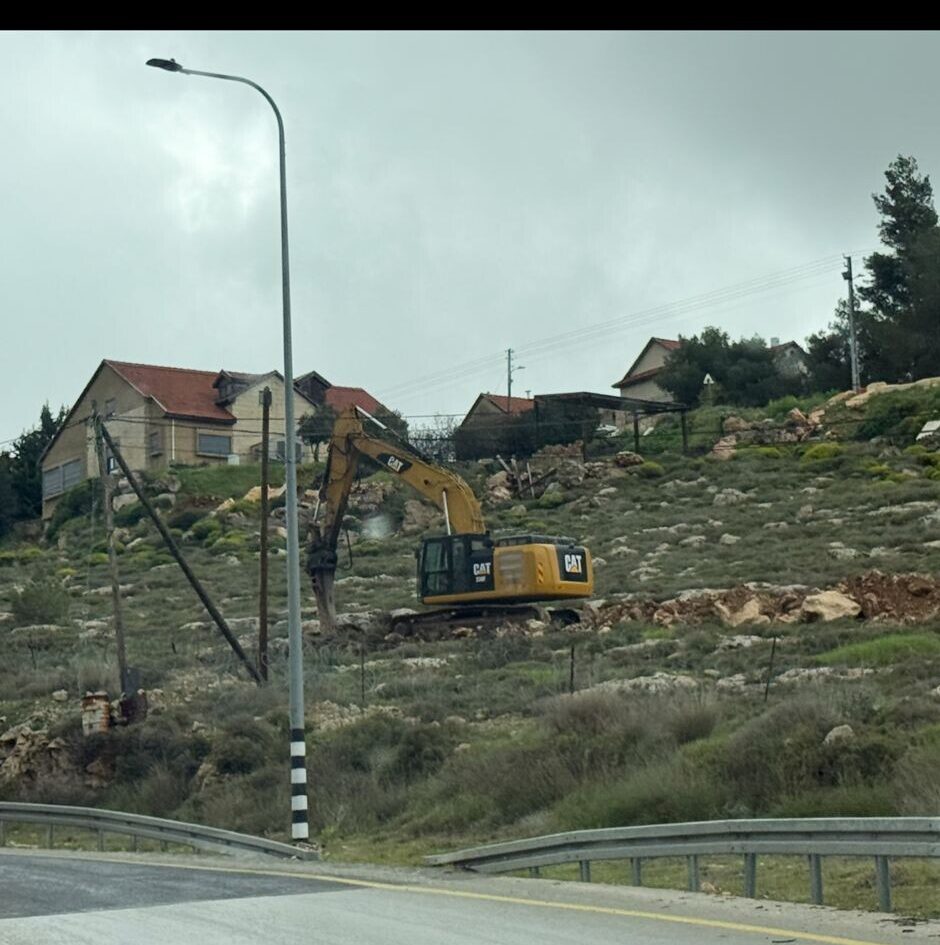 MuhammadFeb-24-2026South Hebron Hill, Beit Hagai: Paving an internal security road
-
Susiya
See all reports for this place-
Susiya The Palestinian area lies between the settlement of Susya and a military base. The residents began to settle in areas outside the villages in the 1830s and lived in caves, tents and sukkot. To this day they maintain a traditional lifestyle and their livelihood is based on agriculture and herding. Until the 1948 war, the farmers cultivated areas that extended to the Arad area. As a result of the war, a significant portion of their land left on the Israeli side was lost. After the 1967 war and the Israeli occupation, military camps were established in the area, fire zones and nature reserves were declared, and the land area was further reduced. The Jewish settlement in Susya began in 1979. Since then, there has been a stubborn struggle to remove the remains of Palestinian residents who refuse to leave their place of birth and move to nearby town Yatta. With the development of a tourist site in Khirbet Susya in the late 1980s (an ancient synagogue), dozens of families living in caves in its vicinity were deported. In the second half of the 1990s, a new form of settlement developed in the area - shepherds' farms of individual settlers. This phenomenon increased the tension between the settlers and the original, Palestinian residents, and led to repeated harassment of the residents of the farms towards the Palestinians. At the same time, demolition of buildings and crop destruction by security forces continued, as well as water and electricity prevention. In the Palestinian Susya, as in a large part of the villages of the southern Hebron Mountains, there is no running water, but the water pipe that supplies water to the Susya Jewish settlement passes through it. Palestinians have to buy expensive water that comes in tankers. Solar electricity is provided by a collector system, installed with donation funds. But the frequent demolitions in the villages do not spare water cisterns or the solar panels and power poles designed to transfer solar electricity between the villages. Updated April 2021, Anat T.
-