
Al Jib (Givat Zeev), Jaba (Lil), Qalandiya, Sun 20.5.12, Afternoon
Translating: Ruth Fleishman
Qalandiya:
The desolation, filth and stench had become part of the essence of the existential state that seems to have clung to the place and people.
While "Day of Jerusalem" was being celebrated on the other side of the walls, here, at the checkpoint and its surroundings that are considered part of "Greater Jerusalem", the daily routine was taking place as though in acceptance of reality, as if it were a predestination that couldn't be changed, without horizons and hope, because their years of experience have tough them that constant change has but one intention- to harm and to benefit.
El- Jib
It is difficult and impermissible to grow accustomed to the sight of an inspection preformed on a person exiting Palestine which entails humiliation and the loss of dignity. 
The differences in heights between the inspectors in the fortified post, who see the person in front/ beneath them through bullet proof and opaque windows, and the person inspected who is forced to stretch his body and life his hand with the documents towards them, is of tens of centimeters. It's not only a difference in height, but an additional method to determine the hierarchy of the superior and the inferior, of the master and the servant.
A coincidence? A mistake or lack of attention to detail?- there is no doubt that this is intentional.
"Oh, you arrived through the red zone!", said the commander after hearing our replay to his question, how the hell did we arrive from the side from which Israelis aren't expected to come. Because the green line had been erased for years from the maps and adds, the red (=Palestine) and the blue (=Israel) have replaced it.
The choice of colours isn't coincidental. Red is associated with danger, blood and pain, while blue is associated with serenity.
At "Abu-Yunis's Café" a construction contractor told us about the conditions under which the laborers are employed, a daily wage of 120 to 150 Shekels: "it depends on the job the person preforms and whether or not he is a professional", and clarified that no social benefits of any other benefits are added to this sum, that the work permits for the settlements, unlike the permits that allow them to work in Israel (which are granted only to those over 35 who have families) are granted at the age of 25 and regardless of marital status.
Of course, it depends on the authorization of the GSS and their renewal every three months.
And another person spoke of his brother who after working for ten years ("and without any troubles") at a settlement on the other side of the wall, one morning two years ago, his permit had been taken from him and he was told that he was prevented passage by the GSS. Ever since he has been walking from office to office, knocking on doors, asking, requesting- nothing. "Even when he had to go through examinations at Mukased Hospital and asked for a one day permit- he didn't receive it".

Jaba checkpoint:
A dog and its trainer were in the midst a van inspection. The driver was standing nearby. The inspection lasted several long minutes. The soldier led the dog with its leash and it sniffed around, inside and outside. After the dog had successfully completed the mission, once it had probably found the object hidden, it was taken away from the vehicle and received from its master a reward in a colourfulplastic bowl. And the driver, whose vehicle had been confiscated and then returned, kicked with anger and fury at the door before entering and then proceeded to drive.
Al-Jib CP Givat Zeev (Jerusalem)
See all reports for this place-
Al-Jib CP GivatZeev (Jerusalem)
It is located on the separation fence, west of the al-Jib enclave. The checkpoint is regularly manned by Border Police and private security companies. Palestinians are not allowed to cross except for residents of the al-Khalaila neighborhood of the village of al-Jib, residents of al-Jib who own land on the western side of the fence, residents of a-Nabi Samuel, which is their only access road to Ramallah and the villages in northwest Jerusalem, as well as Palestinians with work permits in the Givat Zeev settlement and UN workers passing through UN vehicles.
(Updated January 2020)
-
Jaba' (Lil)
See all reports for this place-
Jaba' (Lil) In fact, the Jaba checkpoint is east of the Qalandiya checkpoint. Its declared purpose is the prevention of Israeli citizens from entering Area A. A road checkpoint for vehicles, located on Road 65, borders the southern fence of Kfar Jaba, about three kilometers east of the Qalandiya checkpoint, on the road leading to the settlement of Adam on Road 60. Archaeological excavations within the village found the remains of a cloth house from the First Temple period. The events that led to the construction of the checkpoint are precisely here: on the day of the abduction of Gilad Shalit and before the outbreak of the Second Lebanon War, a 17-year-old man from one of the settlements was abducted by a Palestinian cell. His body was found several days later at the entrances to Ramallah. A military investigation revealed that his abductors had taken him along this route. The checkpoint was set up to prevent future kidnappings and to warn settlers from traveling to Ramallah and entering Area A (which is forbidden for Israelis). The checkpoint that operates around the clock. Usually only vehicles traveling in the direction of Ramallah are inspected. (November 2016): Every morning, when the settlers en masse travel to Jerusalem on Route 60 and every afternoon they return from Jerusalem on Route 60, the army initiates a traffic jam at the entrance to the Jaba checkpoint and stops the movement of Palestinians traveling toward Route 60. (February 2020): In the last two years the checkpoint has not always been manned. Sometimes the soldiers come and just stand, sometimes they come and stop and check those who enter the village, sometimes they patrol the alleys of the village, sometimes they fire stun grenades and gas and sometimes they invade houses and stop young people, say those passing through the Hazma checkpoint. (Updated February 2020)
-
Qalandiya Checkpoint / Atarot Pass (Jerusalem)
See all reports for this place-
Click here to watch a video from Qalandiya checkpoint up to mid 2019 Three kilometers south of Ramallah, in the heart of Palestinian population. Integrates into "Jerusalem Envelope" as part of Wall that separates between northern suburbs that were annexed to Jerusalem in 1967: Kafr Aqab, Semiramis and Qalandiya, and the villages of Ar-Ram and Bir Nabala, also north of Jerusalem, and the city itself. Some residents of Kafr Aqab, Semiramis and Qalandiya have Jerusalem ID cards. A terminal operated by Israel Police has functioned since early 2006. As of August 2006, northbound pedestrians are not checked. Southbound Palestinians must carry Jerusalem IDs; holders of Palestinian Authority IDs cannot pass without special permits. Vehicular traffic from Ramallah to other West Bank areas runs to the north of Qalandiya. In February 2019, the new facility of the checkpoint was inaugurated aiming to make it like a "border crossing". The bars and barbed wire fences were replaced with walls of perforated metal panels. The check is now performed at multiple stations for face recognition and the transfer of an e-card. The rate of passage has improved and its density has generally decreased, but lack of manpower and malfunctions cause periods of stress. The development and paving of the roads has not yet been completed, the traffic of cars and pedestrians is dangerous, and t the entire vicinity of the checkpoint is filthy. In 2020 a huge pedestrian bridge was built over the vehicle crossing with severe mobility restrictions (steep stairs, long and winding route). The pedestrian access from public transport to the checkpoint from the north (Ramallah direction) is unclear, and there have been cases of people, especially people with disabilities, who accidentally reached the vehicle crossing and were shot by the soldiers at the checkpoint. In the summer of 2021, work began on a new, sunken entrance road from Qalandiya that will lead directly to Road 443 towards Jerusalem and Tel Aviv. At the same time, the runways of the old Atarot airport were demolished and infrastructure was prepared for a large bus terminal. (updated October 2021)
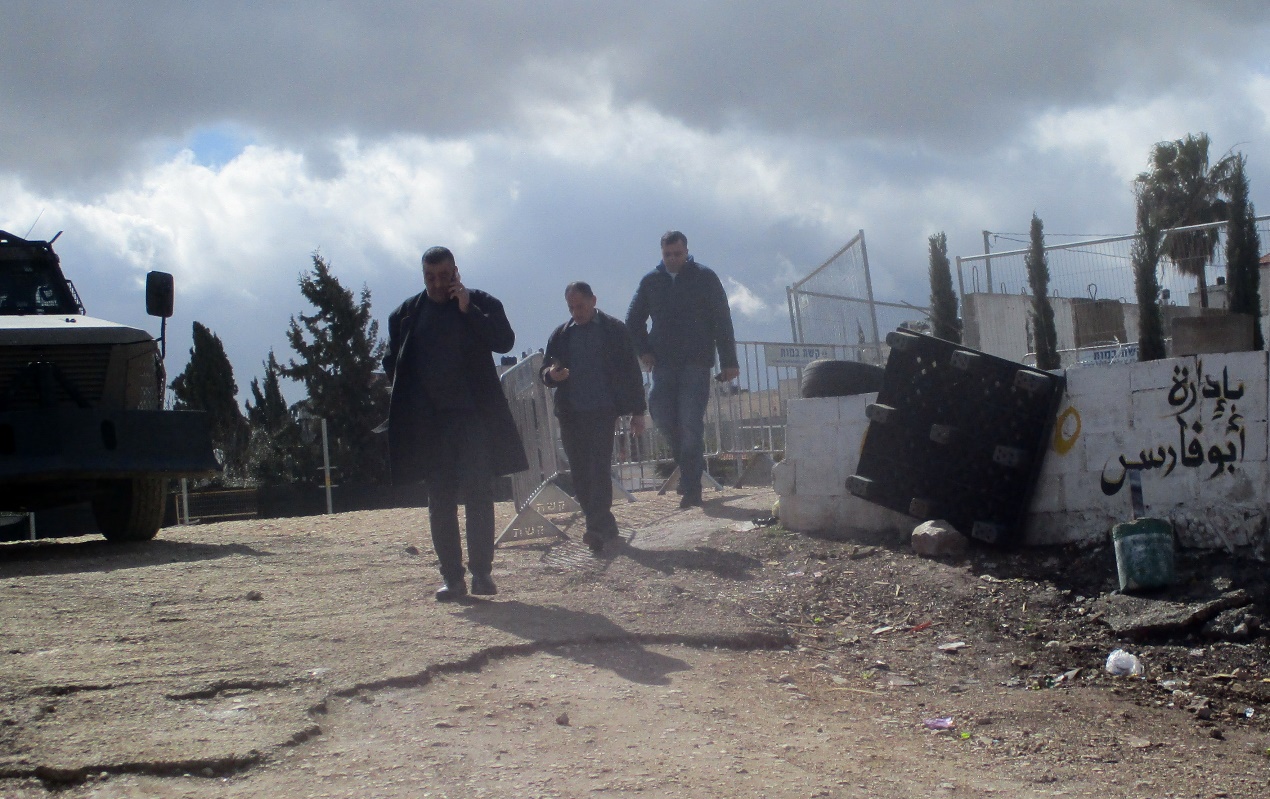 Tamar FleishmanFeb-27-2026Qalandiya: On the way to prayer
-