
Al Jib (Givat Zeev), Qalandiya, Sun 9.10.11, Afternoon
Translating: Ruth Fleishman
Qalandiya checkpoint:
The soldier and security guard spent 45 minutes making inquiries and running about from the  ambulance to their post and back again, while a Palestinian ambulance that was transferring the body of a man who used to live in Gaza but didn't survive the operation he went through in Nablus, and an Israeli ambulance at the other side of the checkpoint, were being detained only several meters away from each other, until finally all doubt was lifted and the deceased was found to be "Kosher", he wasn't, god forbid, a terrorist or a ticking bomb, and so all the obstructions were removed and the carcass could return home.
The heat wave probably did not agree with the deceased.
El Gib checkpoint:
While we were sitting under the fig tree at "Unis's Deli" drinking hot coffee and eating Falafel that had just been taken out from the boiling oil, the locals told about their lives:
They told us how laborers wait during the morning hours in lines that stretch for hundreds of meters like cattle so as to arrive to work at Givon Hahadasha, about the soldiers that "have no respect for human beings", about the curses and insults that they have to take from the soldiers that in spite of them knowing everyone (after all it's always the same people that pass every day), they make it hard for them and hold long inspections so that at times in it not until the late morning hours that everyone pass. But there's no point in going to work at that hour since the employer would just send the laborer back home. And so they lose a day of work which adds up to between 120 to 140 Shekels.
"The laborers", said one person "work like donkeys. But only the rich get richer, the contractors".
We were told about a teenager of fourteen who climbed over the fence (he wanted to visit his mother in hospital at east Jerusalem) and had been ratted in to the police by a well-known snitch from the village. The boy was taken in and now his is serving time in an Israeli prison.
People told us of hundreds of dunams of fertile land that had been confiscated when the separation wall was erected, and of the ancient olive trees that grew in that land but were uprooted and taken to far away and foreign lands.
On the other side of the road a Jewish contractor and his Palestinian workers were building a roof on top of the lane in front of the checkpoint. A generous sovereign makes sure that the heads of those who build houses for settlers on their own stolen land with their own blood, sweat and tears, don't get wet in the rain and don't scorch under the blazing sun.
Al-Jib CP Givat Zeev (Jerusalem)
See all reports for this place-
Al-Jib CP GivatZeev (Jerusalem)
It is located on the separation fence, west of the al-Jib enclave. The checkpoint is regularly manned by Border Police and private security companies. Palestinians are not allowed to cross except for residents of the al-Khalaila neighborhood of the village of al-Jib, residents of al-Jib who own land on the western side of the fence, residents of a-Nabi Samuel, which is their only access road to Ramallah and the villages in northwest Jerusalem, as well as Palestinians with work permits in the Givat Zeev settlement and UN workers passing through UN vehicles.
(Updated January 2020)
-
Qalandiya Checkpoint / Atarot Pass (Jerusalem)
See all reports for this place-
Click here to watch a video from Qalandiya checkpoint up to mid 2019 Three kilometers south of Ramallah, in the heart of Palestinian population. Integrates into "Jerusalem Envelope" as part of Wall that separates between northern suburbs that were annexed to Jerusalem in 1967: Kafr Aqab, Semiramis and Qalandiya, and the villages of Ar-Ram and Bir Nabala, also north of Jerusalem, and the city itself. Some residents of Kafr Aqab, Semiramis and Qalandiya have Jerusalem ID cards. A terminal operated by Israel Police has functioned since early 2006. As of August 2006, northbound pedestrians are not checked. Southbound Palestinians must carry Jerusalem IDs; holders of Palestinian Authority IDs cannot pass without special permits. Vehicular traffic from Ramallah to other West Bank areas runs to the north of Qalandiya. In February 2019, the new facility of the checkpoint was inaugurated aiming to make it like a "border crossing". The bars and barbed wire fences were replaced with walls of perforated metal panels. The check is now performed at multiple stations for face recognition and the transfer of an e-card. The rate of passage has improved and its density has generally decreased, but lack of manpower and malfunctions cause periods of stress. The development and paving of the roads has not yet been completed, the traffic of cars and pedestrians is dangerous, and t the entire vicinity of the checkpoint is filthy. In 2020 a huge pedestrian bridge was built over the vehicle crossing with severe mobility restrictions (steep stairs, long and winding route). The pedestrian access from public transport to the checkpoint from the north (Ramallah direction) is unclear, and there have been cases of people, especially people with disabilities, who accidentally reached the vehicle crossing and were shot by the soldiers at the checkpoint. In the summer of 2021, work began on a new, sunken entrance road from Qalandiya that will lead directly to Road 443 towards Jerusalem and Tel Aviv. At the same time, the runways of the old Atarot airport were demolished and infrastructure was prepared for a large bus terminal. (updated October 2021)
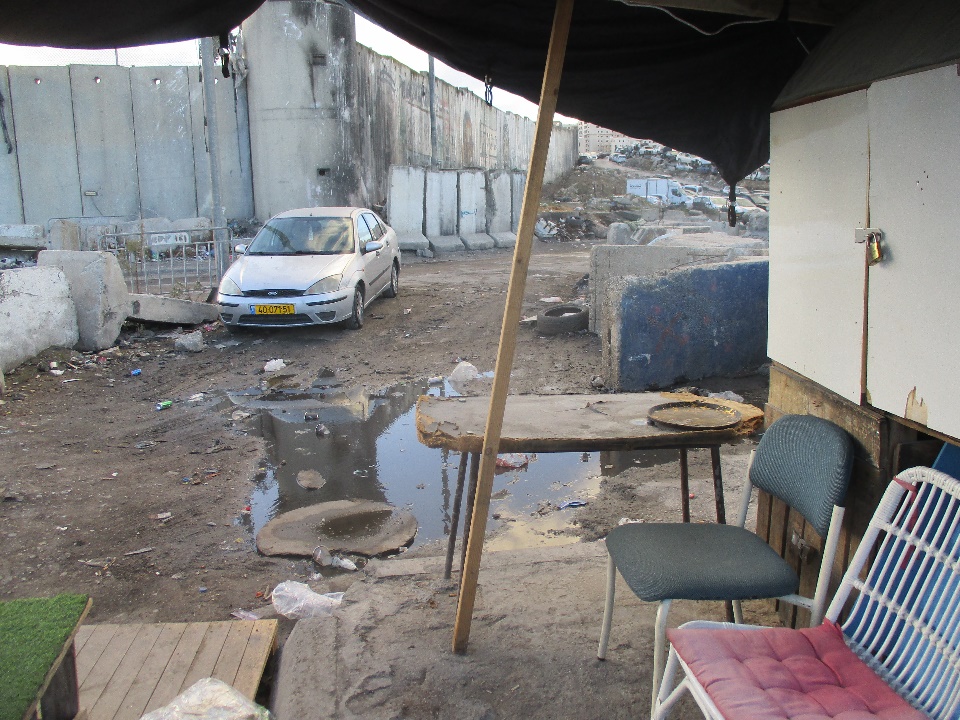 Tamar FleishmanNov-30-2025Qalandiya: Puddles and dirt after the rain
-