
Al Khadr, the demolition order was frozen for two months by a court decision
07:15 Bethlehem checkpoint
A large new traffic circle is next to the traffic light at the Gilo intersection. A long line of cars stretches from the checkpoint to the traffic light towards Jerusalem. We see that, in addition to the narrowing of the road because of the traffic circle, a huge parking lot for double-length buses opened recently lower down. Many of the buses extend at an angle into the road, further impeding morning traffic to Jerusalem.
Heavy traffic at the checkpoint itself was managed efficiently. This time the soldiers (there were no police) allowed us to stand and observe without interference. Mostly we smile and say “Good morning” in Arabic to people hurrying on their way. Most smile in return, something you shouldn’t take for granted given the stress of their morning journey.
They tell us that in general there’s more work available, thank God.
Highway 60 – the tunnel road
Roadwork continues apace. I wish similar work inside the Green Line would go so quickly. The lanes leading to Jerusalem are jammed. Settlers in the southern West Bank often complain about that, according to the newspapers. At the Al Khadr junction, heading toward Beitar Illit, there are large mounds of earth. Apparently, changes are planned there also.
Our main goal today is to visit the family on the outskirts of Al Khadr whose home is threatened with demolition; we’d already visited them in the past. It’s near the checkpoint at the northern entrance to the Efrat settlement. It’s still too early to visit. We continue to Nashash junction which leads to Efrat’s main entrance. On the way is a turnoff with a sign to Giv’at Eitam, a “neighborhood” of 30,000 housing units which will block Bethlehem from the south. The plans have already been approved after a long High Court case but, apparently they’re waiting for the right moment to begin construction in an area the Americans call “E2,” adapting the designation – E1 – of the salient between Jerusalem and Ma’aleh Adumim, a red flag for every American president except for Trump.

We reach the Sheikh Abdallah Ibrahim checkpoint through which the Palestinian workers building Efrat pass. It’s run by the settlement’s security staff, overseen by the army. The procedure involves lists of the contractors who provide the workers and are connected to the security staff. While there’s a maze of revolving gates, someone who’s name is called goes through directly to the contractor’s representative and to the job. It’s not an easy procedure. Workers are transported there and must wait to be admitted. Each has a story. An 18-year-old soccer player on the nearby Wadi Nis team (in Area B, under Israeli security control), doesn’t speak Hebrew, but someone says he’s very talented and the team is the Palestine League champion. The village began to build a large, attractive soccer field, with stands. The army stopped construction because it lacked a permit from the area commander. They’ve already been waiting five years for the permit.
The father of six children is also waiting. He wants to build a house and make a living, but has no money. He has a work permit for Jerusalem which isn’t valid here. He’s waiting for the contractor’s representative to arrange it at the DCO and bring it to him so he can obtain a few hours of work. Natanya says they meet ultra-religious contractors at the Etzion DCO who make a good living from their shady business of arranging permits.

After we confirmed that preparation for construction hadn’t begun at Giv’at Eitam, we return all the way through the long, winding settlement of Efrat to visit the family. We pass a soccer field, playgrounds, a pool and many parks and much greenery. The huge difference between this and the aridity of the adjacent Palestinian villages cries out to heaven.
A visit to Nafouz Dadouah and her seven children, whose house faces demolition
Our relationship began through an English couple, friends of Machsom Watch, who asked us to support and help spread the word about the danger that Abu Mousa’s house in Al Khadr would be demolished for the fourth time. That house was saved, and Nafouz received our number from them. We emailed those friends of Machsom Watch so they would put us in contact with AMOS, an English group that supported the Musa family. We received no reply, until a representative of the group appeared and was shocked by the family’s situation, poverty and impossible living conditions. He immediately raised funds for renovations, and construction began of a kitchen and bathroom inside the structure.
Two days ago, about a year after the application for a building permit was rejected, a notice arrived about a planned demolition within 14 days. Why? The military commander of the area had again refused the application for a permit because it was too near the road to Efrat (even though the attached plan shows – in red – that the proposed traffic circle and road widening doesn’t include the area of the house – in blue). The family had to raise NIS 2000 to appeal to the Supreme Court to halt the demolition because of the family’s situation: the father is hospitalized with cancer, seven children, the house only has two rooms divided by a small kitchen and bathroom. And, of course, all of it is threatened with demolition.


We came to meet with a representative of AMOS and to meet the family. We never met the ill father and weren’t able to understand how involved he was in the matter. The workers carrying out the renovation hadn’t heard from him either. Nafouz, his amazing wife, is handling everything. For the first time we met H`, the Palestinian activist, who was born in Dubai and represents AMOS. He’s a very impressive person who initiated the renovations and oversees them and the dealings with the family. We were also surprised to meet three ecumenical Canadian women activists (the World Council of Churches) who promised to try to mobilize support in Canada and pressure the Canadian embassy. They hold Machsom Watch in high regard. Natanya told them about the organization and referred them to Chana Barag for more information. We also referred them to our website, and exchanged phone numbers.
Hope was in the air because the day after the appeal was submitted to the Supreme Court it was accepted. The court ordered the demolition postponed for two months until a preliminary response from the army and the Civil Administration. We also saw the renovations inside which changed the lives of all the family members – five daughters and two sons, aged 5 and 8). All hoped that, God willing, good will triumph over evil.
As we left we saw the military position at the southern entrance to Al Khadr lower down the road. We assume that from there they observe all the traffic on the road and the homes up the road. And if not them, there are also drones and sophisticated electronic measures. There’s no doubt that Palestinians throughout the West Bank are completely exposed at every moment to the threat of annexation and theft by the all-powerful occupation. That must undoubtedly feel horrible.
Al-Khader
See all reports for this place-
Al-Khadr served as transit from Bethlehem to Route 60. A dirt mound prevent vehicular traffic from and to Bethlehem from the west. A small market developed there. Taxi ranks were on both sides of the obstruction. It was replaced by a similar obstruction at Al Nashash which has recently been removed and thus the way from Bethlehem to Hebron through Route 60 is now free.
-
Bethlehem (300)
See all reports for this place-
Located adjacent to the Separation Wall ("Jerusalem Wrap") at the north entrance to Bethlehem, this checkpoint cuts off Bethlehem and the entire West Bank from East Jerusalem, with all the serious implications for health services, trade, education, work and the fabric of life. The checkpoint is manned by the Border police and private security companies. It is an extensive infrastructure barrier and is designated as a border terminal, open 24 hours a day for foreign tourists. Israeli passport holders are not allowed to pass to Bethlehem, and Palestinian residents are not allowed to enter Jerusalem, except those with entry permits to Israel and East Jerusalem residents. Israeli buses are allowed to travel to Bethlehem only through this checkpoint.The checkpoint, which demonstrated harsh conditions of crowding and extreme passage delays for years, started employing advanced electronic identification posts and has upgraded its gates' system as of the middle of 2019 - and conditions improved.Adjacent to the checkpoint, in an enclosure between high walls and another passage, is the historic Rachel's Tomb, which is now embedded within a concrete fortified building. It contains prayer and study complexes for Jews only, as well as a residential complex. updated November 2019 .
-
Sheikh Abdallah Ibrahim / Wadi Rahal (Efrat, Gush Etzion)
See all reports for this place-
The Sheikh Abdallah Ibrahim / Wadi Rahal (Efrat, Gush Etzion) CP is located on the access road to the Efrat settlement.
The road also leads to land owned by Palestinians from Wadi Rahal and manned by the security guards of the Efrat settlement. The checkpoint is open to passing Israelis 24 hours a day. Palestinian workers and cleaners can pass only according to a list of contractors and in their presence.
In light of the enormous expansion of Efrat, it sounds reasonable that about 1000 workers pass there every morning.
We met a laborer on his way to the checkpoint and asked whether he had a work permit. He showed us a permit that was bought from a contractor for a considerable amount of money.The last time we visited this checkpoint (07:00 in the morning) we could witness the "slave market" held there. Contractors "sell" each other workers and professionals. The workers come mainly from the surrounding villages and they are spared the detour through the Bethlehem checkpoint. The eastward expansion of the Efrat is a link in a broader plan that aims to create a territorial continuum between the Gush Etzion bloc and the Dead Sea area while crossing the occupied territories (thereby preventing continuous Palestinian control of the West Bank." (From a MahsomWatch report, 2022)
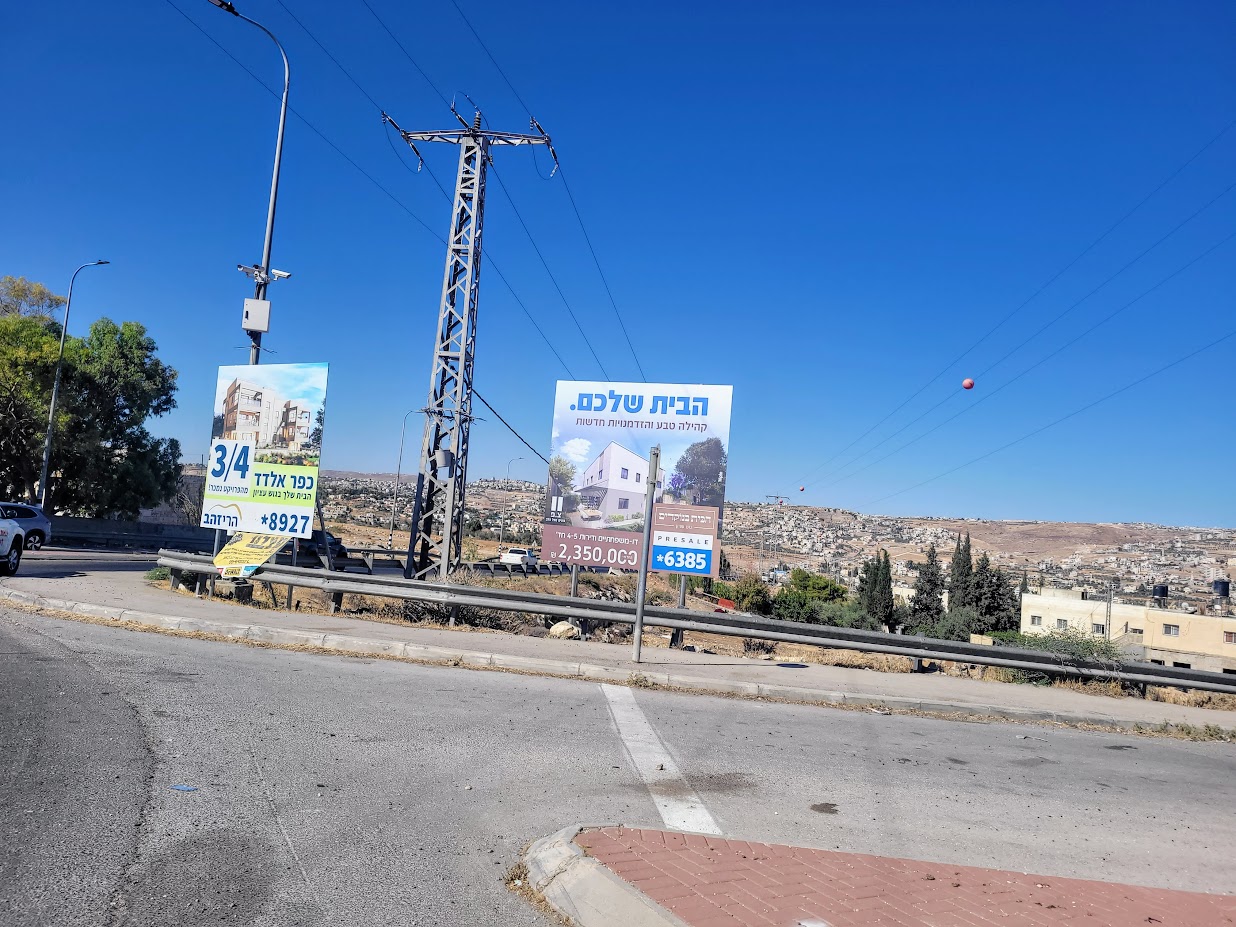 Jul-9-2025Gush Etzion: Settlements from the East Are Expanding
-
Tunnels CP
See all reports for this place-
Tunnels CP
A checkpoint on Road 60, west of the entrance to Beit Jala. The checkpoint is manned by the army, Border Police and private security companies. Palestinian crossing is prohibited, except for residents of East Jerusalem.
-