
AM
BEIT IBA , HUWWARA, Tuesday 8 June 2004 AMWatchers: Miriam S., Yael P., Selma M., Rivka A., Naomi R., Etty P. (reporting) colour = red>08:10 — There was an unannounced roadblock at the Jit junction which had produced a very long line of cars in the Shavei Shomron direction. Four soldiers were checking the vehicles. Passengers were not ordered out of the buses.08:20 — At Beit Iba there were about 150 people in line at the entrance to Nablus, all crammed together, with only two soldiers checking them inside the concrete barrier – one by one. At the exit from Nablus, a small line was being checked two by two by two soldiers.There were four detainees who had been there about an hour. Beside the watchtower at the western end of the checkpoint was a new line inside the concrete sleeve. When I asked about this innovation, the commander , A., answered politely and said he’d call his officer to talk to me. Meanwhile, a reservist, A. (one of the “seamline” volunteers who do duty at checkpoints along the line where Israel touches the Palestinian Authority) tried to advise the soldiers checking those entering Nablus, but the line was still long and densely crowded.A young man showed an appointment for radiation treatment at Assuta Hospital in Tel Aviv for his mother, and said that he had to get to Nablus to obtain a permit so that he could accompany her. The reservist agreed to let him through but insisted that he stand in line like everyone else.09:00 — 2nd Lt. Y., who’s well-known to us, arrived and we asked him to start another line for checking to reduce the crowding. Soon a new line was set up for older people outside the concrete, and the crowding eased. The young man with the Assuta appointment came up for checking, but Y. didn’t want to let him through and said he must to go to the District Co-ordinating Office (DCO) [ the army section that handles civilian matters and usually has representatives at the checkpoints, ostensibly to ease the lot of the Palestinians] and arrange the permit through them; there was no need to go into Nablus. The young man gave up and left at once without arguing. Y. allowed a group of students into Nablus although the school year is over because they have special courses in the vacation.09:30 — On the way to Huwwara, at Jit junction, there was the same unannounced roadblock we had seen before, with a long line of cars and buses and several women and children and two old people – private cars and taxis are not allowed through to Nablus and they were waiting for a bus.09:50 — Huwwara South There was a very small line and the soldiers greeted us, perhaps out of boredom and perhaps sympathetically . The checkpoint commander was Sgt.M., who had co-operated with us in the past but had also gone in for “educational” punishments.10:00 — Huwwara NorthOf the three detainees here , one was a young man whose seriously swollen hands were handcuffed behind his back . He told us in broken English that he had slept in his father’s law office and the army had come at midnight and taken him; he’d been at the checkpoint since 05:00, handcuffed, without drinking or being able to relieve himself and in the full glare of the sun. We asked the soldiers to untie his hands and they replied: “Those hands wanted to do worse things.” We didn’t argue, merely asked why he wasn’t being taken for interrogation or arrested if he was so dangerous and again we asked them to loosen the handcuffs a little. We talked to Mi. from the army’s “humanitarian” hotline and she promised to check. Suddenly, the commander came over and freed him. The young man was very grateful and shook hands with all of us. The other detainees said that all they had done was to get out of their car which was halted in a long line in order to see what the delay was, and their papers had been confiscated and they themselves forced to sit in the sun for more than two hours. The commander turned to us and said: “I don’t know about you. Perhaps you’re better than the others and perhaps not. But I tell you that the young man was released not because of you, but because we received orders; and I don’t intend to talk to you at all and I certainly won’t give you my name.”A taxi driver told us that the keys of his taxi had been taken a week ago. After the commander’s greeting to us , we didn’t try our luck again and moved to Huwwara South. A taxi with a film team from the French Canal Plus station was trying to get through but the woman journalist, A., had no press card since the Israel Government Press Office isn’t issuing them now. She said her team was making a documentary covering the entire West Bank and had already filmed one of our watches. Sgt. M. became very uptight and banished us from the immediate checkpoint area to stand in the blazing sun. When some of us came back because of the heat, he screamed at us, and threatened to call the police if we didn’t leave.There were two detainees. One said he was a peddler selling soft drinks and Sgt. M. had caught him with a tray of glasses at the end of the “sleeve”, shouted at him, taken his documents and sat him down in the sun. I found it difficult to believe that’s what had happened and asked him to show me the place. As we stood talking to him and to other Palestinians at the end of the “sleeve”, M. and another soldier arrived with cocked rifles, shouted at the peddler, chased him towards the detainees’ area and handcuffed him. The man said there was a “history” of clashes and that M. had marked him out. The woman soldier at the “humanitarian” hotline, Mi., promised to check.11:40 — We left the checkpoint: according to the soldiers we create disorder there since, when we arrive, the Palestinians start asking for all kinds of things and move about. I continued to deal with the peddler’s case when I reached home and the “humanitarian” hotline staffer told me the soldiers said that he’d tried to escape and that was why he was handcuffed. I told her the true version, as I had seen it happen, but she found it difficult to believe. Why would the soldiers lie? When she asked why I though M. had attacked the peddler, I suggested that the peddler had replied in a way that M. considered “cheeky”.
Beit Iba
See all reports for this place-
A perimeter checkpoint west of the city of Nablus. Operated from 2001 to 2009 as one of the four permanent checkpoints closing on Nablus: Beit Furik and Awarta to the east and Hawara to the south. A pedestrian-only checkpoint, where MachsomWatch volunteers were present daily for several hours in the morning and afternoon to document the thousands of Palestinians waiting for hours in long queues with no shelter in the heat or rain, to leave the district city for anywhere else in the West Bank. From March 2009, as part of the easing of the Palestinian movement in the West Bank, it was abolished, without a trace, and without any adverse change in the security situation.
 Jun-4-2014Beit-Iba checkpoint 22.04.04
-
Huwwara
See all reports for this place-
The Huwwara checkpoint is an internal checkpoint south of the city of Nablus, at the intersection of Roads 60 and 5077 (between the settlements of Bracha and Itamar). This checkpoint was one of the four permanent checkpoints that closed on Nablus (Beit Furik and Awarta checkpoints to the east and the Beit Iba checkpoint to the west). It was a pedestrian-only barrier. As MachsomWatch volunteers, we watched therre since 2001 two shifts a day - morning and noon, the thousands of Palestinians leaving Nablus and waiting for hours in queues to reach anywhere else in the West Bank, from the other side of the checkpoint the destination could only be reached by public transport. In early June 2009, as part of the easing of Palestinian traffic in the West Bank, the checkpoint was opened to vehicular traffic. The passage was free, with occasional military presence in the guard tower. Also, there were vehicle inspections from time to time. Since the massacre on 7.10.2023, the checkpoint has been closed to Palestinians.
On February 26, 2023, about 400 settlers attacked the town's residents for 5 hours and set fire to property, such as houses and cars. Disturbances occurred in response to a shooting of two Jewish residents of Har Bracha by a Palestinian Terrorist. The soldiers stationed in the town did not prevent the arson and rescued Palestinian families from their homes only after they were set on fire. No one was punished and Finance Minister Smotrich stated that "the State of Israel should wipe out Hawara." Left and center organizations organized solidarity demonstrations and support actions for the residents of Hawara.Hawara continued to be in the headlines in all the months that followed: more pogroms by the settlers, attacks by Palestinians and a massive presence of the army in the town. It amounted to a de facto curfew of commerce and life in the center of the city. On October 5, 2023, MK Zvi established a Sukkah in the center of Hawara and hundreds of settlers backed the army blocked the main road and held prayers in the heart of the town all night and the next day. On Saturday, October 7, 23 The "Swords of Iron" war began with an attack by Hamas on settlements surrounding Gaza in the face of a poor presence of the IDF. Much criticism has been made of the withdrawal of military forces from the area surrounding Gaza and their placement in the West Bank, and in the Hawara and Samaria region in particular, as a shield for the settlers who were taking over and rioting.
On November 12, 2023, the first section of the Hawara bypass road intended for Israeli traffic only was opened. In this way, the settlers can bypass the road that goes through the center of Hawara, which is the main artery for traffic from the Nablus area to Ramallah and the south of the West Bank. For the construction of the road, the Civil Administration expropriated 406 dunams of private land belonging to Palestinians from the nearby villages. The settlers are not satisfied with this at the moment, and demand to also travel through Hawara itself in order to demonstrate presence and control.(updated November 2023)
. Shoshi AnbarMay-18-2025Huwara: The old houses in Area C
-
Jit Junction
See all reports for this place-
The checkpoint is located on Route 60 near at the junction with Route 55, near the village of Jit. There was a checkpoint for vehicles passing between the north and south of the West Bank, which was abolished towards 2010. Since then, surprise checkpoints have been set up there from time to time with a police or Border Police vehicle, and vehicles and their passengers are inspected.
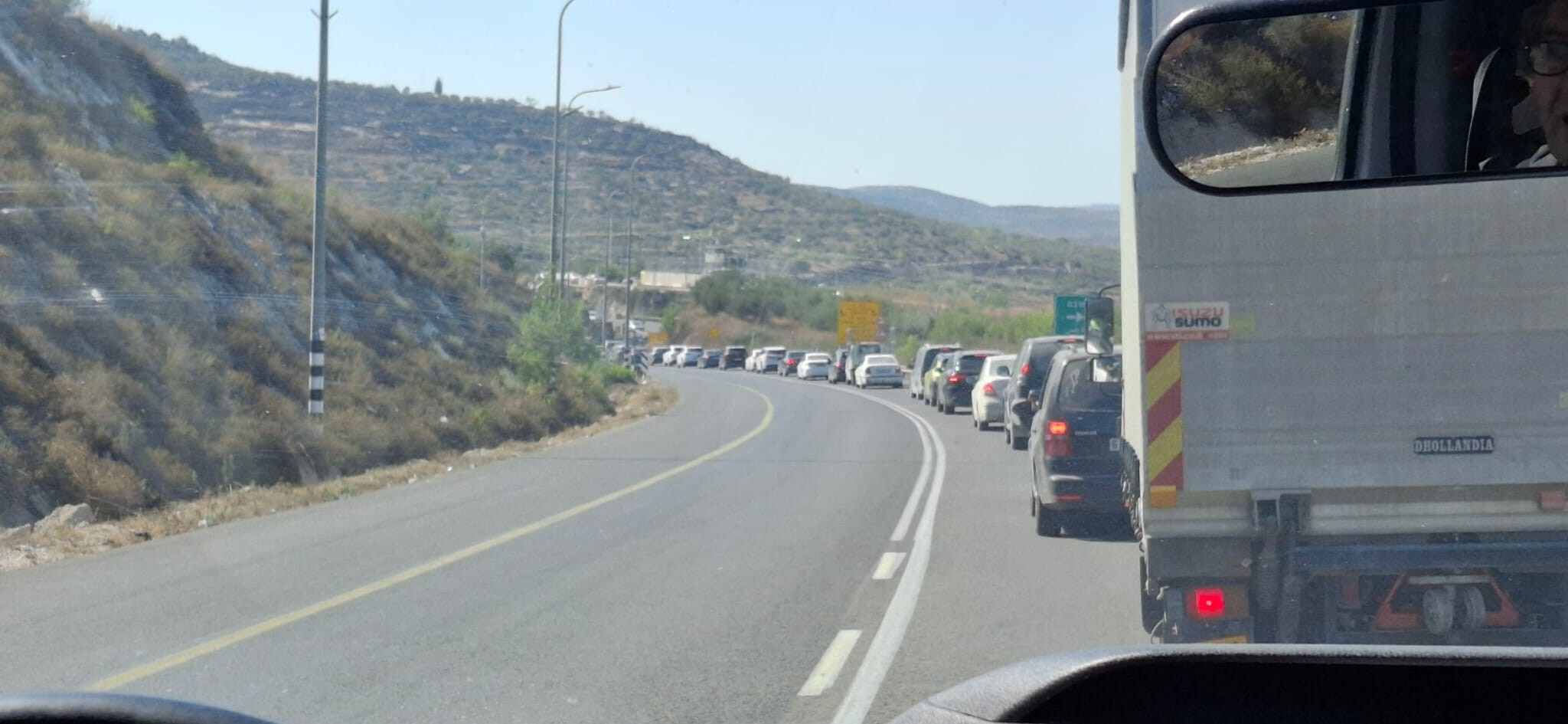 Anat PolakJul-17-2025Yitzhar Road, Jit Junction: traffic jam
-