
‘Anabta, Ar-Ras, Azzun, Beit Iba, Eyal, Jit, Thu 17.1.08, Afternoon
There were no group restrictions for passage through the checkpoints.
14:15-14:25 – Jubara – Gate 753 and Ar-Ras CP
At gate 753 we find a Palestinian from the village of Farah in the Jiftlik being detained. His work permit had expired on the 6th of January, and a new permit had not yet been issued. He had a magnetic card and was carrying his expired permit. He told us, when we arrived, that he had been waiting for two hours (this was confirmed by the taxi drivers who were waiting at the checkpoint and had asked us to help him). Despite our calls to the humanitarian hotline the man was only released at 15:45, after waiting for five hours and after the soldiers confiscated his expired work permit.
At the Ar-Ras checkpoint the northbound heading cars (towards Tulkarm) are being let through. The southbound heading cars are being checked randomly, according to the soldiers’ discrimination, since some are passing through without interruption and others are stopped and searched. We did not see ID checks. We left the CP quickly, since there was no line. There is a pothole on the road from the south; it deepens with every rain. There is no way for Palestinian cars that arrive at the checkpoint to avoid the pothole.
14:35-14:45 ‘Anabta CP. Most of the cars get through without being examined. There is no line. At the parking lot a merchant, whose work permit was revoked after he refused to cooperate with the GSS, approaches us. The man serves as a representative of a few Israeli companies and cannot operate his business without a permit. He told us that when he returned from Jordan he was stopped by the GSS who then asked him to work with them. He outrightly refused and his permit was revoked on the spot. We referred him to Sylvia.
15:15 Beit-Iba. After talking to the taxi drivers we learn that there is no checkpoint in El-Bidan. There is quite a large number of pedestrians and vehicles. There are 13 vehicles waiting to enter Nablus; there are 10 vehicles waiting to exit.
The last car gets through the CP after 58 minutes!
15:21 – there are 6 vehicles waiting in line. The last one got through within 8 minutes. On the other a truck carrying gas tanks had to wait for 9 minutes.
There are 90 pedestrians waiting to get through. There is one detainee in the holding pen. According to the commanding officer they are waiting for instructions from the brigade command. However, 2 minutes later he was released. There are two lines: one is for young men and the other is for women, older men and people with special permits. In the checkpoint we see a poster issued by the Nablus DCL; it lists 40 different types of permits (not all permits are issued by the army; some are issued by the PA or other humanitarian organizations that enable their carrier to stand in the humanitarian line). This poster is a strong example of the bureaucracy of the occupation. Pedestrians entering Nablus are not checked.
A dog is checking packages that are carried through by a porter. The packages are lying on the road.
15:24-15:27 – the dog is checking the cabin of a little truck. He climbs on the seat, while the driver stands outside.
15:32-15:49 – 17 minutes! This is how long it took the soldiers to check a bus leaving Nablus. A soldier got on the bus and checked identification cards. One student did not have and ID and showed him her student card. Another woman was wearing a veil and a military policewoman was called in to examine her. When the soldier asked the policewoman to hurry, she responded by asking “what for?” When the soldier told her that they had been sitting in the bus for half an hour, she answered: “what do I care. They can wait for an hour or two. Why should I have to run?”
It takes 20 minutes to get through the left lane. The right lane takes 40 minutes. The reason for this is that the soldier in the left lane speaks Arabic; he is quick and examines people in groups of five or six. At the time a border policewoman is standing inside checking booth and examining the identification cards and observing the metal detector (it is unclear why it is necessary to use a metal detector after being patted down). At the other line there is no one outside the booth; there is a military policeman inside who is checking bags, ID’s and the metal detector.
Most of the people go through the humanitarian line. We counted the total number of people who went through in all lines in half an hour – 205. Twice we were approached by people who told us that the soldiers only hurried up when we were there, and that once we left they would drop the pace.
For about 15 minutes almost all checks were stopped. We saw the commander talking to the soldiers at the vehicle crossing; it must be some sort of debriefing. At 16:05 they resumed passage. We checked passage times again: the left line – 14 minutes, the right line – 31 minutes. 178 people got through in half an hour.
16:02 – there are no vehicles trying to enter Nablus. There are 11 cars waiting to exit. By the time we left at 16:30 the last car in the line had moved up to the number five slot. That is an approximately 25 minute wait to get through.
16:19 – a taxi that was leaving Nablus ran over spikes that were left on the road. We did not see any of the soldiers apologizing.
16:06-16:06 – the dog searches the gas truck. According to the driver he passes through the checkpoint about two times a day and is searched about once a month. Today he is searched, and by a dog!
16:35 – the line leading in Nablus has 8 cars in it. There are about 20 pedestrians waiting to get through. We leave.
16:40 Jit Junction – no checkpoint
16:43 – El-Pondok. There is work going on to replace a damaged water line. The water line was damaged by army bulldozers who erected dirt mounts about a month ago.
16:45 – Azzun – the entrance from road 55 is open.
17:00 Habala Gate (1393) –the gate is located past a number of greenhouses along route 55 (one of these belongs to Omar, whose license has recently been revoked). A herd of sheep returns from pasture and passes through the gate. The soldiers tell us that the gate is open until 18:15 (apparently from 16:30 in addition to an hour in the afternoon and two hours in the morning). We asked the soldiers whether the residents of Habala or of near by villages can return from work through this gate instead of through the Eyal CP. They tell us that only those whose permit lists the number of the gate can cross here. If someone leaving nearby arrives they call the DCL to ask for instructions.
While we were standing there 2-3 people passed through the gate.
'Anabta CP
See all reports for this place-
'Anabta CP
The checkpoint is located south of the village of 'Anabta, at the intersection of Road 60 (leading to Nablus at the entrance to Area A), with Road (57, 557, 5576) facing west towards the Einav settlement and the checkpoint at the exit from the West Bank - Figs checkpoint. Until 2010 we used to watch the intersection and report the long columns created due to a slow inspection of the vehicles in both directions.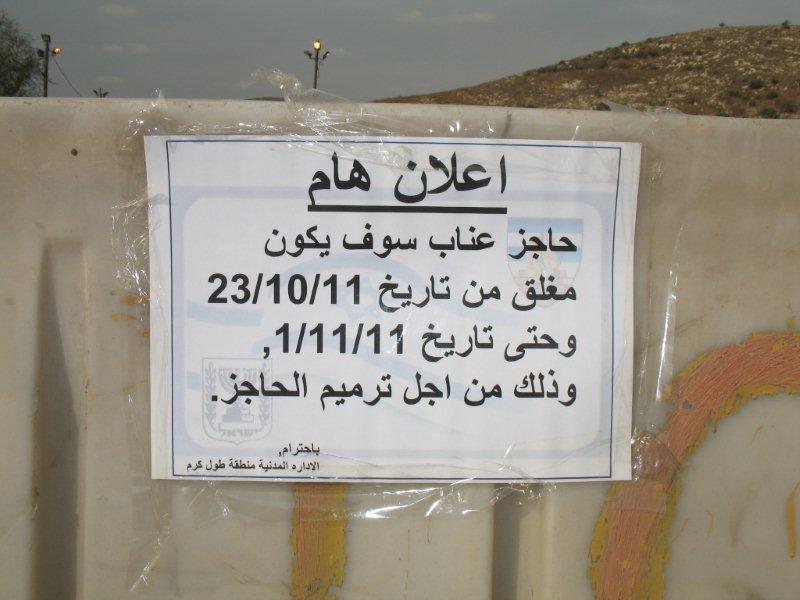 Oct-28-2011Anabta checkpoint 24.10.11
-
'Azzun
See all reports for this place-
Azoun (updated February 2019)
A Palestinian town situated in Area B (under civil Palestinian control and Israeli security control),
on road 5 between Nablus and Qalqiliya, east of Nabi Elias village. The inhabitants are allowed to construct and improve infrastructures. The Separation Fence has confiscated lands belonging to the town's people. In 2018 olive tree groves owned by one of its inhabitants were confiscated for the sake of paving a road to bypass Nabi Elias. Azoun population numbers 13,000, its economic state dire. Its infrastructures are poor, neglect and poverty rampant. In the meantime, the town council has completed paving an internal road for the inhabitants' welfare.
Because of its proximity to the Jewish settler-colony of Karnei Shomron and its outposts, the town suffers the intense presence of the Israeli army, especially at nighttime: soldiers enter homes, arrest suspects, trash the house and sometimes ruin it, as they do in numerous places in the West Bank. At times a checkpoint closes the entrance to the town, so no one can come in or get out.
-
A-Ras (The Children Checkpoint)
See all reports for this place-
A-Ras (The Children Checkpoint)
On Tulkarm-Qalqiliya road (574), east of Hirbet Jubara. tia checkpoint is dedicated to residents traveling to and from Tulkarm, so they should not cross apartheid road 557 (only permissible for settlers).
-
Beit Iba
See all reports for this place-
A perimeter checkpoint west of the city of Nablus. Operated from 2001 to 2009 as one of the four permanent checkpoints closing on Nablus: Beit Furik and Awarta to the east and Hawara to the south. A pedestrian-only checkpoint, where MachsomWatch volunteers were present daily for several hours in the morning and afternoon to document the thousands of Palestinians waiting for hours in long queues with no shelter in the heat or rain, to leave the district city for anywhere else in the West Bank. From March 2009, as part of the easing of the Palestinian movement in the West Bank, it was abolished, without a trace, and without any adverse change in the security situation.
 Jun-4-2014Beit-Iba checkpoint 22.04.04
-
Eyal Checkpoint / Crossing
See all reports for this place-
Eyal Checkpoint is intended for pedestrians and Palestinians only. This is the main barrier for workers to cross from the center of the West Bank. Workers with a work permit to enter Israel can pass through it for trade, medicine, and visiting prisoners. The checkpoint was built on the Green Line north of Qalqilya in the separation barrier that surrounds the city. The checkpoint began operating in 2004 by the military. Opening hours on weekdays from 04:00 to 19:00. We started holding shifts there in 2007. We arrived at the checkpoint before it opened at 4 in the morning. We reported on the difficult conditions and the long and cramped queues of workers who must continue their journey by commuting to work throughout Israel. At the end of June 2009, the checkpoint was operated by a civil security company, The transit time has been gradually shortened, today it is faster, but the Palestinians still have to arrive very early to make it to the transportation. Usually, about 15,000 people pass through.
-
Jit Junction
See all reports for this place-
The checkpoint is located on Route 60 near at the junction with Route 55, near the village of Jit. There was a checkpoint for vehicles passing between the north and south of the West Bank, which was abolished towards 2010. Since then, surprise checkpoints have been set up there from time to time with a police or Border Police vehicle, and vehicles and their passengers are inspected.
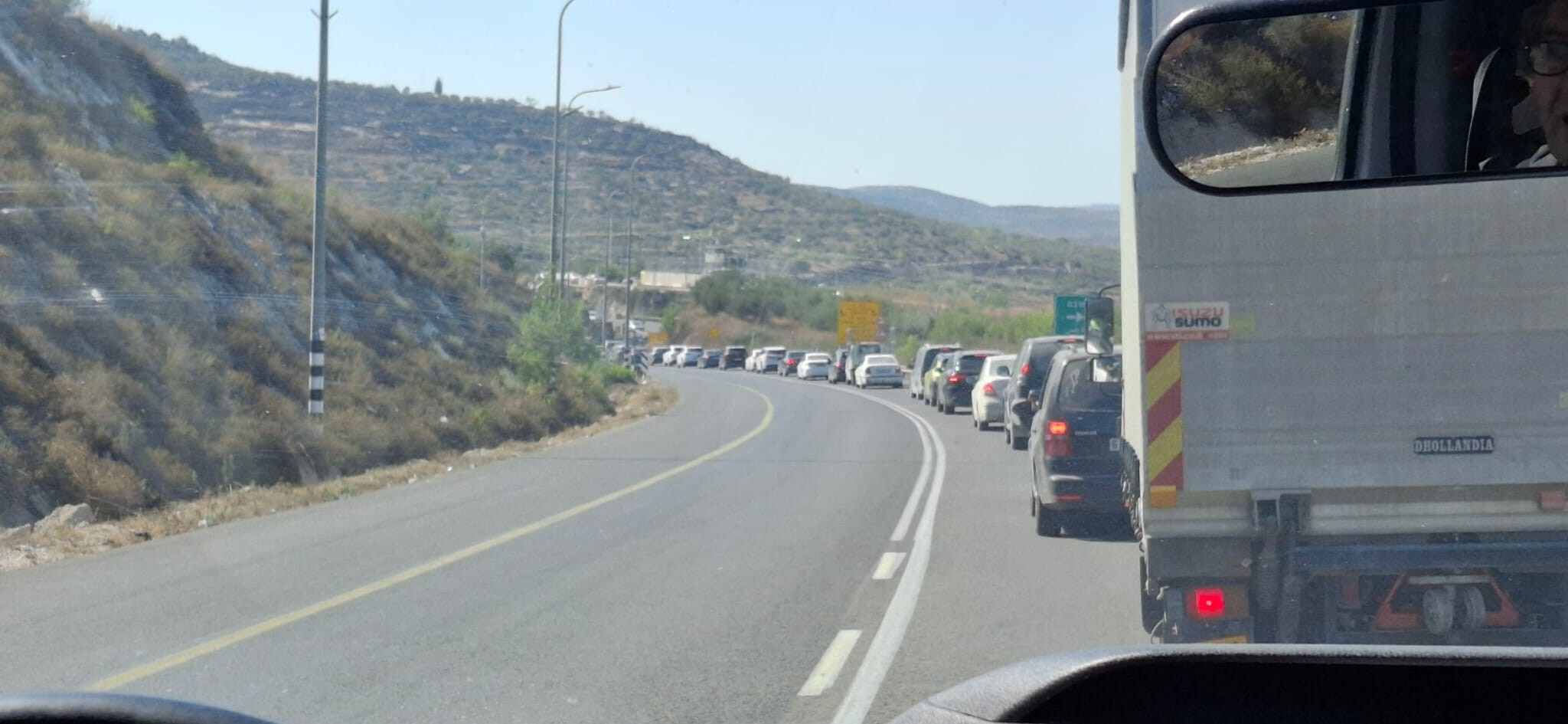 Anat PolakJul-17-2025Yitzhar Road, Jit Junction: traffic jam
-