
‘Anabta, Ar-Ras, Azzun, Jubara (Kafriat), Qalqiliya, Sun 2.3.08, Afternoon
Summary
The media today talked of the "continuing five-day offensive" and
the "ongoing IDF op" in Gaza, and we report on the continuing forty
year plus occupation and the ongoing IDF occupation of the West Bank.
The more things change, the more they stay the same.
12: 40 Habla
The agricultural gate is open, not widely open, but neither is the
one on the far side of the security road. Little action, other than
flocks of sheep and their shepherds, the former waiting as patiently
as the latter, to be called by the soldiers who beckon them forward
(though only the shepherds have to show IDs which are checked in
laborious fashion). Little patience is shown by the three soldiers
(the fourth is seated inside the Hummer alongside the gate). The
commander immediately tells us that filming is not allowed, that we
should look at the red sign, which says nothing of any import, and
certainly nothing about not being allowed to film. He continues to
bother us with his protestations that we are bothering him and
proceeds to photograph us! Not that he knows who we are: he knows
nothing about MachsomWatch, has never heard of us, although he and
his men are from the "regular" army (and not nineteen year old
conscripts).
12: 55 Qalqiliya
At the entrance to the OPT, Border Police check most vehicles
entering the Territories (most unusual). We make a mental note that,
at the turn off the apartheid road to the checkpoint leading to
Qalqiliya, there are no fruit and vegetable vendors (have they been
chased away from this spot)? No line to go into Qalqiliya, no
checking at all, and few cars leaving the city.
As we head back to our car, a jeep, coming from Zufim, watches and
waits: another group of soldiers who know not what MachsomWatch is.
They depart, and we turn back in the direction of Zufim, stopping by
the checkpoint at the entrance of both the settlement, a kilometer or
more away, and the Bedouin village of Arab ar Ramadin Ash Shamali —
both on the other side of the separation fence, one flourishing, the
other trying to stem a demolition order. Nearby, the local garbage
dump is covered in fresh, green spring grass, and numerous youths are
digging frantically. For what, we ask? "Metal," they answer,
grinning. Trying to eke out a measly living as the school buses,
settler cars and endless army vehicles pass them by, without a
thought or a care in the world.
13:30 Azzun
A Border Police jeep and an army ambulance stand where once was the
entrance to the town. Today, pedestrians, mainly students returning
from the university, wind their way around the tangles of razor wire,
over the mounds of earth, piled several meters high, carefully making
their way, already it seems accustomed to this latest affront, and to
the new lay of the landscape (recently gouged out to create yet
another Occupation monstrosity out of the surrounding bucolic peace).
We're told, in no uncertain terms to stand back, not to approach the
mountain of earth. "Don't go closer. They may be throwing stones."
Or, with the usual logic of occupation, "You can't go there, you're
not wearing uniform." As for why the earthworks have been put up in
the first place: "We don't have to tell you why."
Shvut Ami (outpost)
No action, just one lone sign on the hill proclaiming that this is
all the Land of Israel.
15:30 Anabta
There are no cars at all coming out of Tulkarm, and as we approach,
the line of vehicles in the direction of Tulkarm gets shorter. The
explanation for closing of the checkpoint is grudgingly given after
we tell a soldier that we heard it had been closed. "Shooting," is
the laconic reply, "over there on the main road," pointing to Route
55.
When we first get there, only three soldiers checking: IDs of drivers
are not usually checked, Israeli cars (yellow license plates) are
allowed into Tulkarm with no fuss. Only one yellow taxi is stopped,
and has been for an hour, the driver being "punished" although his
crime is not made clear.
15:45 — the line of vehicles into Tulkarm gets longer, seems now to
go all the way to the junction, and a flock of sheep pass through the
line of vehicles, wending their way from the side of the poppy strewn
olive grove to the other side of the road. A white truck is carefully
checked: it seems to have large bottles of vegetable oil in it. An
ambulance is also painstakingly checked, the driver telling us
that "it's not good," as the line behind him gets longer, and the
soldier on duty says to each passing vehicle, "hey, what's going on?"
IDs are never checked, but pedestrians are made to pirouette by the
concrete walkways and show what's in their little plastic bags or
briefcases. For a few minutes, not more than three, the soldiers
actually make two lines in order to make the checking flow more
smoothly, but that doesn't last. What is clear is that once we move
away from checkpoint central, the line begins to move, it becomes
shorter, so that by the time we reach the junction again, the line is
no more!
16:15 Jubara
We're told that there's no way we can go up to Jubara and on to Ar-Ras
through the locked gate. We pull over to the central part of the
checkpoint where we wait and are told that we are "being checked" (by
phone, as is normal for Palestinians), and so we wait patiently.
Eventually, the sergeant commander goes over to the gate and unlocks
it. On our way back, a group of senior officers is wandering around
the checkpoint and one of them is polite enough to send his warrant
officer to see us safely on through the small gap made by the huge
trucks parked at the checkpoint.
16:30 Gate 753
Checking here is slow, a couple of cars, some pedestrians, and we
wait – again.
16:35 Ar-Ras
The commander asks if we're "authorized" to travel through Jubara. He
goes on to ask, "Why are you here?" There's a long line of vehicles,
at least ten, stretching down the hill, coming from Tulkarm. IDs are
thoroughly checked as are the backs of cars, glove compartments as
well as trunks. One soldier laments that his shift has been ten hours
at the checkpoint today, another says eight and a half. The
reason: "shooting." Another non sequitur in the language of
Occupation.
'Anabta CP
See all reports for this place-
'Anabta CP
The checkpoint is located south of the village of 'Anabta, at the intersection of Road 60 (leading to Nablus at the entrance to Area A), with Road (57, 557, 5576) facing west towards the Einav settlement and the checkpoint at the exit from the West Bank - Figs checkpoint. Until 2010 we used to watch the intersection and report the long columns created due to a slow inspection of the vehicles in both directions.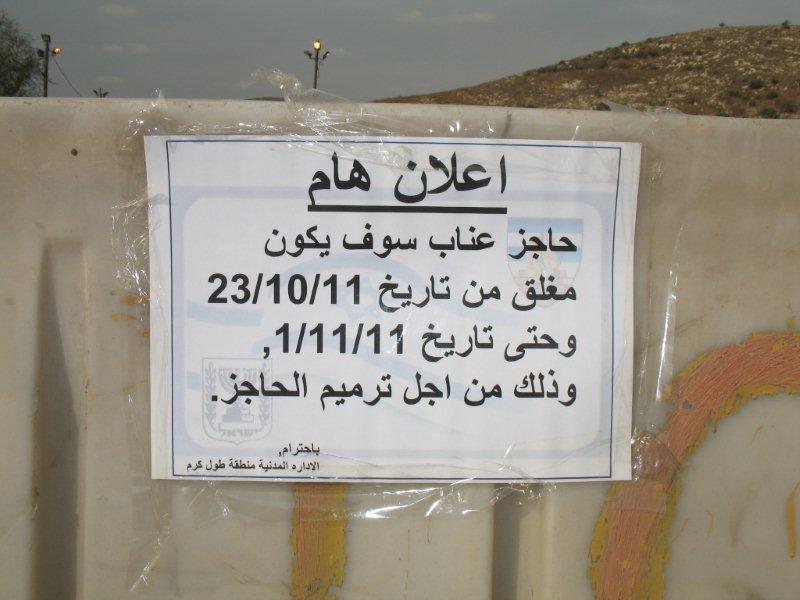 Oct-28-2011Anabta checkpoint 24.10.11
-
'Azzun
See all reports for this place-
Azoun (updated February 2019)
A Palestinian town situated in Area B (under civil Palestinian control and Israeli security control),
on road 5 between Nablus and Qalqiliya, east of Nabi Elias village. The inhabitants are allowed to construct and improve infrastructures. The Separation Fence has confiscated lands belonging to the town's people. In 2018 olive tree groves owned by one of its inhabitants were confiscated for the sake of paving a road to bypass Nabi Elias. Azoun population numbers 13,000, its economic state dire. Its infrastructures are poor, neglect and poverty rampant. In the meantime, the town council has completed paving an internal road for the inhabitants' welfare.
Because of its proximity to the Jewish settler-colony of Karnei Shomron and its outposts, the town suffers the intense presence of the Israeli army, especially at nighttime: soldiers enter homes, arrest suspects, trash the house and sometimes ruin it, as they do in numerous places in the West Bank. At times a checkpoint closes the entrance to the town, so no one can come in or get out.
-
A-Ras (The Children Checkpoint)
See all reports for this place-
A-Ras (The Children Checkpoint)
On Tulkarm-Qalqiliya road (574), east of Hirbet Jubara. tia checkpoint is dedicated to residents traveling to and from Tulkarm, so they should not cross apartheid road 557 (only permissible for settlers).
-
Jubara (Kafriat)
See all reports for this place-
The Jabra checkpoint was on Road 557, south of Tulkarm, on the side of the Figs Pass, which is located within the Palestinian Authority (a few kilometers east of the Green Line), and serves as an entry barrier from the territories to Israel. The checkpoint to the village of Jubara, which until 2013 was in the seam area, blocked and surrounded by a fence, was intended for the passage of the family members of the house next to the checkpoint, and also for the MachsomWatch volunteers (with special permission only), on their way to checkpoint 753. on the other side of the village. The soldiers supervising the "fig crossing" also supervised the crossing at this checkpoint, in our shifts we often waited a long time until the key was found and the gate opened. The checkpoint was abolished and became part of the separation fence that was moved west following the High Court.
-
Qalqiliya checkpoint
See all reports for this place-
Qalqilya is surrounded on all sides by the separation barrier. The only exit from the city is in the east of the city on the road that leaves the city in an easterly direction. This is where the checkpoint was located. When the checkpoint was active until 2009 our shifts watched long queues of cars being inspected at the only exit from the city to the West Bank. The checkpoint was canceled, but there is a military presence at the entrance to the city.
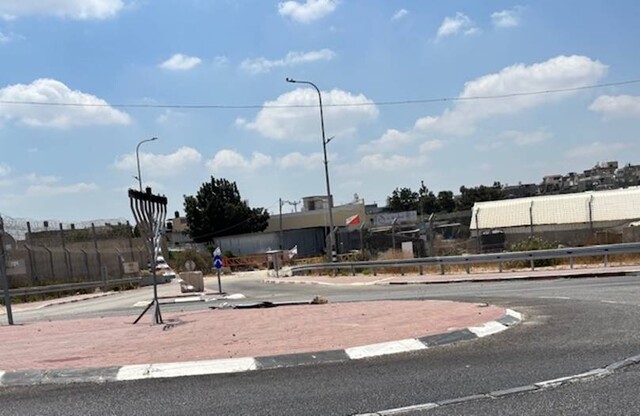 Nina SebaAug-18-2025Azzun: Enclosed by a high fence and the gate to the village is closed
-