
‘Anabta, ‘Azzun, Ar-Ras, Deir Sharaf, Jit, Jubara (Kafriat), Thu 19.3.09, Afternoon
Translation: Galia S.
General
This shift has been dedicated to touring and getting to know the new checkpoints and the way the passage is handled there.
12:30 – the main entrance to Azzun has been blocked during the night, as have two additional exits: Khirbet Asala and Izbat Tabib. The exit northward (Tulkarm) and the exit southward (Biddya and further) are the only ones that have remained open.
The residents we meet say there was no stone throwing prior to the blockade. The residents themselves opened the road to Khirbet Asala and now all the traffic moves through the narrow lanes of Khirbet Asala to Izbat Tabib and from there to road 55. Unlike the last time the exit from Azzun was blocked and we saw how the Palestinian security forces intervened and detained people suspected of throwing stones, this time we hear of no such action.
12:45 – A "rolling" [unannounced mobile] roadblock is being set up at Jit junction. We don't stop because we rush to Anabta aiming to meet there a checkpoint tour of people from the Israeli Ministry of Foreign Affairs, but when we arrive they have already left.
Anabta
13:00 – In both directions the traffic flows almost without interruption. We meet an officer, an engineer working for the army, from who we learn that a checkpoint for vehicles with 5 lanes is going to be built here, which will continue with the same work pattern and won't turn into a checkpoint for pedestrians. We return and go up toward Beit-Lid and from there to Jubara.
The junction of road 574 and the entrance to the village of Far'un (near the garbage site)
There is no checkpoint between Ar-Ras and the entrance to Tulkarm.
Schoolchildren's Gate (753) at the fence and the entrance to Jubara
13:50 – Two elderly sisters, residents of Tulkarm, are detained because they wish to enter Jubara and from there go to Tulkarm without a permit to stay in Jubara. We recognize them seeing them similarly detained two weeks ago. We want to help them pass and go back home, but the soldiers (religious soldiers of the "Nahal") release them right away [The Nahal is the force of Pioneering Combatant Youth that combine military service and agricultural work in settlements (Kibbutzim) close to the border].
14:00 – Down at gate 407 the soldiers refuse to let us pass saying they have "new orders". Phone calls to the head of the Tulkarm DCO [District Coordination Office of the IDF Civil Administration that handles passage permits] are of no avail and we turn back.
Up at gate 753 the commander wants to help us and calls gate 407 only to hear that there are new orders. "I haven't been told", is his answer to us. We thank them and go back to road 57 via Beit Lid.
The Barrels checkpoint (Deir Sharaf) that has opened this week.
15:00 – The checkpoint closes every midnight and is supposed to open the following day at 05:00. A staff sergeant who seems to be the commander explains that since the checkpoint is manned 24 hours a day, the soldiers will let the workers pass in the morning at any time they arrive. The following Sunday we realize that this is not what really happens. We hear that the soldiers opened the checkpoint only at 05:10. When they opened it, the hundreds of people that had been waiting there since 04:00 passed all together without checks. We also hear that Israeli Arabs can pass and enter Nablus at Saturdays.
According to what we hear, checks are supposed to be carried out every other five minutes. This checkpoint, located right by the junction, where the road goes up to Shavei Shomron, the confiscation of lands that belong to Deir Sharaf residents, and the plan to build an upper road between Shavei Shomron and Qdumim and thereby create separated levels, are even more depressing than the old Beit Iba checkpoint. They leave no hope and mark the "solution" in the area.
At this time of the day (15:00) there are no checks and in both directions the traffic flows.
We leave a few minutes later after a policeman who comes out of a police car that stands there threatens us with arrest if we don't go away. We decide that next time we will park near the building-blocks factory.
Jit junction
15:15 – The rolling roadblock has been removed. The entrance to the village of Sarra which is close to the junction is still blocked. The only Palestinian car that passes on this road has probably come from Qusin. The roadblock at the exit from Sarra and the one near Juneid are supposed to be removed in the following days. When these two roadblocks are removed, the army will block the exit to Jit junction and the traffic from Sarra as well as the villages Juneid, Beit Wazzan and the nearby neighborhoods in Nablus (Rafidiya) will go our only through the new checkpoint at the exit from Deir Sharaf.
Ras at Tira in the Alfei Menashe enclave
16:15 – We decide to go up to the village and see with our own eyes the lands stealing that takes place with the permission of the High Court of Justice (that has left the decision concerning the designed route of the new fence, the one that is said to diminish the area of Alfei Menashe, to the army). The fact is that the designed route passes at a distance of 50 meters from the houses of the Ras at Tira residents, inside the greenhouse of one of them (who succeeded in stopping the works getting an interim order) and through the water infrastructure of the village. Most of the village lands are left outside the fence, which prevents immediate access. On the other hand our estimated distance between the designed route of the fence and the houses of Alfei Menashe is close to 1 kilometer.
We hear from the residents that the attorney Michael Sefarad has looked into the matter and said there is nothing they can do. To make the picture of the stealing complete, we learn that like in other villages along the fence, in Ras at Tira, too, they are going to locate the two gates in the fence at the farthest place from the village and the lands, ensuring in this way a gradual drying out at the lands. The way we feel is hard to describe, knowing that we are part of the same state that carries out such stealing in the name of security, but that, in fact has nothing to do with security.
Conclusion: Somehow, despite the easements for traffic, we leave feeling that the situation is getting worse and worse and permanent "solutions" are more and more to be found in the area itself. A very depressing tour.
'Anabta CP
See all reports for this place-
'Anabta CP
The checkpoint is located south of the village of 'Anabta, at the intersection of Road 60 (leading to Nablus at the entrance to Area A), with Road (57, 557, 5576) facing west towards the Einav settlement and the checkpoint at the exit from the West Bank - Figs checkpoint. Until 2010 we used to watch the intersection and report the long columns created due to a slow inspection of the vehicles in both directions.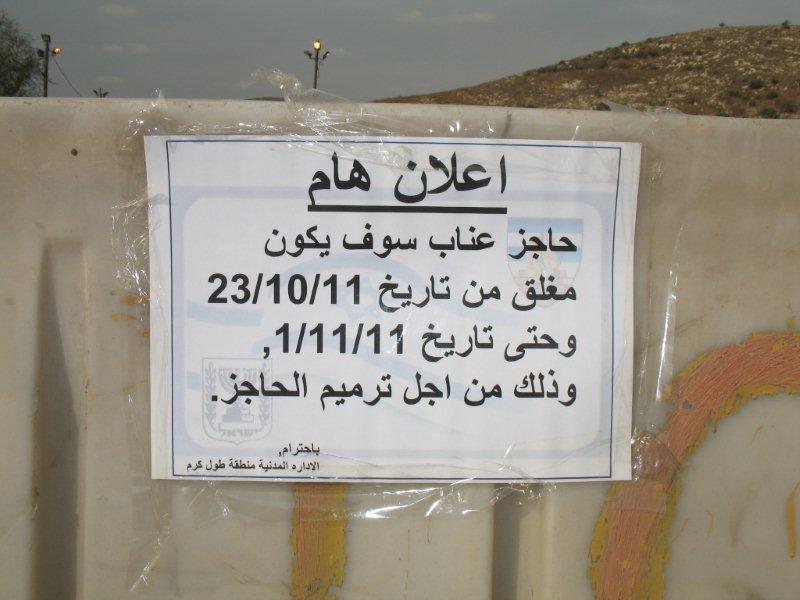 Oct-28-2011Anabta checkpoint 24.10.11
-
'Azzun
See all reports for this place-
Azoun (updated February 2019)
A Palestinian town situated in Area B (under civil Palestinian control and Israeli security control),
on road 5 between Nablus and Qalqiliya, east of Nabi Elias village. The inhabitants are allowed to construct and improve infrastructures. The Separation Fence has confiscated lands belonging to the town's people. In 2018 olive tree groves owned by one of its inhabitants were confiscated for the sake of paving a road to bypass Nabi Elias. Azoun population numbers 13,000, its economic state dire. Its infrastructures are poor, neglect and poverty rampant. In the meantime, the town council has completed paving an internal road for the inhabitants' welfare.
Because of its proximity to the Jewish settler-colony of Karnei Shomron and its outposts, the town suffers the intense presence of the Israeli army, especially at nighttime: soldiers enter homes, arrest suspects, trash the house and sometimes ruin it, as they do in numerous places in the West Bank. At times a checkpoint closes the entrance to the town, so no one can come in or get out.
-
A-Ras (The Children Checkpoint)
See all reports for this place-
A-Ras (The Children Checkpoint)
On Tulkarm-Qalqiliya road (574), east of Hirbet Jubara. tia checkpoint is dedicated to residents traveling to and from Tulkarm, so they should not cross apartheid road 557 (only permissible for settlers).
-
Deir Sharaf checkpoint
See all reports for this place-
Deir Sharaf checkpoint is located west of Nablus and south of the settlement of Shavei Shomron, at the entrance to the village of Deir Sharaf on the road leading to Nablus. The checkpoint was activated in early March 2009 after the Beit Iba checkpoint was closed. Palestinians are allowed through the checkpoint , but not for Israelis. Unlike the checkpoints leading to Qalqilya and Tulkarm, crossing of Israeli Palestinians is only allowed on Saturdays.
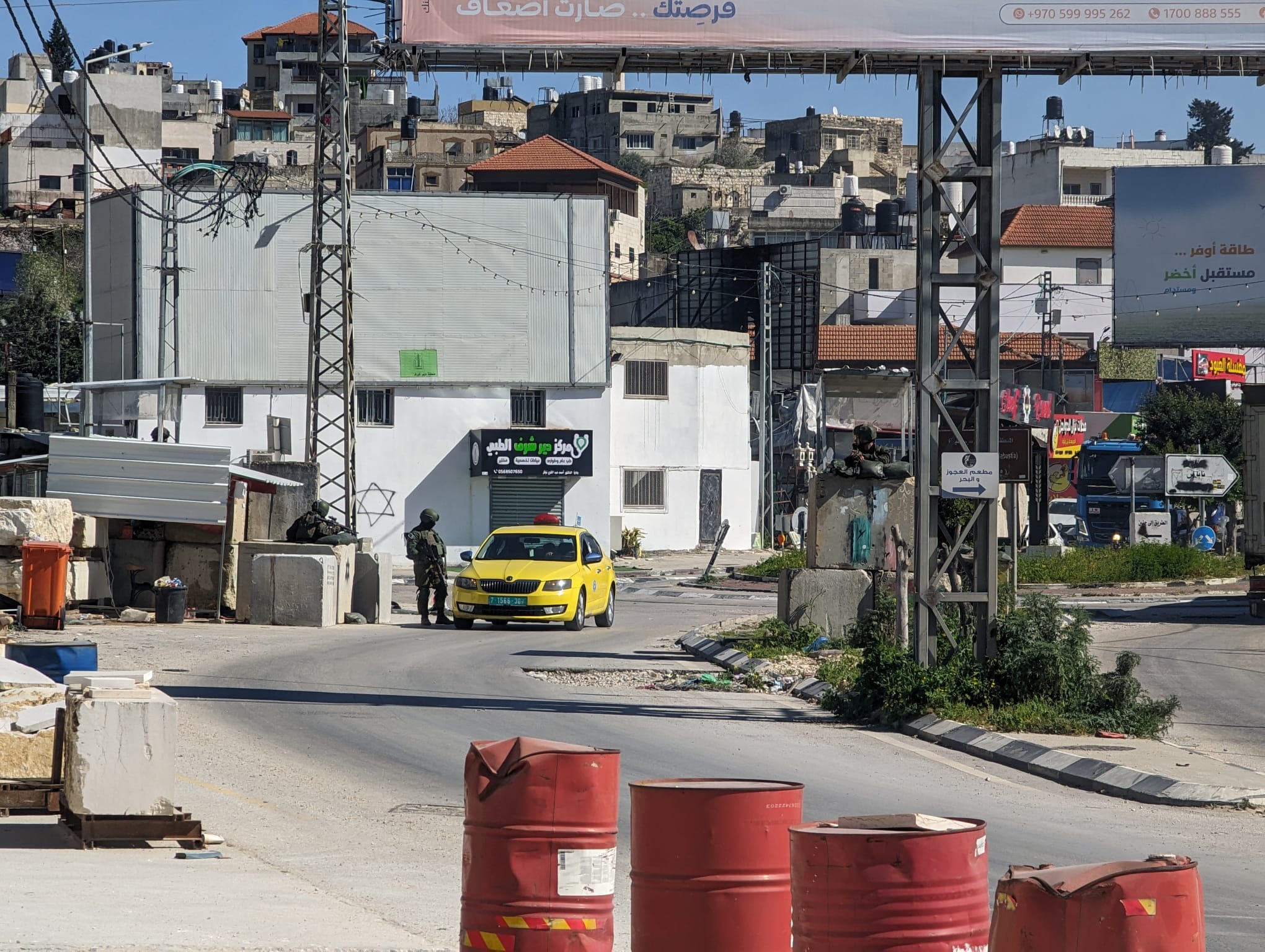 Nina SebaFeb-28-2024Deir Sharaf - the entrance to the village
-
Jit Junction
See all reports for this place-
The checkpoint is located on Route 60 near at the junction with Route 55, near the village of Jit. There was a checkpoint for vehicles passing between the north and south of the West Bank, which was abolished towards 2010. Since then, surprise checkpoints have been set up there from time to time with a police or Border Police vehicle, and vehicles and their passengers are inspected.
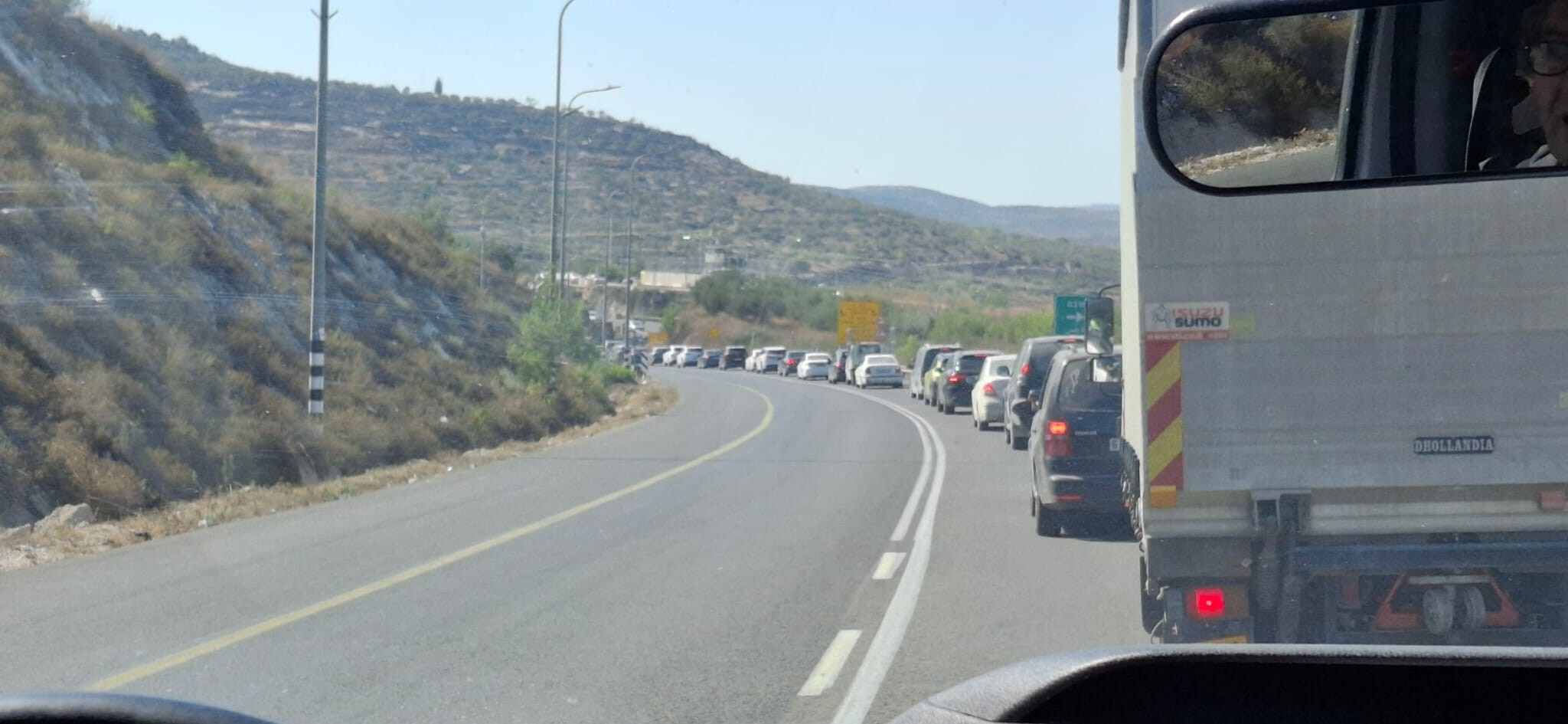 Anat PolakJul-17-2025Yitzhar Road, Jit Junction: traffic jam
-
Jubara (Kafriat)
See all reports for this place-
The Jabra checkpoint was on Road 557, south of Tulkarm, on the side of the Figs Pass, which is located within the Palestinian Authority (a few kilometers east of the Green Line), and serves as an entry barrier from the territories to Israel. The checkpoint to the village of Jubara, which until 2013 was in the seam area, blocked and surrounded by a fence, was intended for the passage of the family members of the house next to the checkpoint, and also for the MachsomWatch volunteers (with special permission only), on their way to checkpoint 753. on the other side of the village. The soldiers supervising the "fig crossing" also supervised the crossing at this checkpoint, in our shifts we often waited a long time until the key was found and the gate opened. The checkpoint was abolished and became part of the separation fence that was moved west following the High Court.
-