
‘Anabta, ‘Azzun, Beit Iba, Deir Sharaf, Habla, Irtah (Sha’ar Efrayim), Jubara (Kafriat), Qalqiliya, Shave Shomron, Sun 9.10.11, Afternoon
Summary
The October 2011 reports of the United Nation’s (UN) Office for the Coordination of Humanitarian Affairs, Occupied Palestinian Territories (OCHOA), began either with “Fast Facts” or “Key Issues.” Both headings speak to an Occupation that is even more horrible than in the past. “Israeli forces injured 22 Palestinians throughout the OPT. Settlers injured another three Palestinians and vandalized around 250 trees. Israeli authorities demolished 26 Palestinian-owned structures, mainly including residential tents and water cisterns in “Area C,” where Israel retains control over security as well as planning and zoning. And all this throughout the OPT where already half a million Israelis live, and where Israel, in A.B. Yehoshua’s words, “nibbles” at the territory of the Palestinians where, in fact it is “plundering and infringing the very essence of the inhabitants’ identity.” What hope is there for a Palestinian state in such an environment?
Habla, Gate 1392
13:02 – the mess created by the change, in Israel, but not in Palestine, from daylight savings time last week, seems to have worked itself out. The same, we are told, could be said about the change from the IDF to a privately contracted firm to be on duty at Sha’ar Eliahu (Gate 109) where the checking , we are told, is a little less arduous than last week, but where Palestinians are treated very differently, surprise, surprise, from Israelis. These conversations go on while all wait for the gate/checkpoint to open. A soldier comes out to the waiting Palestinians, about a dozen of them, to say, “in two minutes.”
13:06 – again, surprise, surprise, the two minutes is, in fact, five when a Hummer arrives bringing the rest of those scheduled, including the Military Policewoman who again makes her presence felt here.
13:15 – the same people waiting here before 13:00, including the lady who offered us fresh “lubia” (freshly picked beans), still wait.
13:25 – only now do most of the waiting people get through. Shortly afterwards, the school bus comes by, carrying the cheerful Bedouin school kids (boys today) on their way home. We notice, not for the first time, that the bus, this school year, is much smaller than before. We wonder if this hasn’t to do with the number of homes that have been pulled down from the area near Alfei Menashe, in which case, those children probably no longer go to school in Habla.
13:30 – Separation Barrier near the ’Enclave’ around Alfei Menashe
Once again the gate here, facing us, is open, again no work on the new road being created by Israel near the Barrier, and we note that the flags are still flying at the little hamlet which is surrounded on all sides by Israel’s so-called “protective measures,” but which, in actual fact, give license for the settlement of Alfei Menashe to expand and attain contiguity with the nearby Green Line.
Qalqiliya
Free flowing traffic, no police or military
Route 55
All quiet today, few military or police vehicles around. At Azzun, we note, once again, that the flags that flew so proudly the day Abu Mazen returned to Ramallah from the UN General Assembly are no more. Individual flags, perhaps, for those who are brave enough to withstand the punishment of the Occupiers, but at the official level, say, the Municipality of Azzun, no way can they deal with the harassment and humiliation which has surely made them remove the colorful bunting and the flags from the central roundabout in this town.
Beit Iba
There are works going on at the former checkpoint, and rather than leaping to conclusions, we realize that the rocky road leading to Deir Sharaf is probably also caused by infrastructure works, maybe new sewers (and not the recreation of the infamous checkpoint).
Shavei Shomron
No checkpoint, no police or military in sight. Just the usual busy traffic making its way onward to Jenin.
14:30 Deir Sharaf
The DCO was “good enough,” we learn, to call the local Council to tell the Palestinian landowners that they had from 9-13 October to pick their own olives in the olive groves just south of the Shavei Shomron settlement. So, today, the second day of Israeli-authorized olive picking – from lands many of which were, years ago, stolen from local families, some are indeed picking olives, but, once again this year, in their words, “It’s only half a harvest.” Only two brothers of the M. family are picking olives where once, maybe four or five years ago, some of us joined the many brothers and sisters, the aging mother and a variety of youngsters. S., the man selling vegetables and fruits from a cart, shows the meager picking of his harvest. Half a sack load where once he had sixty. He goes on to tell us of the scourge of wild boars that descend on the village after nightfall, the boars having been set upon the village of Deir Sharaf, by the Israelis, at the start of the Second Intifada, and boars, as most people know, eat everything and make life exceedingly difficult – but that’s the idea of this Occupation.
On the way to Anabta and Jubara, nothing to report, and at the Figs Gate, all our IDs or passports are checked or rather looked quizzically by an uncommunicative military policeman, our trunk checked. Business as usual.
15:30 Irtah/Sha’ar Efraim
Surprise, surprise, the guard, whom we already know, more or less welcomes us, telling us that Palestinians are no longer checked on their return from work as they make their way back home, but that we can’t join them. To Tulkarm, we wonder? And he tells of the delicious food, particularly the hummus that he’s eaten there. A mad world.
The many, many men returning from work are cheerful, and often have greetings for the four of us. One woman whom we’ve known from the Habla gate now tells of her great joy in coming through this “terminal” as she now has a job (plus, of course, a permit) to work in another town in Israel proper. The usual cheerfulness and friendliness of the Palestinian workers is heartwarming.
'Anabta CP
See all reports for this place-
'Anabta CP
The checkpoint is located south of the village of 'Anabta, at the intersection of Road 60 (leading to Nablus at the entrance to Area A), with Road (57, 557, 5576) facing west towards the Einav settlement and the checkpoint at the exit from the West Bank - Figs checkpoint. Until 2010 we used to watch the intersection and report the long columns created due to a slow inspection of the vehicles in both directions.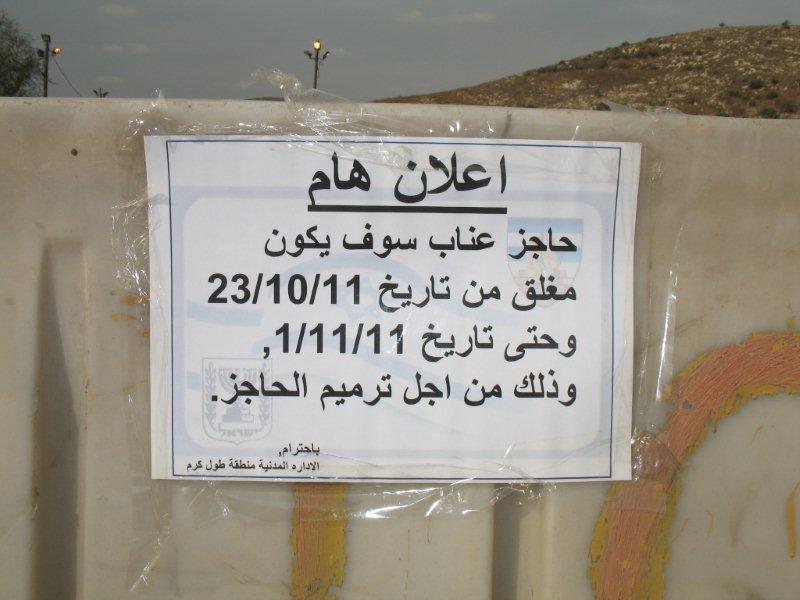 Oct-28-2011Anabta checkpoint 24.10.11
-
'Azzun
See all reports for this place-
Azoun (updated February 2019)
A Palestinian town situated in Area B (under civil Palestinian control and Israeli security control),
on road 5 between Nablus and Qalqiliya, east of Nabi Elias village. The inhabitants are allowed to construct and improve infrastructures. The Separation Fence has confiscated lands belonging to the town's people. In 2018 olive tree groves owned by one of its inhabitants were confiscated for the sake of paving a road to bypass Nabi Elias. Azoun population numbers 13,000, its economic state dire. Its infrastructures are poor, neglect and poverty rampant. In the meantime, the town council has completed paving an internal road for the inhabitants' welfare.
Because of its proximity to the Jewish settler-colony of Karnei Shomron and its outposts, the town suffers the intense presence of the Israeli army, especially at nighttime: soldiers enter homes, arrest suspects, trash the house and sometimes ruin it, as they do in numerous places in the West Bank. At times a checkpoint closes the entrance to the town, so no one can come in or get out.
-
Beit Iba
See all reports for this place-
A perimeter checkpoint west of the city of Nablus. Operated from 2001 to 2009 as one of the four permanent checkpoints closing on Nablus: Beit Furik and Awarta to the east and Hawara to the south. A pedestrian-only checkpoint, where MachsomWatch volunteers were present daily for several hours in the morning and afternoon to document the thousands of Palestinians waiting for hours in long queues with no shelter in the heat or rain, to leave the district city for anywhere else in the West Bank. From March 2009, as part of the easing of the Palestinian movement in the West Bank, it was abolished, without a trace, and without any adverse change in the security situation.
 Jun-4-2014Beit-Iba checkpoint 22.04.04
-
Deir Sharaf checkpoint
See all reports for this place-
Deir Sharaf checkpoint is located west of Nablus and south of the settlement of Shavei Shomron, at the entrance to the village of Deir Sharaf on the road leading to Nablus. The checkpoint was activated in early March 2009 after the Beit Iba checkpoint was closed. Palestinians are allowed through the checkpoint , but not for Israelis. Unlike the checkpoints leading to Qalqilya and Tulkarm, crossing of Israeli Palestinians is only allowed on Saturdays.
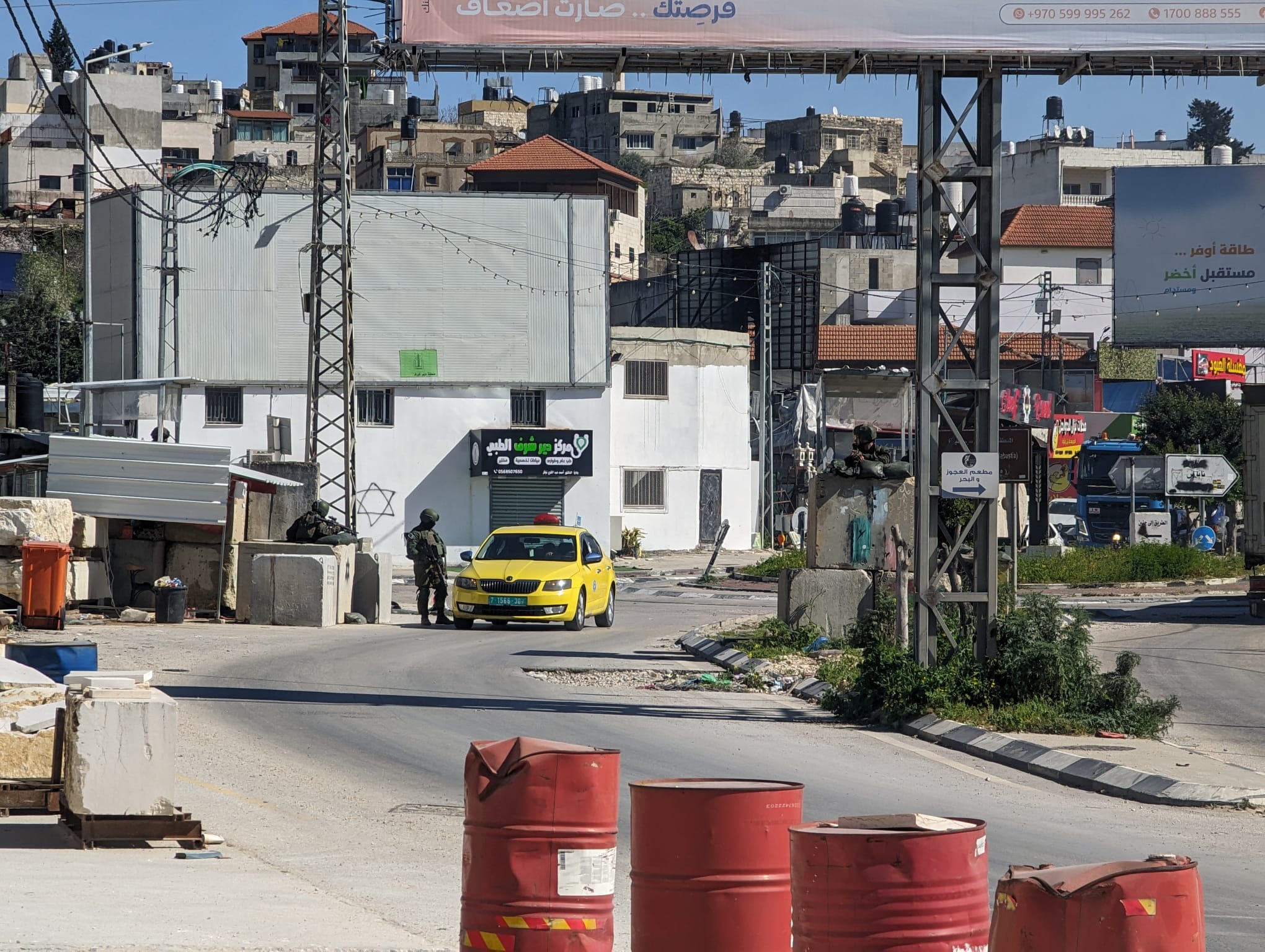 Nina SebaFeb-28-2024Deir Sharaf - the entrance to the village
-
Habla
See all reports for this place-
Habla CP (1393)
The Habla checkpoint (1393) was established on the lands of the residents of Qalqilya, on the short road that
connected it for centuries to the nearby town of Habla. The separation barrier intersects this road twice and cut off the residents of Qalqilya from their lands in the seam zone.(between the fence and the green line).
There is a passage under Road 55 that connects Qalqilya to the sabotage This agricultural barrier is used by the farmers and nursery owners established along Road 55 from the Green Line and on both sides of the kurkar road leading to the checkpoint.
This agricultural checkpoint serves the residents of Arab a-Ramadin al-Janoubi (detached from the West Bank), who pass through it to the West Bank and back to their homes. The opening hours (3 times a day) of this agricultural checkpoint are longer than usual, about an hour (recently shortened to 45 minutes), and are coordinated with the transportation hours of a-Ramadin children studying in the occupied in the West Bank.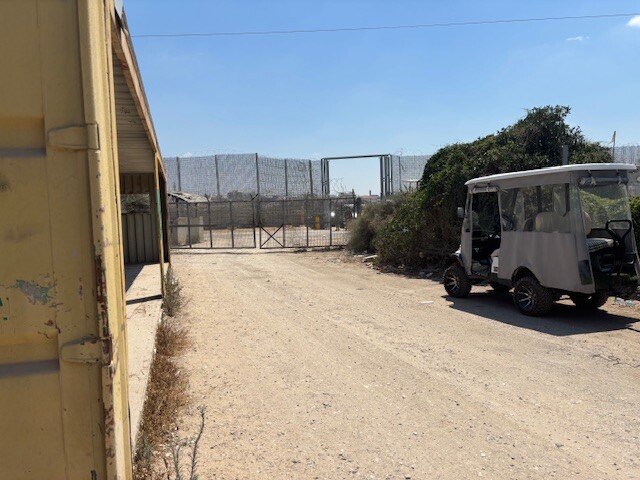 Nina SebaAug-18-2025Habla: The gate is in the process of closing
-
Irtah (Sha'ar Efrayim)
See all reports for this place-
The checkpoint is for Palestinians only. It is the main barrier to the passage of workers from the northern West Bank to Israel. Workers with a permit to work in Israel and also for trade (with appropriate permissions), medicine, and visiting prisoners. One can cross the checkpoint only on foot. The checkpoint is located north of Road 557 and south of Tulkarm. Operated by a civil security company, opening hours: between 4:00 and 19:00 on weekdays. As members of Machsom Watch, we began our shifts to this location in 2007. We arrived before it opened at 4 in the morning and report since, on the harsh conditions and the long and crowded queues of workers. The workers who pass by continue their journey by transportation to work throughout Israel. In the first period of its activity, about 3,000 and then 5,000 people passed through this checkpoint every day. Due to the small number of checking points and arbitrary delays for long periods of time in the "rooms", workers feared losing their transportation. Hence workers leave their homes at 2:30 at night to be among the first. Today, 15,000 pass and the transition is faster. Workers are still leaving their homes very early to get past the checkpoint at 7 p.m. In an adjacent compound, there is a terminal for the transfer of goods on a commercial scale, using the back-to-back method.
-
Jubara (Kafriat)
See all reports for this place-
The Jabra checkpoint was on Road 557, south of Tulkarm, on the side of the Figs Pass, which is located within the Palestinian Authority (a few kilometers east of the Green Line), and serves as an entry barrier from the territories to Israel. The checkpoint to the village of Jubara, which until 2013 was in the seam area, blocked and surrounded by a fence, was intended for the passage of the family members of the house next to the checkpoint, and also for the MachsomWatch volunteers (with special permission only), on their way to checkpoint 753. on the other side of the village. The soldiers supervising the "fig crossing" also supervised the crossing at this checkpoint, in our shifts we often waited a long time until the key was found and the gate opened. The checkpoint was abolished and became part of the separation fence that was moved west following the High Court.
-
Qalqiliya checkpoint
See all reports for this place-
Qalqilya is surrounded on all sides by the separation barrier. The only exit from the city is in the east of the city on the road that leaves the city in an easterly direction. This is where the checkpoint was located. When the checkpoint was active until 2009 our shifts watched long queues of cars being inspected at the only exit from the city to the West Bank. The checkpoint was canceled, but there is a military presence at the entrance to the city.
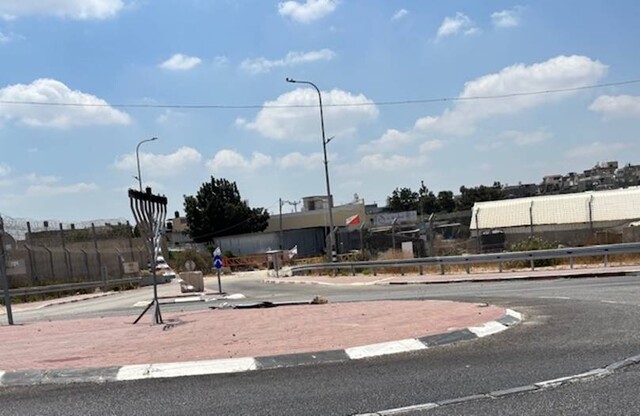 Nina SebaAug-18-2025Azzun: Enclosed by a high fence and the gate to the village is closed
-
Shave Shomron Checkpoint
See all reports for this place-
The checkpoint is on Route 60 (the main road to the northern West Bank), opposite settlement. Has been blocked to Palestinians since disengagement from Gaza and northern Samaria.
-