
‘Anabta, ‘Azzun, Burin (Yitzhar), Habla, Za’tara (Tapuah)
Because it was important to me to go on this shift but had no partner, I asked a friend to accompany me.
13:45 Habla. They started closing the gates at 13:53, seven minutes too early, and at 14:00 the soldiers had already left.
13:50 ‘Azzun. Soldiers standing beside a jeep at the entrance to the village.
14:35 Za’tara/Tapuach checkpoint. Manned; not many cars.
15:00 Burin/Yitzhar. After reading in Al Ittihad Wednesday about what had happened in Burin I spoke to Munir who met me and told me what had occurred.
Tuesday, 23.9, at 6 AM, the soldiers closed all the entrances to the village, including dirt roads, preventing laborers from going to work and teachers from reaching their schools. The blockade was lifted only at midnight.
Two youths from the village arrived in a vehicle at the main entrance to the village, on their way home. The soldiers didn’t allow them to enter. The youths argued with the soldiers who then handcuffed and blindfolded them and sat them on the ground facing a wall. They searched the car. A friend of theirs happened by, saw the vehicle by the roadside and telephoned his brother.
The brother and another person asked the soldiers for the car keys so they could bring it home. The soldier gave him the keys. When he bent to open the door another soldier hit him hard in the back with his rifle barrel. Instinctively he turned and pushed the soldier. Then four soldiers jumped him, began beating and cursing him and his friend. They were also detained. A soldier told them to lift their arms and spread their legs. He fired at one who argued with him at point blank range between the legs. The bullet penetrated his leg and exited the other side. They didn’t let him sit, until he collapsed. A military ambulance arrived; a soldier emerged and bandaged the wound. Then a Palestinian ambulance arrived and took him to hospital in Nablus. He’s still hospitalized.
One of the other detainees had a broken jaw from being beaten. They were taken to the base at Huwwara and released after three hours as a result of Chana Barg’s intervention. The family of the hospitalized man wasn’t allowed out of the village to visit him.
Their names: Nasser Mansour, aged 22; Muntaser Mansour, aged 25; Baha’a Amaran, aged 19.
17:25 Huwwara checkpoint, Beit Furiq. No soldiers
When we were at the Habla gate I received a call from Deir Al Ghusun, agricultural gate 636, complaining that it has opened very late in the afternoon – at 17:00 instead of 13:30 – for a number of days. Men, women and children who were to have returned home in the afternoon are stuck at the gate in the heat without water or food. I telephoned the DCL; they said they’re aware of the matter and are dealing with it.
'Anabta CP
See all reports for this place-
'Anabta CP
The checkpoint is located south of the village of 'Anabta, at the intersection of Road 60 (leading to Nablus at the entrance to Area A), with Road (57, 557, 5576) facing west towards the Einav settlement and the checkpoint at the exit from the West Bank - Figs checkpoint. Until 2010 we used to watch the intersection and report the long columns created due to a slow inspection of the vehicles in both directions.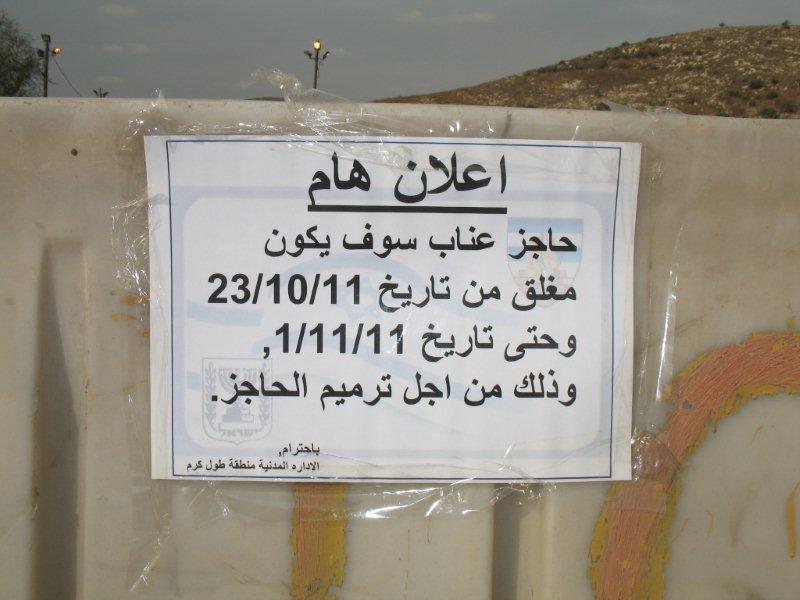 Oct-28-2011Anabta checkpoint 24.10.11
-
'Azzun
See all reports for this place-
Azoun (updated February 2019)
A Palestinian town situated in Area B (under civil Palestinian control and Israeli security control),
on road 5 between Nablus and Qalqiliya, east of Nabi Elias village. The inhabitants are allowed to construct and improve infrastructures. The Separation Fence has confiscated lands belonging to the town's people. In 2018 olive tree groves owned by one of its inhabitants were confiscated for the sake of paving a road to bypass Nabi Elias. Azoun population numbers 13,000, its economic state dire. Its infrastructures are poor, neglect and poverty rampant. In the meantime, the town council has completed paving an internal road for the inhabitants' welfare.
Because of its proximity to the Jewish settler-colony of Karnei Shomron and its outposts, the town suffers the intense presence of the Israeli army, especially at nighttime: soldiers enter homes, arrest suspects, trash the house and sometimes ruin it, as they do in numerous places in the West Bank. At times a checkpoint closes the entrance to the town, so no one can come in or get out.
-
Burin (Yitzhar)
See all reports for this place-
Burin (Yitzhar)
This is a Palestinian village in the Nablus governorate, a little south of Nablus, on the main road passing through the West Bank. The settlements: Yitzhar and Har Bracha, settled in locations that surrounded the village, placed fences so it is cut off the main road.
There are around 4000 inhabitants. Most of them are engaged in agriculture and pasture, although many graduates of the two secondary schools continue to study at the university. Academic positions are hardly available, they find work as builderd, or leave for the Gulf countries.
The village lands were appropriated several times for the establishment of Israeli settlements and military bases, and as a result, Burin's land and water resources dwindled. lSince 1982, more than 2,000 dunams of village land have been declared "state land" and then transferred to Har Bracha settlement.
Over the past few years and more so since 2017, the villagers have been terrorized by the residents of Yitzhar and Har Bracha, the Givat Ronen outpost and others. Despite the close proximity of soldiers to an IDF base close to one of the village's schools, residents are suffering from numerous stone-throwing events, vehicle and fire arson, also reported in the press.
In 2023, the prevention of the olive harvest in the village plot was more violent than ever. Soldiers and settlers walked with drawn weapons between the houses of the village and demanded that people stop harvesting in the village itself and in the private plots outside the village. The settlers from Yitzhar and Giv'at Roned raided the olive groves and stole crops. 300 olive trees belonging to the residents of Burin, near Yitzhar, were uprooted. The loss of livelihood from the olives causes long-term economic damage to the farmers' families, bringing them to the point of starvation.
(updated for November 2023)
-
Habla
See all reports for this place-
Habla CP (1393)
The Habla checkpoint (1393) was established on the lands of the residents of Qalqilya, on the short road that
connected it for centuries to the nearby town of Habla. The separation barrier intersects this road twice and cut off the residents of Qalqilya from their lands in the seam zone.(between the fence and the green line).
There is a passage under Road 55 that connects Qalqilya to the sabotage This agricultural barrier is used by the farmers and nursery owners established along Road 55 from the Green Line and on both sides of the kurkar road leading to the checkpoint.
This agricultural checkpoint serves the residents of Arab a-Ramadin al-Janoubi (detached from the West Bank), who pass through it to the West Bank and back to their homes. The opening hours (3 times a day) of this agricultural checkpoint are longer than usual, about an hour (recently shortened to 45 minutes), and are coordinated with the transportation hours of a-Ramadin children studying in the occupied in the West Bank.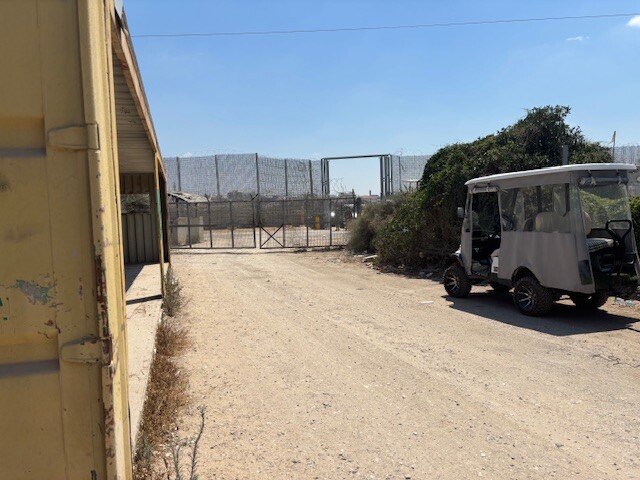 Nina SebaAug-18-2025Habla: The gate is in the process of closing
-
Za'tara (Tapuah)
See all reports for this place-
Za'tara (Tapuah) Za'tara is an internal checkpoint in the heart of the West Bank, at the intersection of Road 60 and Road 505 (Trans-Samaria), east of the Tapuah settlement. This checkpoint is the "border" marked by the IDF between the north and south of the West Bank, in accordance with the policy of separation between the two parts of the West Bank that has been in place since December 2005. At the Za'tara checkpoint, there are separate routes for Israelis and Palestinians. In the route for Israelis, there are no inspections and the route for Palestinians inspects. The queue lengthens and shortens suits. The checkpoint is open 24 hours a day. The checkpoint is partially staffed and the people who pass through it are checked at random.
 Shoshi AnbarSep-27-2023Za'atra (Tapuah Intersection). Signs
-